
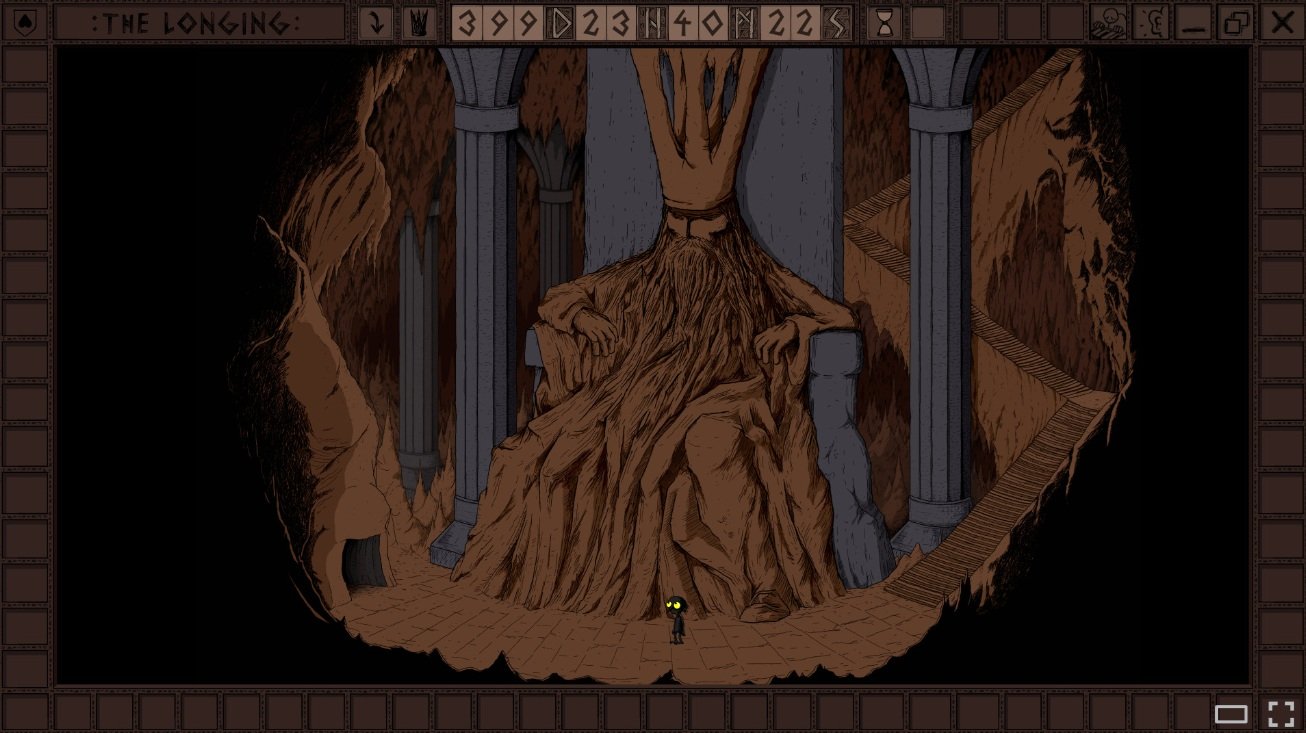
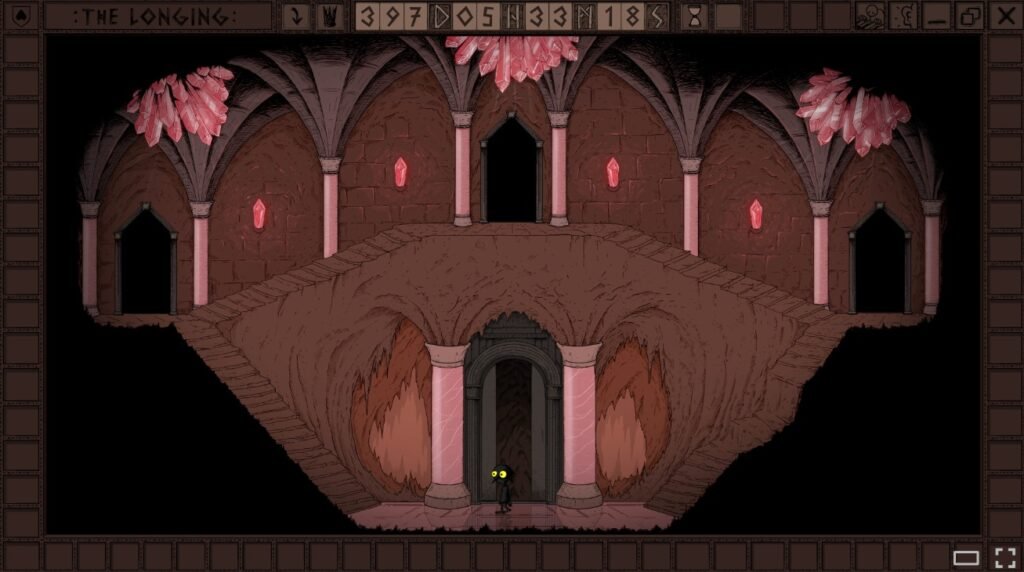
The Longing (2020) can easily be perceived as an unconventional video game. It invites the player to take control of a small creature known simply as Shade, who is tasked with waiting for the awakening of its king in an underground kingdom. The game’s unconventionality resides in its mechanics and structure, as the player must wait for the king during 400 real-life days, with the game counting them even when the player exits it. As enunciated by the game’s Steam store page, players may “[s]tart the game and simply come back after 400 days to see how it ends. You actually don’t have to play the game at all.” (n.p.). However, there are tasks which the player can perform, but the gameplay and interaction are, indeed, minimal: they consist solely, and only if the player decides to do so, of a number of optional leisurely activities, as Shade can collect books, simply explore the kingdom and its many rooms and caves, decorate its small lair with found objects, and complete a number of puzzles which are very simple and not mandatory.
I argue that the game makes use of medieval tropes to evoke an experience of the Middle Ages that rests less on iconographic and aesthetic representation than on the way it invites the player to experience a conception of time which is close to medieval European practices of meditation and contemplation. The game’s medieval tropes may be found in the feudal relationship established between Shade and its monarch, as the creature is described as “the last servant of a king who once ruled an underground kingdom.” (ibid.). However, it is in the experience provided to the player that the game is truly innovative and may invite important reflections.
As Anna Peirats and Rubén Gregori state, there is a change experienced “in the type of spirituality existing since the 11th century after the influence exerted by Franciscanism from the 13th century”, especially with the circulation of meditation manuals (1). This gave rise to a new spiritual movement (the devotio moderna), which emphasised “inner meditation and devotion”, as well as a focus on constant and methodical prayer and contemplation (ibid.). These practices should occur, preferably, in “isolation from the world”, with “silence and solitude as indispensable elements” (ibid. 2). Indeed, solitude was a requirement for one to be considered as a “true” mystic, as “men and women living in community” could easily be “influenced by the institutional trappings of monasticism” (Mancia xvi), and, as such, cultivate an existence away from the divine. Sarah McNamer also emphasises these aspects as central to the aforementioned shift in spirituality during the Middle Ages (86-102).
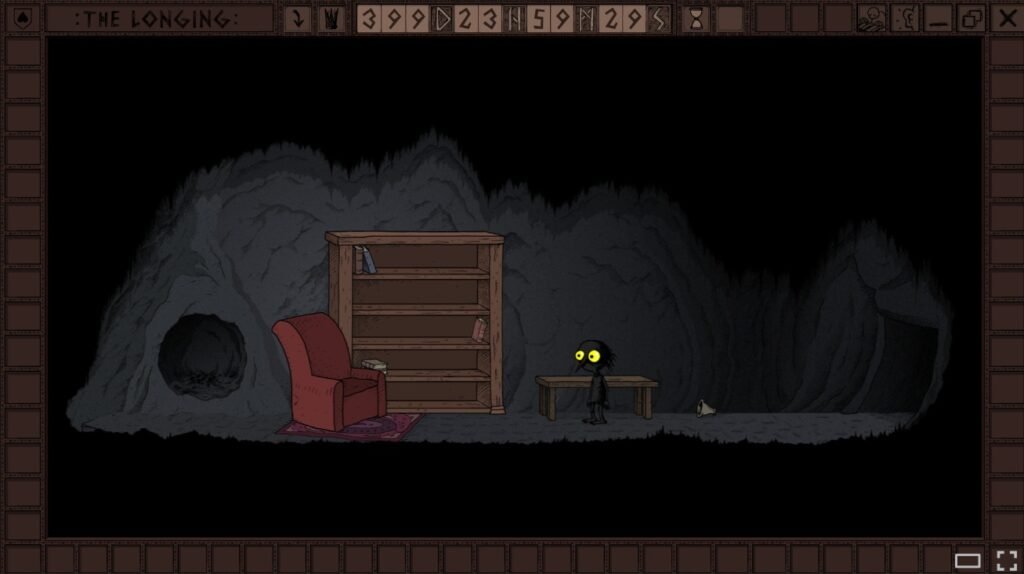
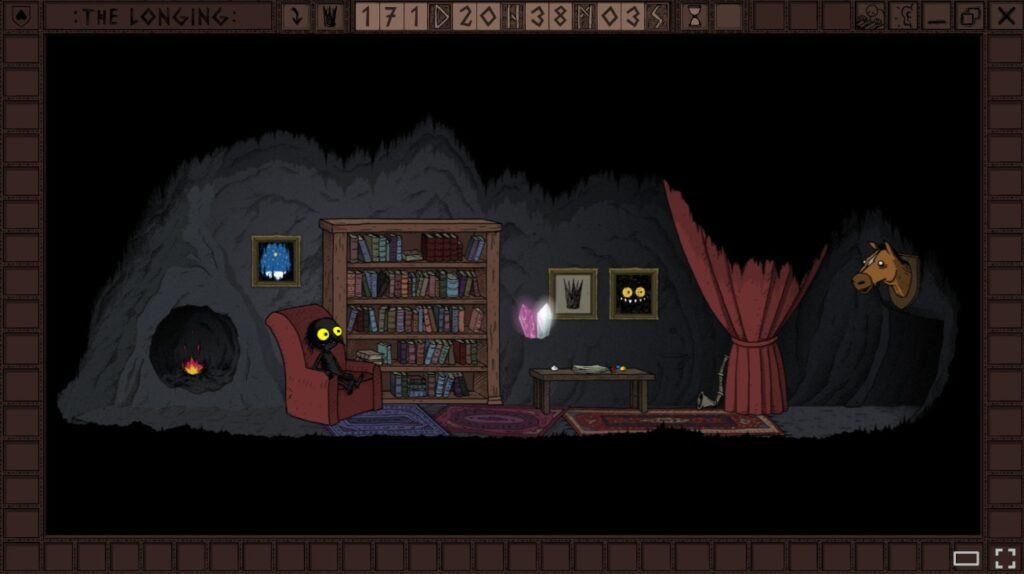
I consider that The Longing, more than focusing on any other aspects which could be explored when conceiving a game with medieval tropes, evokes precisely this experience of medieval meditation, approaching the medieval less as an aesthetic than as a temporal experience afforded to the player, allowing them to engage with a conception of time more in line with contemplation, waiting, patience and solitude than the typical acceleration of modern digital games and our own contemporary experience. Indeed, Shade seems to almost embody the devotio moderna itself, and the player, by extension, is compelled to participate in it through the restrictions imposed by the game’s (lack of) mechanics. Books are Shade’s sole companions – and the player can actually read them, with most consisting of works from the Western literary canon –, evoking medieval meditation manuals. Waiting for the king to awaken is the game’s sole objective. Walking through and contemplating the numerous rooms of the kingdom – each with its own particularities and characteristics – appears to be the most natural course of action, which can only take place slowly, as the game provides no mechanics which allow Shade to run. Finally, the soundtrack is notoriously calm and meditative, reinforcing the game’s contemplative atmosphere. As such, through these elements, the game is capable of creating a digital space in which important reflections on medieval meditation – and, as a further venue of research, on the eternal loyalty and obedience expected from a servant to their king in the European feudal Middle Ages – may emerge.
References
“The Longing”. Steam (Store), https://store.steampowered.com/app/893850/THE_LONGING/. Accessed 26 August 2026.
Mancia, Lauren. Meditation and Prayer in the Eleventh- and Twelfth-Century Monastery: Struggling Towards God. ARC Humanities Press, 2023.
McNamer, Sarah. Affective Meditation and the Invention of Medieval Compassion. University of Pennsylvania Press, 2010.
Peirats, Anna, and Rubén Gregori. “Meditation and Contemplation: Word and Image at the Service of Medieval Spirituality”. Religions, vol. 14, no. 2, 2023, pp. 0-20, https://doi.org/10.3390/rel14020188. Accessed 28 August 2026.
Studio Seufz. (2020). The Longing [Video game]. PC: Application Systems Heidelberg.
Note: All images were taken from the game’s Steam store page.
Author’s Biography
Jéssica Iolanda Costa Bispo is an Invited Assistant Professor at the School of Social Sciences and Humanities of the Nova University Lisbon (NOVA-FCSH). She holds a PhD in Modern Literatures and Cultures, with a thesis on video game adaptations of Lewis Carroll’s Alice novels. She is an integrated researcher at the Centre for English, Translation, and Anglo-Portuguese Studies (CETAPS), where she is the Vice-Coordinator of the Research Area “Anglophone Cultures and History” and part of the Research Area “Anglo-Portuguese Studies” and the Research Strand “From Classicism to Victorianism”. She is also a member of the Portuguese Association for Anglo-American Studies, the International Gothic Association, the European Society for the Study of English, the European Association of American Studies, and the Utopian Studies Society. Her main fields of research include Victorian literature and culture, Game Studies, Gothic literature, vampire fiction, dystopian literature, and Medieval Studies.
I’d not come across this game before this, maybe I should give it a go 🙂
I guess my initial question is: do you think this loyalty and obedience element reflects an attitude to rulership as opposed to an attitude to faith? The sorts of medieval texts I deal with emphasise a lot the active, personal nature of rulership, with great rulers being defined and written about as having an almost superhuman sense of immediacy and presence. Whereas this seems the opposite, so I’m wondering if the contemplative element really frames the King here more as a sacred than a royal figure.
Thank you for your comments and question, James! I do not think the elements you mentioned necessarily reflect an attitude to rulership as opposed to an attitude to faith, especially because of what you’ve just said! This figure, while it is portrayed as a king indeed, with an underground kingdom to rule, and Shade as a servant, it does acquire a connotation to the sacred by the way it is omnipresent but not really there (though one of the endings of the game do see the king awakening and greeting Shade), and by inspiring such devotion.
Please, do try the game! It is fascinating 🙂
[…] – ‘The wilderness, self-reliance and community in Medieval Dynasty’– Poppy Tester18h40 – ‘Temporal Experience and Medieval Contemplation in The Longing’– Jéssica Iolanda […]
I’ve played a few games that market themselves as “zen.” And, as the name implies, they focus on a very Western perspective of what Eastern meditation is. I haven’t played something like this, which seems both more purposeful and less immediate.
I wouldn’t have made the connection between this game and Western meditative traditions. And had I, I would have likely called it “monastic,” so I appreciate you already touching on that and showing there’s a difference I was unaware of.
The closest comparison I can think to this game is The Stanley Parable’s “don’t play for five years” achievement. But it’s connotation is markedly different, as the game pokes fun at gameplay, But this is actually utilizing the time intentionally. I’ll definitely have to pick it up myself.
Thank you for sharing your thoughts! You’ve touched on a very interesting topic, which is Eastern meditation. My research is more focused on the Western/European Middle Ages, but I do think I should delve more into other contexts from time to time!
A very interesting game – and a very interesting angle of comparison!
I’ve come across “The Longing” previously in the context of slow and/or cozy games. How do you see the connection between these medieval-inspired ways of dealing with time and our generation’s infatuation and romanticization of coziness and mindfulness? Is there anything we – and more specifically, game designers – can learn from the past – would we be simply projecting our anxieties onto the past if we delved more purposefully into medieval conceptions of time for cozy analogues?
Thank you for your question, Vinicius! Actually, I’ve been postponing a research project precisely on cozy games and why they are so attractive nowadays. Many coming from indie developers, even these become extremely successful, with huge sales and very positive reviews. I do think that this focus on cozy games translates a state of deep anxiety, fear and uncertainty nowadays (with the explosion of AI, conflicts and wars all over the world, political instability everywhere, etc. etc.). Cozy games allow us, I think, to rest, to “reset” somehow, to still use the digital space as escapism (instead of what I think is the tendency nowadays, which is to use reality to escape the digital/internet). There’s almost one for every taste. If we apply this concept of cozy games to game production and frame their narrative, mechanics and aesthetics with medieval tropes and representations, I do think that we might be projecting our anxieties onto the past, as you’ve stated. Then again, I think, is The Longing really a cozy game? I think it can be, but I also think that it might open up ways of thinking about subversive gameplay(s), and how not playing is actually the intended way of playing. This, I think, does offer plenty material to establish comparisons with medieval practices of contemplation and meditation. Thanks!
Thank you for this brilliant piece. You write “I argue that the game makes use of medieval tropes to evoke an experience of the Middle Ages that rests less on iconographic and aesthetic representation than on the way it invites the player to experience a conception of time which is close to medieval European practices of meditation and contemplation.” The feeling that I got (feel free to say I’m way off base) is that there’s an argument to be made for something along the lines of inherently Medieval game mechanics, where the rules of play themselves either speak to, or prompt the player into a mindset of, the Middle Ages regardless of the aesthetic coating. It’s similar to the argument Chess made about gendered mechanics circa 2017 in Ready Player Two, but about time periods instead of gender. Is that where you were going with your analysis? Because if so, I think that’s an interesting idea and I have questions! What other mechanics do you think could work as medieval mechanics? Do you think they would work with different aesthetics (say futuristic)? How much buy-in from players do you think is needed for these to be successful? Thanks again for your discussion!