
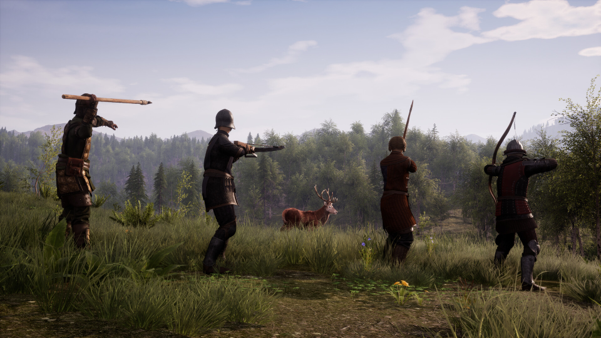
In the 2021 RPG Medieval Dynasty, the player builds and manages a medieval settlement. In the original game, the playable protagonist is Racimir. He is an eighteen-year-old refugee at the beginning of the game, who arrives in the Valley with very little after his parents are killed in an unnamed war.
Medieval Dynasty is a game of survival, and the player must initially ensure that Racimir has sufficient food and warmth. However, Racimir’s home for one eventually becomes a bustling settlement, and the player’s responsibility increases too. Once villagers are recruited, they can be assigned roles which keep the settlement running, including cook and farmer. These are performed with varying degrees of efficiency based on the NPC’s stats. Racimir can get married, and as the seasons and years pass his descendants carry on his “dynasty” after his death.
The game takes places in the eleventh-century. Though the Valley is not situated anywhere in particular, its landscape resembles Eastern Europe. However, the game forgoes the strict social hierarchy of medieval Europe and instead depicts a world where a person with nothing can become a ruler through tenacity and mastery of the wilds.
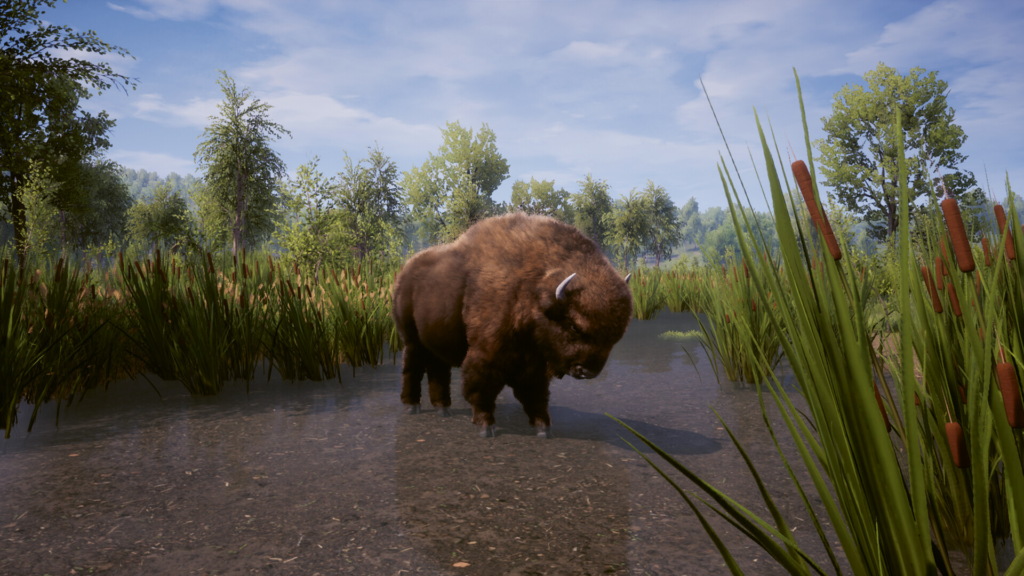
The Valley has a king. He is never encountered, only spoken about. In the game, the player doesn’t encounter any members of the nobility. Taxes must be paid to the castellan each spring. Aside from that, rules are limited. People can build and establish settlements wherever they like. Rather than being a restrictive medieval society, the wide, open landscape of the Valley offers freedom and opportunities for self-reliance and social mobility. There are many dangers, however. The presence of groups of bandits – a staple of many medieval games – implies a lawlessness, the negative of individualism without community spirit.
Unlike other popular medieval settlement builders, which take a top-down approach where the player inhabits an omniscient creator figure, Medieval Dynasty can be played using a first-person viewpoint. This allows players to see the world from Racimir’s perspective, and engage first-hand with the landscapes, its realistic beauty and its hardships, to collect resources and build the new settlement.
The inclusion of an individual protagonist is significant, as it is a game where a person can become a trustworthy leader through self-reliance and mastery of the wilderness and its resources. Throughout the game, however, it is important for the player to ensure that the villagers are satisfied. If their needs are neglected, they will abandon the settlement.
Although there are other games in the Dynasty series which take the same mechanic to different scenarios, from a modern-day farm to feudal Japan – the vast landscape of the rural Middle Ages gives players the ideal landscape for a survival game of self-reliance, where they can become leaders away from the mandates of the rest of society.
Thanks for this Poppy! I think one thing I’d be interested in your thoughts on is how much this really ends up drawing on the 18th-19th century tropes of frontier mythos – I think there is an aspect of this throughout survival-crafting-building games as a genre, though relatively few of them have quite this community building aspect. Does Medieval dynasty involve much interaction outside your group beyond bandits and the castellan (are there e.g. traders that turn up or NPC villages?)
The role assignment mechanic system is interesting too – can any villager in theory take any role, or are there specialisations and restrictions?
Hi James! Thank you for your questions!
I agree that many games in this genre draw on frontier tropes. With Medieval Dynasty, I’m not sure how much of this was conscious on the part of the developers. I feel that in some respects, the game reflects frontier tropes more than it does the Middle Ages. The protagonist who has escaped war and has travelled to a new land for a better life. His initial independence and battle against, then utilisation of the wilderness. The ability to change his station and preside over a settlement he has built. The medieval landscape is ideal for this, with its wide, open spaces, plentiful resources, and also danger. It also has opportunities for “traditional” practices like artisan work and farming, which overlap with the frontier fantasy.
I think Racimir is supposed to be an exceptional individual, which also resonates with the idea of the frontier and self-reliance. Even though community building is an important aspect of the game, he has no inner circle, or people to help lead.
The player’s settlement is not isolated and very much still part of the Valley rather than being completely independent. In terms of interaction, the player can also interact with NPCs in the other settlements, the herald, as well as some quest NPCs. Actually, the survival of the player’s settlement very much relies on these interactions – trading, for example.
In terms of the roles assigned to NPC villagers, any villager can take any role. However, output is determined by the NPC’s stats. A villager with a higher extraction skill would be best suited to the lumberjack role, for example. Aside from Racimir’s wife and heir, the NPC villagers are mainly workers. In fact, they very much feel like cogs in a machine. If there is an issue, like the player runs out of a certain resource, production can grind to a halt. Even if the settlement is full of NPCs, there’s a certain lifelessness to it.
[…] Pestilence: Mechanizing Eco-Anxiety within a Fourteenth-Century Dystopia’– Blair Apgar18h20 – ‘The wilderness, self-reliance and community in Medieval Dynasty’– Poppy Tester18h40 – ‘Temporal Experience and Medieval Contemplation in The Longing’– […]
Thanks for this Poppy!
Building on James’ question – there seem to be a lot of similarities here with post-apocalyptic and other survivalist settings. Is that a fair parallel? And do you have any idea how the developers and players feel about the medieval world presented in the game?
Hi Rob!
Thank you for your questions! I think that is a very fair parallel. I think that one thing that medieval and post-apocalyptic/survivalist landscapes have in common is the danger, as well as the open landscape where you encounter few other people aside from bandits. In some post-apocalyptic games, the worlds often resemble pre-modern periods, even if they are set in the future. One thing that stands out to me about Horizon: Zero Dawn, which is set in the 31st century, is that the player can find artefacts which are clearly from our time, such as car keys. However, he protagonist does not know what they are. There is a sense of time being cyclical, here. Once an apocalypse takes place, time seems to begin again.
Marcin Warszawski, the game’s producer, cites Kingdom Come: Deliverance as an influence, for its realistic, Slavic medieval setting. The survival elements were inspired by non-medieval games such as The Forest and Green Hell, which are nonetheless set in rural landscapes where the survival mechanisms could be translated to the Middle Ages, such as collecting and utilising raw materials.
From what I’ve seen online, players often find the medieval setting authentic in terms of visuals, but find the “survival” elements less realistic, such as being able to build on land without being tied to the feudal system.