
Crusader Kings III (CK3) allows the player to mold history according to their will within the limits of the gameplay and of their abilities. As a simulator of counterfactuals, the game allows the player to pose ‘What if?’ questions, and to try and answer them. Despite some historical oddities in the game’s database, heavily reflective of its historiographical biases, the game hands a historical clean slate to the player, starting their playthrough at a chosen point in History that is depicted as truthfully as is allowed by the game’s requirements (Rubio Arévalo 2021, Venegas Ramos 2022). The player is however limited by the game’s teleological mechanics (Ribeiro 2021).
All of these aspects are greatly reinforced in modding. Mods themselves attempt to rewrite history through the game’s simulation. Britannia: The Winter King (BTWK), a mod adaptation of Bernard Cornwell’s Warlord Chronicles, simulates the Anglo-Saxon ‘invasion’ of Britain as depicted in the book trilogy.
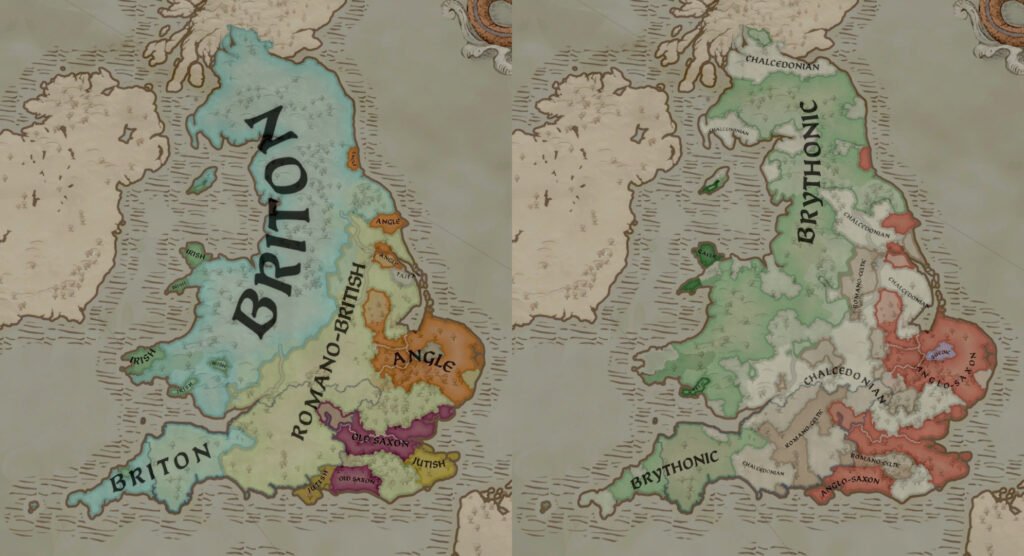
The mod allows the player to reconquer Britain from the Angles, Saxons, and Jutes and to form the Britonnic ‘high kingship’ by following a series of reforms, deciding at the end to either ‘Restore Imperial Dignity’ or to form a sovereign Britonnic state by ‘Claim[ing] the Inheritance of Macsen Wledig’ (a.k.a emperor Magnus Maximus).
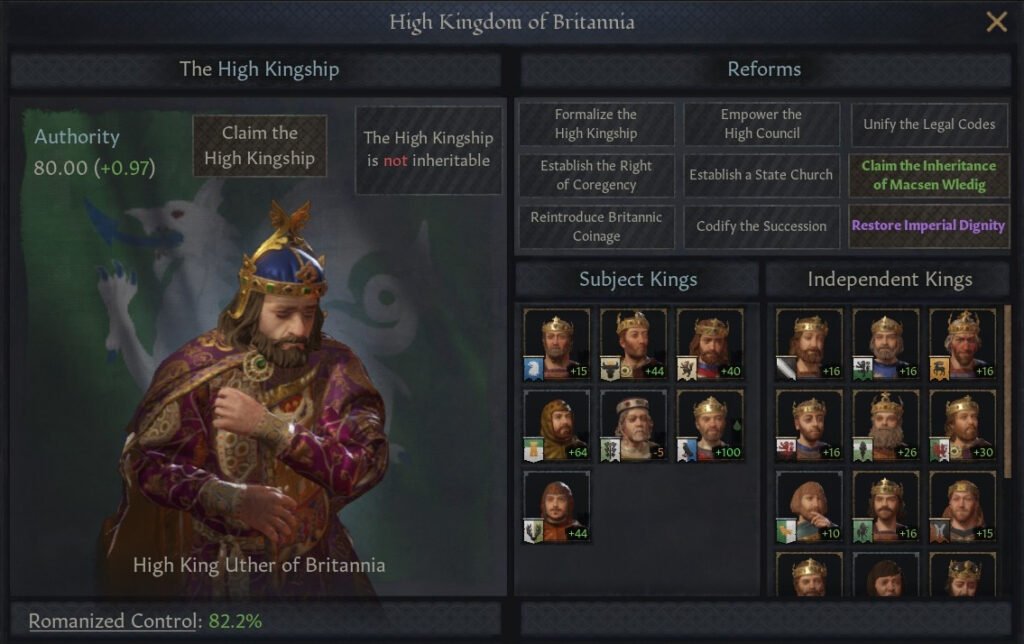
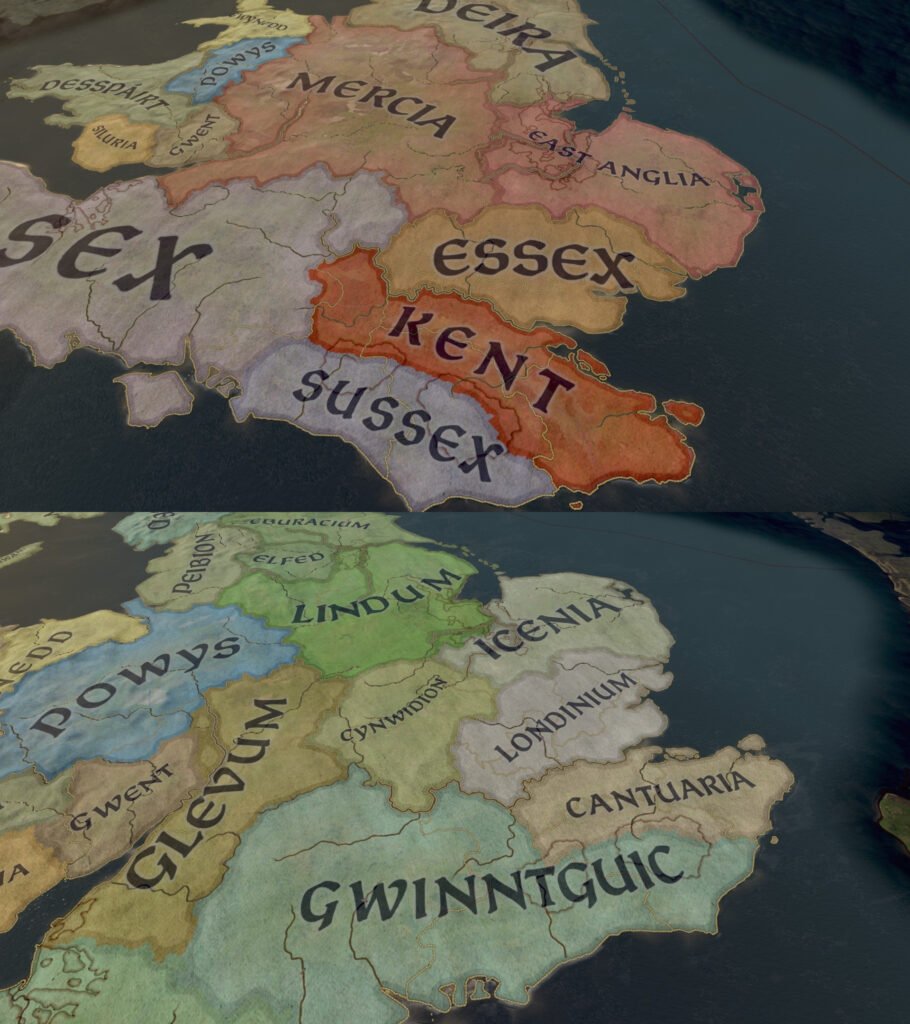
BTWK is much less of a sandbox than vanilla CK3. Its systems are tailored in order to broadly follow historical plausibility and book narratives. Players are prevented from freely doing things as they would in the vanilla game. For example, a Saxon ruler could not possibly rule the indigenous Briton kingdom of Londinium, and instead has to form the new kingdom of the East Saxons. Multiple culturally dynamic de jure layers from the vanilla duchy-tier and above thus collide.
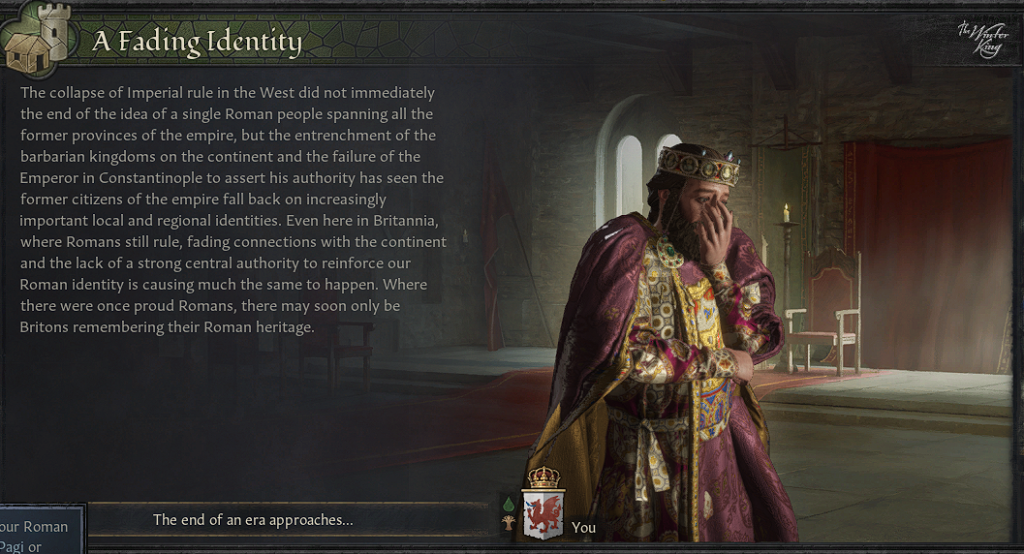
Tailoring game mechanics to this extent requires planning out specific events and counterfactuals, both letting the imagination go wild and staying within the plausible (albeit extremely improbable). What if Romano-British culture had survived? What would a British Romance language sound like?
The mod is still subject to requirements pertaining to the nature of CK3 gameplay as well as player expectations. For example, one cannot expect the player to accept the absence of a ‘Bretwalda’ title in a mod set in ‘Dark Age’ Britain, despite the consensus that the term had no concrete political existence.
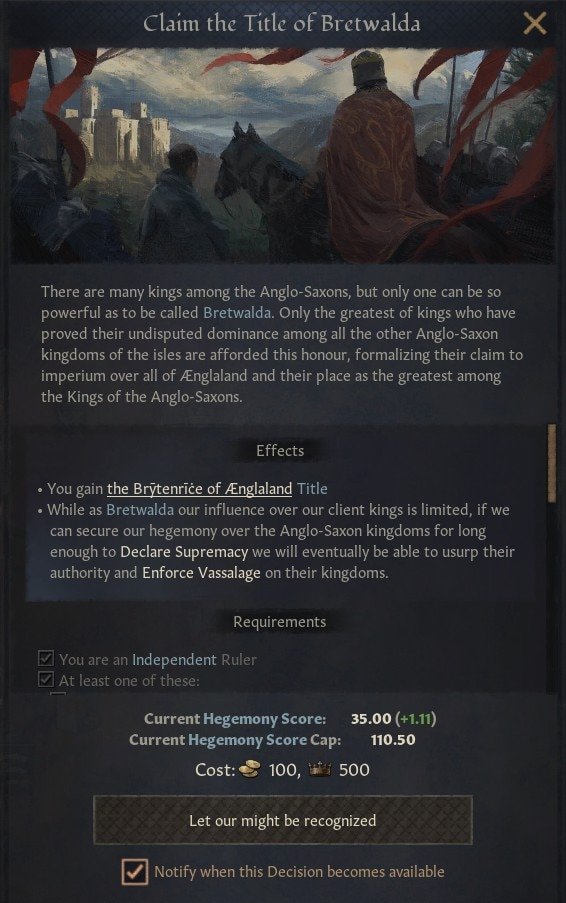
Considerable historiographical work goes into this historiographical balancing act. This requires a system-oriented mindset: take the formation of Northumbria for example. What is the system in the merging of Deira and Bernicia? Could this have extended south of the Humber? At what point did the two kingdoms become indefinitely inseparable? What should the requirements for the merging be?
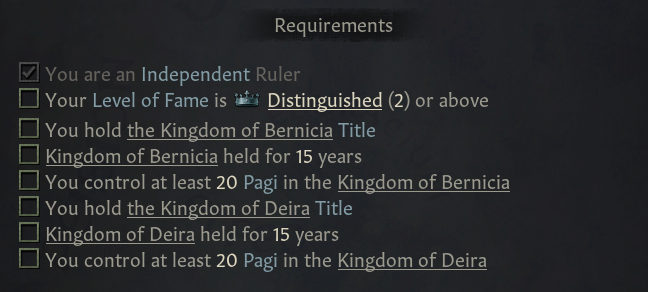
If playing counterfactual simulators can make the player ‘reflect critically on historical events’ (Apperley 2013), modding can make the modder ‘create nuances and counterarguments to the position expressed through the original game’ and ‘demonstrate the same critical thinking developed through undergraduate or even postgraduate history courses, and potentially equal to that of professional scholars’ (Houghton 2022). I would argue — drawing qualitative data from ongoing fieldwork, interviews and surveys from within modding teams (Kremer 2026) — that tailoring a system-heavy sandbox such as Crusader Kings III to focus on specific historical dynamics (and plausible counterfactuals) shapes the ‘historiographical skills’ of the modders themselves in a way that goes beyond simple historical research.
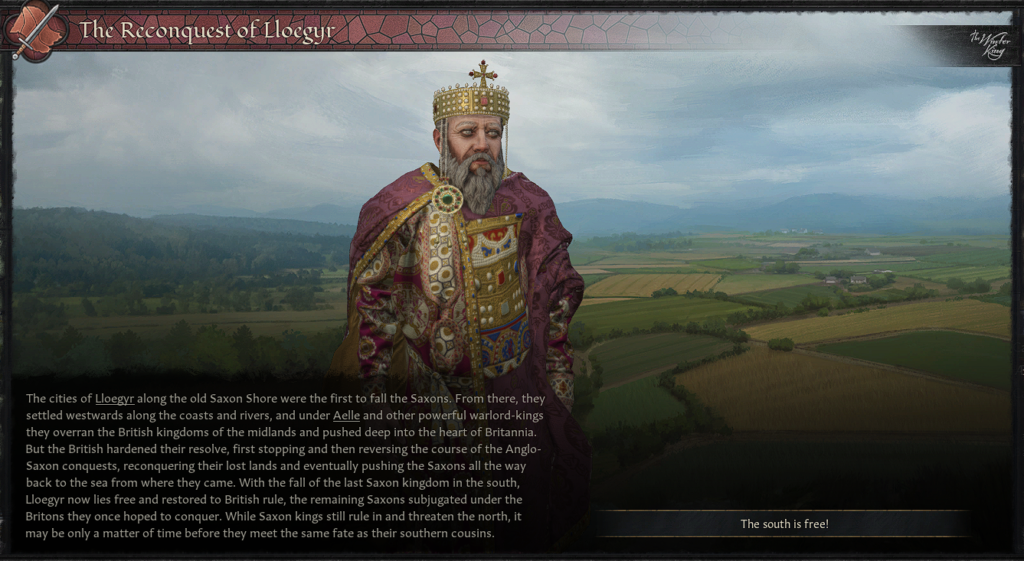
After all, what does allowing Britons to ‘reconquer Lloegyr’ entail in terms of historiographical research and bias? This interrogation may perhaps be left to the reader, but the general study of historiographical biases and their trends in modding communities clearly deserves more attention.
Many thanks to Luca0312, the original creator of BTWK for CK2, DC123456789, the current lead developer, as well as the entire BTWK modding team for the time and efforts given for this paper and more!
Link to the mod page: https://steamcommunity.com/sharedfiles/filedetails/3771827282.
Bibliography
Apperley, Tom, ‘Modding the Historians’ Code: Historical Verisimilitude and the Counterfactual Imagination’, in Andrew B. R. Elliott and Matthew Wilhelm Kapell (eds.), Playing with the Past: Digital Games and the Simulation of History, 2013, pp. 185-98.
Grufstedt, Ylva, ‘Unbending Medievalisms – Finding Counterfactual History in Sandbox Games Set in the Middle Ages’, in Robert Houghton (ed.), Playing the Middle Ages: Pitfalls and Potential in Modern Games, 2023, pp. 29-49.
Houghton, Robert, ‘Playing the Investiture Contest: Modding as Historical Debate in the Undergraduate and Postgraduate Classroom’, in Robert Houghton (ed.), Teaching the Middle Ages through Modern Games: Using, Modding and Creating Games for Education and Impact, 2022, p. 201‑28.
Kremer, Maxime, ‘« Fixing the game’s history » : Apports communautaires et mobilisations historiographiques dans les jeux Crusader Kings’, talk (in French) given at the June 2026 workshop ‘Vers une approche pluridisciplinaire du jeu vidéo’, in the process of being adapted into a paper, <https://hal.science/hal-05646949>. See the appendices for an excerpt of the survey results.
Ribeiro, Felipe Augusto, ‘Uma teoria digital do feudalismo: dinastia, poder, vassalagem e Estado no game Crusader Kings (2012-2020) [A digital theory of feudalism: dynasty, power, vassalage and the state in the game Crusader Kings (2012-2020)]’, Medievalia: Revista del Instituto de Investigaciones Filológicas (Universidad Nacional Autónoma de México), 53.1 (2021), pp. 191–219, doi:10.19130/medievalia.2021.53.1.25628.
Rubio Arévalo, Juan Manuel, ‘“Why is this game so (damn) hard?” The tenuous balance between simulation, historicity, and playability in medieval strategy video games’, Annual of Medieval Studies at CEU, 2021, 27, pp. 217‑35, <https://ams.ceu.edu/2021.htm>.
Venegas Ramos, Alberto, ‘Seeing and playing the Middle Ages: problems and limitations in the virtual and video-play reconstruction of the medieval past’, Imago Temporis, 2022, pp. 433‑48, doi:10.21001/itma.2022.16.15.
Author Bio
I am a graduate in Computer Science (Paris & Aberdeen) and a Master’s student in Medieval History at Sorbonne Université (Paris) under Prof. Bruno Dumézil. My research and conference presentations examine historiography in medievalist video games and modding, framing games as digital humanities tools (combining GIS and prosopographical networks) for the study of the early Middle Ages. I study the historiography and medievalistic perception of the era, focusing on the Irish and British Isles as well as the Frankish world. As Historical Research Assistant at Ubisoft, I work on Assassin’s Creed and other historical fiction games as part of my epistemological research on historiography in video game creation.
ORCID: 0009-0003-6037-8259 | HAL: maxime-kremer | Academia.edu: MaximeKremer
ResearchGate: Maxime-Kremer | Modernités Médiévales | BlueSky
I think a thing to tease out about modding as a historiographical form is that, whilst I totally agree modding is making arguments and counterarguments, do you think we need to think more about on what basis and to what end it’s doing so?
In particular, how do you think the constraints of community expectations, game engine limitations, existing expertise, and incentives in the modding world provide a different set of incentives to those facing academic historians, and what impact does it have on what they produce? Are there particular areas that you think modders are more inclined to argue through historiographically and others they neglect, and where does that differ from their historian counterparts?
Thank you very much for the question James!
On game engine limitations, I have to recommend two wonderful papers, namely Rubio Arévalo 2021 and Venegas Ramos 2022. The conclusions drawn out from both these papers are wonderful. Unexpectedly (on my part), the results from the surveys I’ve done from within the team show that the devs themselves attained the same level of critical thinking and came to the same conclusions as game studies scholars. I personally think that’s an amazing concrete validation of scholarly expectations and I’ll hopefully be discussing it further at MAMO 2027.
On the subject of community expectations and existing expertise, I think the debate shifts to that of ‘accuracy’ v. ‘authenticity’ (see Zimmerman 2020 ‘Approaching the Authenticities of Late Modernity’ and 2021 ‘Historical Digital Games as Experiences’). In all honesty, this is a subject I’m still due to dive in, I’ll be giving a presentation on it at a conference in Paris in March. From what I’ve seen so far in CK3 dev teams, I’d say there’s perhaps a bigger focus on ‘accuracy’ (as opposed to ‘authenticity’) than that found in the professional sector, but perhaps significantly less than one might expect.
‘Incentives in the modding world’ is something I couldn’t possibly see with the limited amount of data I have thus far, but I would tend to say that they broadly follow those from the professional video game sector. Obviously, market-related limitations are non-existant, and mods do not tend to approach subjects of identity and representation.
Lastly, each and every member of the modding team has their own particular hyperfixation. In CK3 terms, some focus on linguistics (there’s been wonderful debates on the Jutish quality of Kentish regiolects), while other would tend to spend their time researching military history. Personally, I’m a fan of maps, prosopography and political history. As an example, I’ve been creating an ontological model of Pictish unification, but I haven’t researched Pictish warfare at all.
[…] 2 – Modding16h – ‘Reconquering Lloegyr in Crusader Kings III: Modding as a counterfactual historiographical exercis…– Maxime Kremer16h20 – ‘Skyrim Puzzles Mods: Finding Indie Freedom within Mainstream […]
Thanks, Maxime! This is a very interesting example of a work that needs to balance faithfulness (however we may frame it) not just to a given historical period, but to a particular rendition of its source material.
As I was reading it, I was reminded of something Ylva Grufstedt wrote about in her Paradox book: about how certain counterfactual choices baked into their games reinforce, rather than challenge, historiographical and ‘pop history’ conventions- e.g. by playing into established counterfactual fantasies, like ‘what if the Nazis had won the war?’
How do you see these tensions playing out in this mod? Especially given that the Warlord trilogy, beyond its strictly portrayal of the period, also offers a very specific revisionist *narrative* of the Arthurian cycle and ‘Dark Age [sic]’ Britain?
Thanks for your comment Vinicius!
I should say that the age old historiographical (and archeological) debate of settlement v. assimilation (forced or not) by the Anglo-Saxons in Britain has been the subject of many talks within the dev team.
In the end, the easiest answer is always to rely on the ‘translationary’ quality of the mod by giving agency to Cornwell’s work. This is the choice of ‘authenticity’ rather than ‘accuracy’. ‘Accuracy’ may very well be unattainable when discussing a subject with such a strong divide in the academic debate. Unfortunately (or not, depending on your POV), Cornwell deliberately blurs the lines, and the protagonists’ POV limits the extent to which Cornwell is even able to discuss such subjects.
Overall, though, I wholeheartedly agree with Grufstedt: modding is one of the ways in which ‘true’ popular medievalism can bloom, free from market-related concerns (see my above answer to James on concerns of authenticity).
I really enjoy this, particularly the Northumbria example.
Out of curiosity, are you aware of situations where the mod changed how it handled some of its historic implementation? I realize the CKIII version of this mod is fairly new, and at a glance it looks like CKII updates focused on expansion. But, I thought I’d ask.
Thanks Andrew!
A few examples come to mind. Outside of the changes I’m responsible for (Scotland and Ireland) and of the change in scale (the CK3 mod is significantly denser than the CK2 one), I’d say the new government system is much more faithful to recent historiography and more distant from the previous ‘tribal’ v. ‘pre-feudal’ framework, especially thanks to the new CK3 admin government type.
The counterfactual historical outcomes mentioned in my article (Britannic romance, imperial restoration…) have also been entirely revamped, and most of the linguistic work has been re-done.
To be fair, a significant amount of the changes are thanks to CK3’s new systems, namely flexible cultures, faiths, and the struggle/situation framework.
There’s probably a bunch of stuff I’m forgetting or misremembering, I’ll ask around and see whether the dev team has anything else to add!
Short answer from the lead dev:
Most other changes in historical interpretation are quite subtle: localisation (vocabulary) and mapping (especially around the Solway firth on the current map scope) being the most significant.
Real great stuff! Thank you for this piece!
I have a small question just to get you to keep going at it.
How much do you think than these styles of mods end up reproducing common sense historical reenactment, and how much can they allow for exploring possibilities even within the established parameters (this case the difference you highlighted between vanilla and mod)?
Thank you!
Thank you Leandro!
As you might guess, the success of ‘historical counterfactual simulators’ (in this case, Paradox historical grand strategy games) is directly tied to the trend of online historical counterfactuals, most notably through a few well-known YouTube channels. Players have the same expectations as online audiences (the two groups often overlap) and these are able to materialise in their hands when playing.
Obviously, the mod’s setting reinforces existing independentist and nationalist tropes: what if the Britons had pushed back the ‘invaders’? The sandbox character of CK3, though, allow for weirder stuff: a Pictish HRE? A Danish al-Andalus? Moreso than in the base game, the level of skill required to achieve such feats is indirectly tied to the distance between the historical outcome and the imagined counterfactual.
The particularity of the mod resides in the fact that most ‘somewhat likely’ or popular counterfactuals are scripted in: there’s a specific mechanic for an Irish-backed unification of Wales based in the kingdoms of Dyfed and Llŷn. Once Gaul is added, every post-roman realm will have its own path after uniting the region: what if Clovis’ realm was subsumed by the Visigoths?
There’s definitely a struggle in trying to balance the plausibility of the counterfactuals with their popularity, and wrestling with vanilla CK3 mechanics puts a burden on the dev team. I think this is a wonderful project, and I encourage you to play it if you ever have the time!
Thank you Leandro!
As you might guess, the success of ‘historical counterfactual simulators’ (in this case, Paradox historical grand strategy games) is directly tied to the trend of online historical counterfactuals, most notably through a few well-known YouTube channels. Players have the same expectations as online audiences (the two groups often overlap) and these are able to materialise in their hands when playing.
Obviously, the mod’s setting reinforces existing independentist and nationalist tropes: what if the Britons had pushed back the ‘invaders’? The sandbox character of CK3, though, allow for weirder stuff: a Pictish HRE? A Danish al-Andalus? Moreso than in the base game, the level of skill required to achieve such feats is indirectly tied to the distance between the historical outcome and the imagined counterfactual.
The particularity of the mod resides in the fact that most ‘somewhat likely’ or popular counterfactuals are scripted in: there’s a specific mechanic for an Irish-backed unification of Wales based in the kingdoms of Dyfed and Llŷn. Once Gaul is added, every post-roman realm will have its own path after uniting the region: what if Clovis’ realm was subsumed by the Visigoths?
There’s definitely a struggle in trying to balance the plausibility of the counterfactuals with their popularity, and wrestling with vanilla CK3 mechanics puts a burden on the dev team. I think this is a wonderful project, and I encourage you to play it if you ever have the time!