
What does it mean to feel a medieval past that one has never lived? Digital games increasingly return to medieval Rus’, yet these virtual worlds are rarely neutral reconstructions; they function as (ideologically) contested stages. This paper applies three theoretical frameworks to analyze how games construct the digital medieval Rus’ through nostalgia, affective orientation, and material entanglement.
Drawing on Ania Loomba’s (2005) colonial nostalgia, I argue these games selectively retrieve an ideologically charged Rus’ past, shaping it into one of two dialectically gendered forms: either a cozy, feminized domestic haven or a deterministic, masculinist trajectory of progress and decline. This binary is constitutive, channeling the past through present longings. The hearth and the Kremlin thus stand as twin poles of a peculiar nostalgia that manifests contemporary desires.
Using Sara Ahmed’s (2010) affective economies, I show how objects and their inherent mechanisms are oriented to produce gendered feelings tied to promises: coziness around domestic spheres, ambition around strategic ones. Applying Ian Hodder’s (2012) entanglement, I argue that specific material objects and their ludic visualisation constitute these worlds — an interdependent materiality manifesting a fabricated heritage.
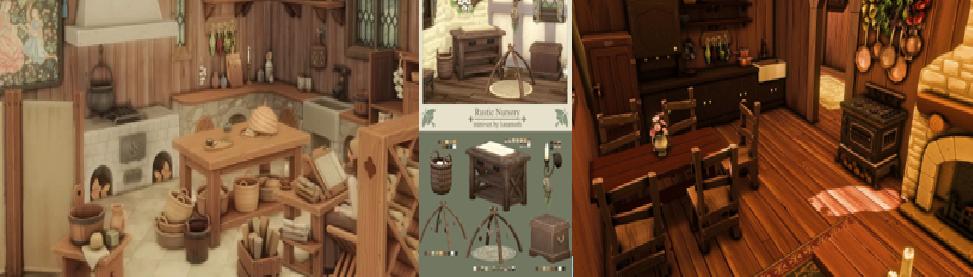
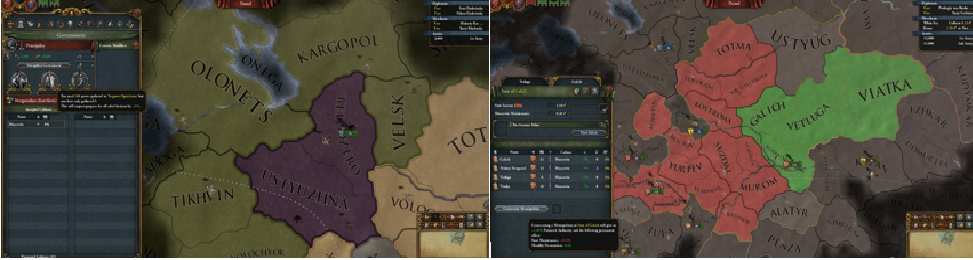
Close readings of ludic visualities — screenshot series and interface analysis (Table 1) — yield two extremes. In The Sims 4 medieval CC, domesticity is almost exclusively cozy: hearths, textiles, and wooden furniture yield a purely emotional payoff (Fig. 1). At the opposite pole, Europa Universalis IV orients players entirely toward territorial consolidation via coring, expanding, and managing Muscovite realms; its sonic background (A Russian Heart, Ivan’s Dream, Following the Volga) underscores a manifest destiny with no domestic sphere (Fig. 2).
| Game | Orientation Axis | Visual Palette |
| The Sims 4 medieval CC | Domesticity (exclusive) | Warm, soft textures |
| Europa Universalis IV | Conquest (exclusive) | Sparse abstract map |
| Black Book | Oscillating hearth/wilds | Folkloric |
| Crusader Kings III (RICE) | Soft-power domestic, linked to conquest | Abstract maps, cultural notions |
| Age of Empires IV | Conquest (strategic) | Images of distinctive historical buildings |
| Mount & Blade II: Bannerlord | Conquest (martial) | Gritty battlefields |
Table 1: Ludic orientation and visual palette per game
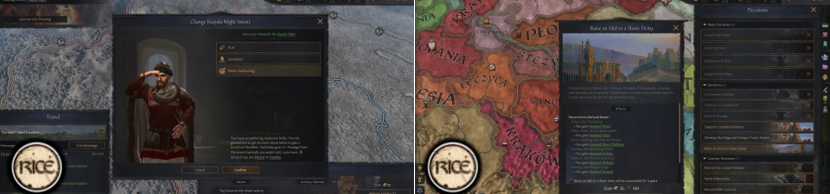
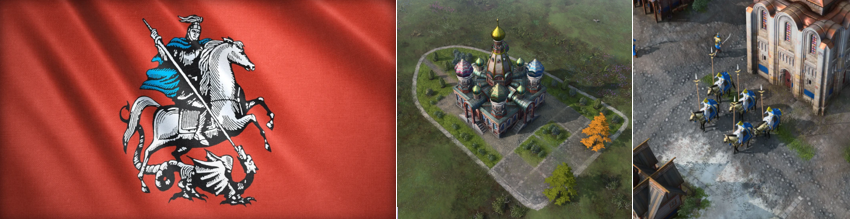
Between these poles, titles oscillate in instructive tension. Black Book centers on the witch Vasilisa, who gathers village resources to mend a home, staging the hearth as refuge against the demonic wilds and evoking nostalgia for a lost premodern rural life in 19th-century pre-Revolutionary Russia (Fig. 3). Crusader Kings III‘s RICE mod Galicia-Volhynia: Borderlands of Red Rus adds regional peculiarities and Russo-Slavic rituals whose domestic soft power generates prestige (Fig. 4). Age of Empires IV renders the Rus’ Landmarks — St Basil’s Cathedral, Dormition Cathedral — as strategic choices for military power, orienting players toward the teleological rise of (Muscovite) Rus’ (Fig. 5). Mount & Blade II: Bannerlord reduces the Rus-derived Sturgia to a warband of recruiting and sieging (Fig. 6).

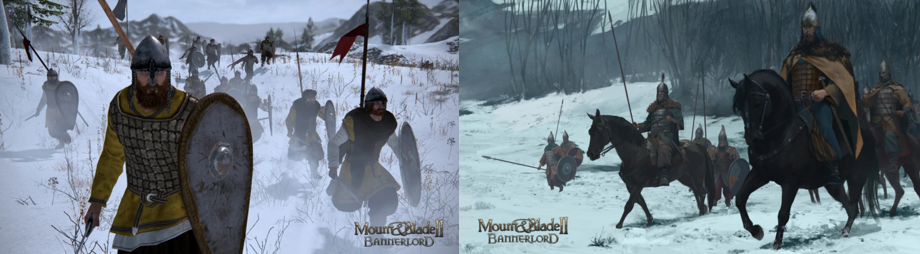
Together these examples show that orientation is never incidental: it decides which past is felt and how the player is bound to it. Such worlds foreclose genuinely contingent digital pasts — worlds that resist tidy binaries and embrace the messiness of open history. A caveat remains: the affective-orientation lens risks underestimating how players resist, subvert, or reframe these orientations, and flattening ambiguous play within a single title. I therefore call for closer attention to negotiated and deviant play.
Bibliography
Loomba, A. (2005). Colonialism/Postcolonialism (2nd ed.). Routledge.
Ahmed, S. (2010). The Promise of happiness. Duke University Press.
Hodder, I. (2012). Entangled: An archaeology of the relationships between humans and things. Wiley-Blackwell.
Ludography
Age of Empires IV: Anniversary Edition. Developed by Relic Entertainment, published by Xbox Game Studios, 2021. Windows PC.
Black Book. Developed by Morteshka, published by Flylemon, 2021. Windows PC, Nintendo Switch, PlayStation 4, Xbox One.
Crusader Kings III. Developed by Paradox Interactive, 2020. Windows PC.
Europa Universalis IV. Developed by Paradox Development Studio, published by Paradox Interactive, 2013. Windows PC, macOS, Linux.
Mount & Blade II: Bannerlord. Developed by TaleWorlds Entertainment, published by TaleWorlds Entertainment, 2022. Windows PC, PlayStation 5, Xbox Series X/S.
The Sims 4 . Developed by Maxis, published by Electronic Arts, 2014. Windows PC, macOS, PlayStation 4, Xbox One.
Author Bio
Dr. Kristina Wittkamp is a Senior Researcher at the Chair of Modern Eastern European History, University of Passau. Her current research focuses on Rus‘ and its legacy as discoursive topics in diachronic perspectives. Medievalism and historical cultures in its East (Central) European ‘successor societies’.
Obviously in the strategic-masculinised sphere, encountering the non-Russian other confrontationally is a big element. Are there any occasions of such encounter in Russian games that involve the “hearth sphere” more, either direct human encounters or encounters with definitionally non-Russian material culture? How are those handled?
Thanks, this is really interesting. I was wondering if you could expand a little on the difference made by some of these being mods, and some being ‘official’ parts of the game – partly as to whether you think the mods are influenced by what players find in games elsewhere? (Whether to mimic or reject depictions they find in other games). Of course if a player can mod a game (or even choose to download a mod) they are to some extent I suppose taking more ownership over the kind of past they want to ‘feel’ in a game; does that have a significant impact here when comparing across games?
Thank you, Kristina!
You concluded the paper stressing the importance of not assuming automatic player conformity. There have been a few attempts to theorize that in game studies, coming from different directions and disciplinary traditions.
In your own experience, what do you think is a fruitful theoretical framework to understand how these messages get assimilated/negociated/subverted by players?