
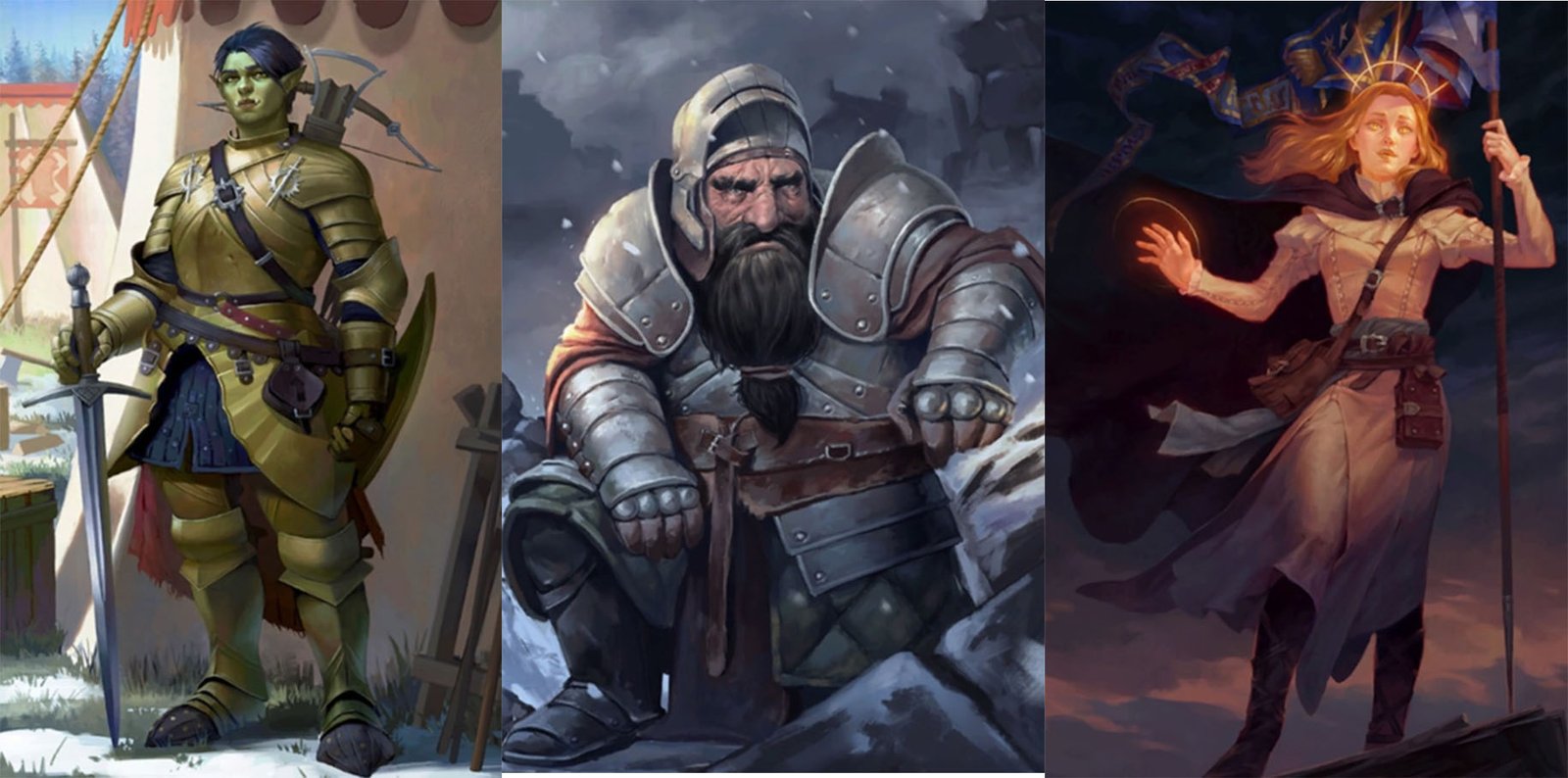
Paladins are commonplace across fantasy roleplaying games. Typically appearing as knights in shining armour, these warriors are almost ubiquitous within games based on the Dungeons & Dragons rulesets – including the Eye of the Beholder, Baldur’s Gate, Icewind Dale, and Neverwinter Nights series – and have appeared in a huge range of other games such as World of Warcraft and the Ultima, Quest for Glory, Gothic, The Bard’s Tale and Dragon Age series. As a result of their wide reach, these games have become important influences in the depiction of paladins within popular culture.
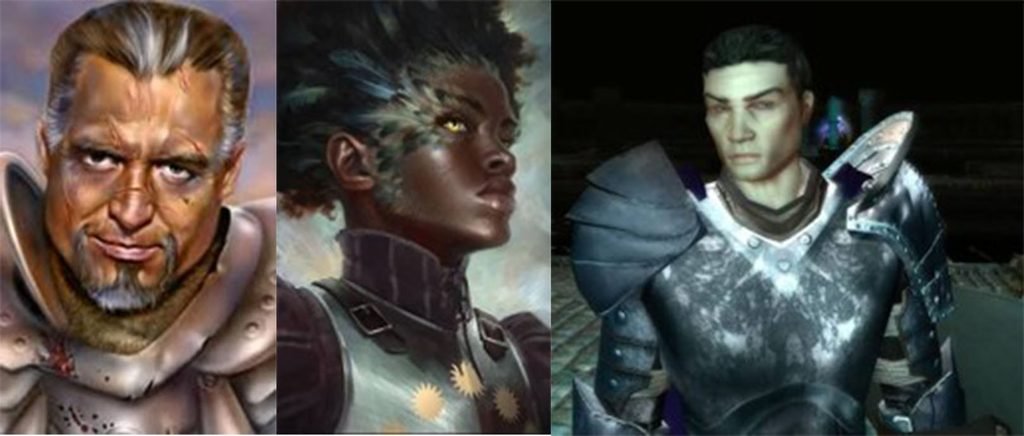
Various Paladins: Keldorn Firecam (Baldur’s Gate II) [Baldur’s Gate Fandom.com], Pallegina mes Rèi (Pillars of Eternity) [Pillars of Eternity Fandom.com], and Casavir (Neverwinter Nights 2) [NWN2 Fandom.com]
The paladins of these games are implicitly or explicitly holy warriors powered by the divine – almost always presented as servants of a pseudo-Christian God. These characters gain access to a range of abilities and powers with a divine theme and naming conventions including ‘Divine Smite’, ‘Holy Shield’ or ‘Consecration’. They are empowered to heal the sick by laying hands. They receive their powers and spells through prayer, typically allowing these abilities to be granted by their divine sponsor. Beyond this, the audio-visuals associated with these powers almost always lean heavily on Christian imagery with a propensity for shafts of light, halos, angelic wings, and monastic chant accompanying their use.
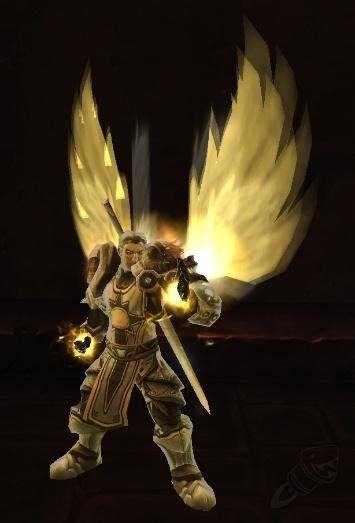
Paladin Under Influence of Avenging Crusader Spell (World of Warcraft) [WoWHead]
Within these games, paladins are also almost always morally upstanding. This is perhaps most firmly established through games following the earlier iterations of the Dungeons & Dragons rulesets (such as the early Baldur’s Gate games). These games often imported the alignment system of their tabletop forebears, requiring paladins to be Lawful Good (the stereotypically most noble alignment) and to maintain a righteous reputation: conducting too many evil acts and dropping too low on the karma meter would result in paladin allies deserting or attacking the player or, if the player character were a paladin would cause them to ‘fall’ losing their special abilities.
Paladins are clearly connected to crusading knights. This is immediately apparent through their knightly aesthetics: beyond their links to Christianity, many paladins are presented in armour styles associated with the Templars and other knightly orders. It is also evident through the naming conventions around their abilities such as ‘Crusaders Mantle’ or ‘Crusading Aura’.
This combination of tropes presents crusaders (paladins) as noble and performing the will of God and in doing so rather flattens the depiction of the crusades in these games. The paladin’s struggles are explicitly virtuous and implicitly supported by the divine and, conversely, their opponents must be evil and heathen. This, combined with the depiction of paladins as protectors, ties in with common clash of civilization narratives around the crusades, placing the Western paladins firmly in the right.
This depiction is not significantly mitigated where the paladin’s enemies are supernatural. Although a handful of exceptions exist (such as the conflict between the virtuous Paladins and nefarious Hashishin in the Gothic series), most roleplaying games make use of non-human characters as opponents, with paladins fighting pseudo-Christian demons, Tolkienesque Orcs and Goblins, or any number of other fantasy races. However, this mutates rather than removes the clash of civilizations narrative: the crusading paladins are still in conflict with another culture, one which is explicitly and often irredeemably evil. Moreover, as many of these fantasy races are coded as non-Western, the clash of civilizations narrative is further emphasised.
This is carried over to the appearance of paladins in a handful of games outside the roleplaying genre. The Total War: Warhammer series incorporates paladins as leaders of a series of factions (the Knights of Origo, Thegan’s Errantry and Chevaliers de Lyonesse) originating from Bretonnia (pseudo-France) explicitly engaged in a crusade against the forces of darkness in Araby (a fantasy version of the Holy Land). While this crusade is conducted primarily against factions of the undead with an ancient Egyptian aesthetic, the tropes remain intact.
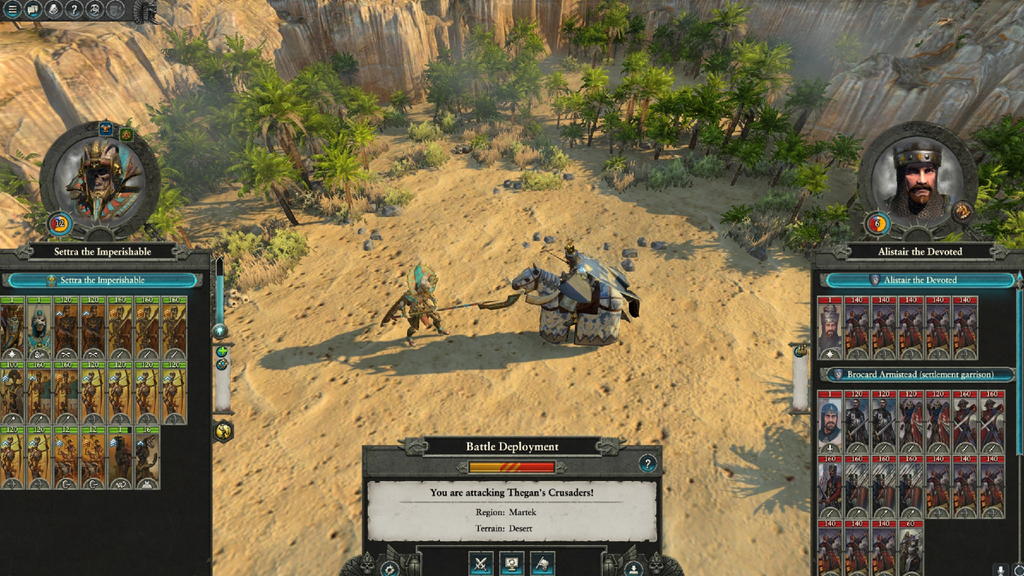
Undead Forces Attacking Thegan’s Crusaders (Total War: Warhammer II) [Total War Warhammer Fandom.com]
There’s some potential to explore and critique these depictions of noble crusading knights – indeed we see a lot of this in other genres, the action orientated Dante’s Inferno is a particular example – but this is largely shallow in roleplaying games. The most prominent exploration is through narrative and mechanics around falling which provide a tangible consequence for paladins who do not live up to their moral expectations. But even here, the factors which trigger a fall are often arbitrary and almost always permit the unrestrained slaughter of designated ‘enemies’. More generally, the paladin, and by implication the crusading knight, is still an idealised righteous and holy warrior: by definition if they cease to be so, they are no longer a true paladin. Moreover, fallen paladins are very much a rarity within these games: most paladins remain righteous.
To go further and create a more considered approach to the crusades and crusading, roleplaying games need to have a reckoning with their systems of morality. While these games often provide complex discussion of ethical issues through their choice based systems and moral quandaries, morality is still a blunt instrument in many respects. What makes a good and evil action often appears arbitrary or inconsistent. Moreover, roleplaying games still tend to default to always chaotic evil opponents for their lawful good heroes to defeat. There’s certainly potential to overcome these issues and develop more nuanced accounts of conflicts such as the crusades, but this is seldom realised.
The paladin is at the heart of this issue. As paragons of virtue and obvious analogues for crusading knights, they represent an embedding of a particular view of the crusades and crusaders which is particularly hard to avoid, even in games which take steps to avoid this link.
Pathfinder: Wrath of the Righteous for example mitigates the core connection between paladins and crusading knights through its plethora of classes and subclasses: a range of classes fit the classic depiction of the armoured crusader including Cavaliers (a close fit for knights in shining armour), certain varieties of Warpriest (including most notably the Champion of the Faith), (unintuitively) the Hellknight Prestige class, and the Crusader subclass of Cleric. Each of these classes bears obvious aesthetic and narrative similarities with different aspects of crusading knights allowing a broader and more complex depiction of their motivations and behaviour. This combined with the variety of characters of all classes and backgrounds engaged the crusade at the heart of the game gives a somewhat more nuanced depiction.
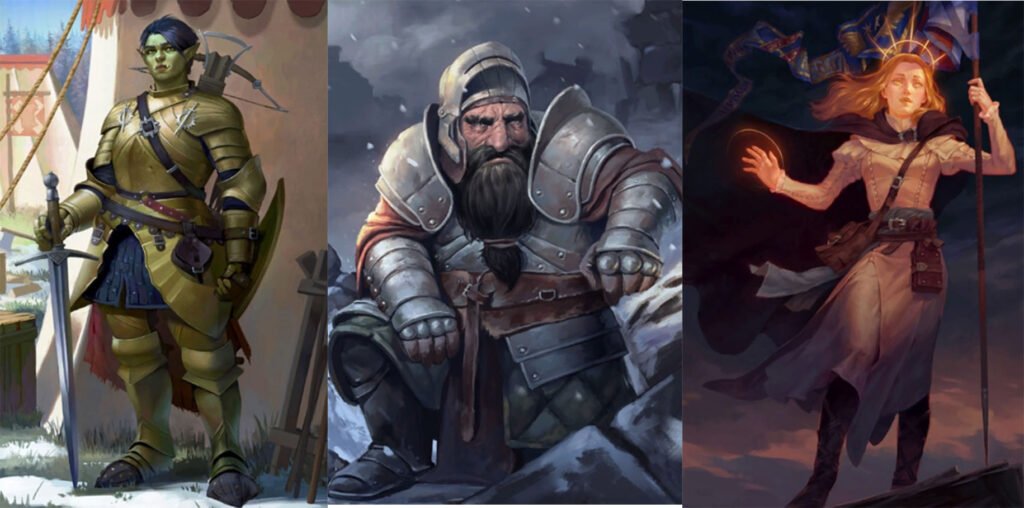
Cavalier, Warpriest and Paladin (Pathfinder: Wrath of the Righteous) [Pathfinder: Wrath of the Righteous — Guide and Walkthrough, Chris Williams, GameFAQs.com]
Nevertheless, roleplaying games are still limited by the prominence of the paladin. The notion of the paladin is firmly tied to the image of the crusaders within the popular mindset (at least amongst large sections of the gaming community) and it may be impossible to fully divorce the two. To fully engage with the crusades it may be time to retire the paladin.
I’ve been doing questions for three days so sorry Rob that you’re getting my one “this is a comment not a question” for this year – I sort of simultaneously agree and disagree with this. I absolutely take all the points made here but I guess my view is partly that, as regards retiring the paladin entirely, that ship has probably sailed: we could all ban paladins in our own D&D games, but we’re not the people we need to reach here in terms of getting people to think about paladinhood, crusading, and what those things mean.
I do also think there’s a bit more complexity out there already than you give complete credit for. I’ve definitely seen e.g. TTRPG podcasters talk about ideas for very much non-European, less Christian inspired ideas for divinely ordained warrior-heroes, for example, which I think could be a productive approach. I think we might also need to think more about the “dark crusader” or negative paladin archetype – I don’t agree that this is a rarity, I think it’s pretty established by this point. The Grey Wardens are very obviously an order of paladins even if Dragon Age doesn’t use that term, as in other ways are the Templars, and both are very, very often on the wrong side morally throughout those games in ways that the game is pretty clear about. And then there’s the Woedican Steel Garrotte in Avowed, very much the zealot paladin played as full villain. Those representations have their own problems, of course, but I don’t think we can boil the paladin down to “paladins are represented as being morally correct” any more, and it’s relatively rare that the sort of early D&D objective morality systems crop up much in actual CRPGs and play nowadays.
So whilst I totally see where the “maybe it’s time to retire the Paladin” comes from, I think we need to remember that as medievalists we’re all exhausted by misuse of the crusades and we’re not seeing it through the same lens as most people. I wonder if there are more productive ways forward that centre more on providing people with different ideas of what paladins can or should be, especially non-European ideas or people whose ‘paladinhood’ is less tied to Crusader-style orders or state models. We could also look at different ideas of what crusaders can be or were that don’t fit the paladin model, or explore those in different ways (“what do you mean, the banking and diplomacy service is all run by paladins”). Paladins are actually famously annoying in D&D play because they so often end up being the party policeman – giving people something cooler and more interesting than that has a potential role, I think, and is something where historians could have a more useful role in helping build different possibilities. My sense is that that exploration is more likely to make an impact from our end than trying to persuade people to take out that “religious warrior” niche altogether, because we’d be giving people a way to open up and complicate those stories rather than to not tell them.
I guess to the extent there’s a question here, it’s “do you have a sense of how a ‘retire the paladin’ push would work, and if not, what’re your thoughts on the above as an alternative”?
This is all absolutely fair, and it’s definitely a lot more nuanced than I’ve made out (I’d already abused the word limit pretty badly so I resorted to simplification and hyperbole).
You’re bang on that there are plenty of more complex depictions of individual paladins – PoE’s Pallegina gets some decent complexity and is very much not the standard paladin, BG3’s Minthara is outright villainous but still a paladin, etc. But in a lot of cases it’s about paladins struggling with the standard issues of duty vs good vs family vs glory (like Keldorn and Anomen in BG2) and the lore and abilities are still very much about being a good (and normally law abiding) divine servant. So even if we see a decent range of individual counter examples and dark paladins, the assumption is that most paladins are the good guys. (PoE gets a bit more complex with this with some shady orders of Paladins, but the most prominent group are all about generosity and compassion).
Dragon Age and the Templars is an interesting one, and is one way of getting round the paladin issue I think. Templars immediately get a different more morally gray (if not outright sinister) vibe thanks to everything from Phillip IV to Assassin’s Creed via Ivanhoe etc. So right from the start you’ve lost the immediate link to heroism and replaced it with a darker and more ambiguous history. The lore and narrative backs this up very neatly and is only slightly undermined with the playable subclass and its abilities (righteous strike, holy smite etc.) and the fact that the subclass is unlocked (in Origins at any rate) by having a good relationship with the character who comes the closest to the standard issue paladin. I need to have a proper look at Avowed though.
So it could be as simple as getting rid of the term ‘paladin’. But then I don’t know what to replace it with. Crusader, Templar etc have their own baggage, Holy Warrior has other implications.
I suppose I think that “redefine paladin to be a more expansive term” might be easier than ditching it? If I’m at a gaming table, “you can’t play a paladin” is a much harder sell than “I have these five alternate new types of paladin you can play”, which can then incorporate say “Persianate hero where Paladinhood is the royal farr”, or “Paladin but your powers are provided by devotion to your home city”, or “Paladin who gets their powers by the collective belief of ordinary people in the Paladin’s ability to protect them”, or “Steppe culture paladin whose job it is to guard and guide the antelope herds and protect them from monsters”. And none of those would have to have crusader vibes or aesthetics – I think from what you’re saying, the aesthetic connection to crusaderism is kind of the thing you’re most keen to ditch?
Maybe I need to write an “alternate paladins” article at some point…
Avowed is definitely a very straight-up “the main paladins are the bad guys” (which because it’s in the same setting as Pillars, also changes the “who will players think of as the most prominent paladin order in Eora” game – I think it’s now the Steel Garrotte). I wonder if one thing that we need to factor in here is just change over time, Keldorn was written over twenty years ago and I think if you summed up the recent paladin-equivalents from the past 10-15 years it’s a much less shining-armour story (Order of the Flaming Rose is another very obviously paladins type setup). I absolutely think your argument holds for materials produced up to about the “dark gaming turn” of the late 00s when the Witcher 1 and DA:O came out, but I’m still not convinced “the paladins are basically the good guys” really holds at all consistently thereafter in the western RPG/TTRPG traditions (I don’t really play JRPGs so have no idea of things over there).
I think even some of those ability names etc might change tone over time: “holy smite” reads very differently depending on your view of what religion is and what it does, and I’d maybe argue that western RPGs over time have gotten increasingly sceptical of religion and the gods: in BG1/2, temples are a place you pop into for healing, in BG3 even a traditionally “good” deity like Mystra comes across famously awfully to the point where a lot of people read her relationship with her mortal consorts like Gale as abusive. So I think some of the imagery here has actually been undermined for some of D&D’s core audience, even at the same time as obviously other people are going “no all of this is smiting the unclean stuff is good” for the absolute worst reasons. I guess one of my concerns here is that the killer-in-shining-armour “problem crusaders” are I think much less prevalent or much more problematised in new CRPG releases already, and I don’t think we have a way of reaching the people who continue that tradition at the tabletop. Maybe I’m being over-optimistic though!
Thanks James.
Yes, I think it’s the aesthetic link that’s the big issue for me – whether it’s in terms of appearance and naming conventions around abilities, or just how they’re described – but also how this feeds into the mechanics used by the class. I do like the various different types of paladin approach, Pathfinder: Wrath of the Righteous was pretty good for this (Ranger/Hunter paladins, bookworm paladins etc), although these mostly still conform to the standard knight in shining armour appearances and all have the same morality requirements. Combining this with the PoE dispositions system or something similar could get pretty close to what you describe. But an ‘alternative paladins’ article would be grand please.
I’m really going to have to get through Avowed. And yes, change over time is certainly a factor here, with more recent games generally taking a more complex approach to paladins (and most other things). But I don’t think we can write off the influence of the older games, given the Enhanced Editions / re-releases from the last few years, visible legacy in a lot of indie games (and some AAA action RPGs like Diablo 4), and still evident presence in big budget RPGs (BG3 makes things somewhat more nuanced, but being a paladin is at worst about being at the lighter end of the shades of grey morality). You’re right that there’s much more nuance than I set out, but I think there’s still a notable presence of do-gooding paladins. Although that might be me showing my age. I’m going to have to do another demographic study aren’t I..?
Skepticism of religion is another thing I need to think about a bit more. I think I’d be more inclined to get on board with ‘Divine’ ‘Holy’ etc as neutral/negative terms if they weren’t accompanied by acritically applied halos, wings and pillars of light. And while there’s a fair bit of moralising about the righteousness of the ‘good’ gods and their servants in a few of these games, they still almost universally send you out to kill thousands of sentient beings designated as ‘evil’. A less combat orientated (or less combat mandatory) game like Esoteric Ebb could help with this, but these are a relative minority.
I also need to think more about how this would work on the tabletop and how players in general actually interact with paladins. That feels like a different, terrifying, but interesting study though…
I concur with James Ballie about this, and would like to add that you obviously haven’t played Pillars Of Eternity; it treats paladins noticeably differently, in particular Pallegina Mes Rei, whose portrait you’re using on top of this essay. You should be more familiar with source material before referencing it.
Thanks for this – as above, PoE does have a more complex presentation of paladins and I’d have loved to talk about this with more space. Nevertheless, there’s still plenty of links to the good knight in shining armour trope. (e.g. We’re explicitly told the most widespread paladin order is all about generosity). Pallegina is used here to illustrate what paladins look like and to give a bit of variety beyond ‘white guy in armour’ – and I think she still looks the part, even if her personality/morality is at odds with the traditional paladin.
A gentle note, just commenting as I’m the person being agreed with here, it’s probably better to frame these sorts of critiques as questions: if you think something’s lacking from someone’s paper, asking them “could you discuss X/Y/Z more” is usually more exploratory an approach than telling them they got it wrong. You may find they had their own reasons for doing something, or do actually disagree with your conclusion on it, or simply they ran out of space or time to discuss the particular point you’re interested in, and especially in these sorts of short-format pieces working out where someone’s coming from rather than assuming they’re obviously unfamiliar with a particular example is usually better for sparking a useful discussion.
I do agree (with both you and Rob!) that PoE’s idea of paladins is really interestingly different, and could definitely have a whole presentation in and of itself in some future year. Does Eora have a tie-in TTRPG or similar, now that I think about it? I don’t know if there are any very obvious overlaps of tabletop settings that do anything much like Pillars, though I’m far less familiar with tabletop material in general because I only really run one game system regularly (and that’s Savage Worlds which isn’t class-based).
I had to look this up – I’d heard something around the release of Deadfire, but never followed up. It looks like an early draft was released, but the project seems to be dead. Again, a very cool thing to look over…
Thanks for this Rob, it’s very interesting! I was wondering as I was reading this about whether sometimes the popularity of the paladin and uncritical promotion of potential ‘crusader’ figures can also result from their unusual relationship with agency/responsibility, especially in D&D or rulesets following it. By which I mean that the paladin, cleric, and warlock all more than any other class (and perhaps the paladin and warlock, given the oath/pact situation) all ‘have’ to act in certain ways because their god/patron tells them to (or, otherwise, they can indeed lose their powers in many settings). But to some extent that can perhaps have the effect of justifying some of the violence through a lack of responsibility – it’s not me, it’s my god who wants me to slaughter thousands of orcs! So it’s totally fine! I didn’t choose to do it! But I don’t know if that applies to non-ludic crusader figures in medievalist works (e.g. films) – do you think there’s anything there, or is that not really an element of understanding these characters and their presentation? (If there *is*, it would seem potentially problematic in additional ways than those you’ve outlined here).
Ooo, I’m not sure Kate, but this feels important!
My kneejerk is: I think you’re right, player agency and restrictions placed on that give paladins and similar a different aspect in games. It makes adherence to the oath/pact/etc. meaningful in a less abstract way than film etc. But the limitations of these games and their focus on violence mean that it pretty much has be ok to murder thousand of sentient beings without dwelling on it. And that straightaway ties paladins into all of the issues around race baked into ‘it’s ok to kill an orc’, with all of the associated colonialist/imperialist baggage – which in turn reinforces the clash of civilizations element inherent to the crusades and hence paladins.
Weirdly (or not) the sort of annoying paladin in TTRPGs which James mentioned and I failed to address could sort of act as a counter to this – although I think in most cases the issue would be similar.
I’ve been mulling over this ever since Paul Sturtevant delivered a similar paper in one of the very first MAMGs.
Don’t you think this particular association between chivalry with the crusading ethos, so prevalent in contemporary media, is too simplistic?
I’m thinking of things like the Peace/Truce of God movements, which shows a relationship between faith and (violent) do-goodery in very different terms, or even works like the Chanson de Roland – where, even though there is a clash between Christians and non-Christians, the real villain is someone from the in-group).
I’m very aware modern entertainment is deliberately simplistic, but I wonder if we, as experts, couldn’t contribute by expanding the historical vocabulary, rather than just dropping the ban hammer.
I knew I should have linked to Paul’s paper as a jumping off point! I’m nowhere near as strident as he was, but it’s definitely in the same vein.
You’re absolutely right that equating chivalry with crusading is far too simplistic, and I think exploring other aspects like the Peace of God, Courtly Love, etc. could give scope for a more interesting exploration. I think Pathfinder: Wrath of the Righteous engages with this quite well with its vast range of Paladin subclasses (and other classes which fit the chivalric knight mold).
I’m still trying to decide how far I’d want to drop the ban hammer. I think ‘Paladin’ is still a very loaded term so getting rid of it (or at least narrowing its use) in favour of other more neutral descriptors could be an approach – although finding something neutral is more of a challenge. Changing the graphics, ability naming conventions and mechanics to match more complex lore/behaviour of individual paladins would be another option – we see the start of this with Pillars of Eternity I think. I’ve been wondering about separating abilities from their source, but can’t come up with anything more elegant than GURPS which has its own issues.