
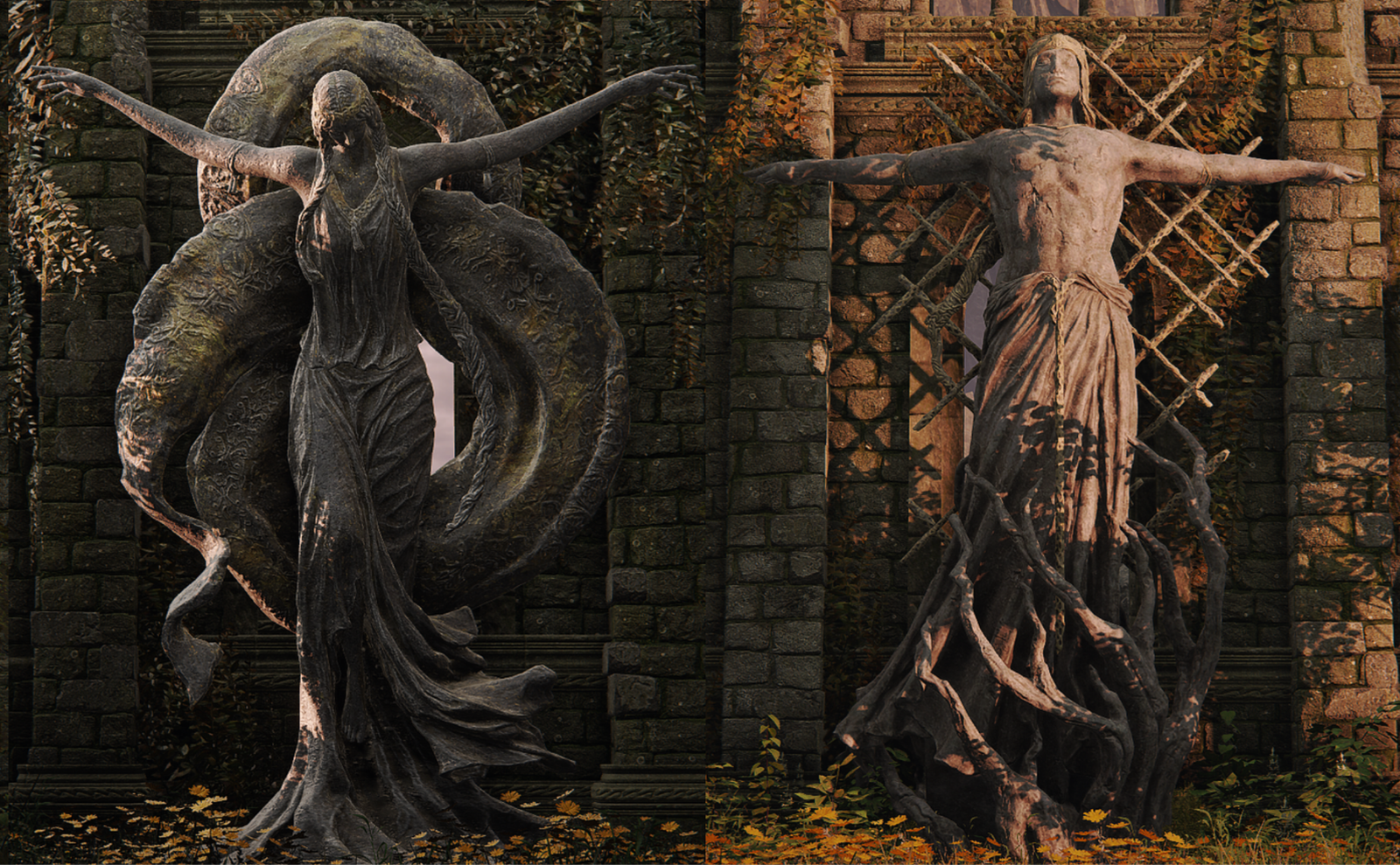
The world of FromSoftware’s 2022 RPG Elden Ring draws heavily on abstract alchemical processes of the Renaissance to create characters that challenge our contemporary worldviews on gender. This work focuses on two characters: Queen Marika the Eternal, the ‘White Queen’ or feminine mercury; and Radagon of the Golden Order, the ‘Red King’ or masculine sulfur. By fusing them together, their titles and defined lines of gender collapse into the ‘hermaphroditic res-bina’ (Rebis, or ‘two thing’). Thus, they at once reject our contemporary sense of gender while simultaneously upholding it through a binary split in character design. I analyze their Rebis through Leah DeVun’s The Shape of Sex alongside works by Judith Butler to understand Elden Ring’s alchemical view of gendered identity as an alternative view for the future.
The alchemical movement spans the Medieval, Renaissance, and Early Modern periods; Elden Ring focuses on specifically Renaissance alchemical literature, a period of time when the concept of hermaphrodism went from ‘impure hybrid’ to ‘productive transformation of the spiritual and physical’ (DeVun, 2021, pp. 72) via the Rebis, a ~14th century doubly-gendered divine being following the ‘marriage’ of masculine sulfur (the Red King) and feminine mercury (the White Queen).
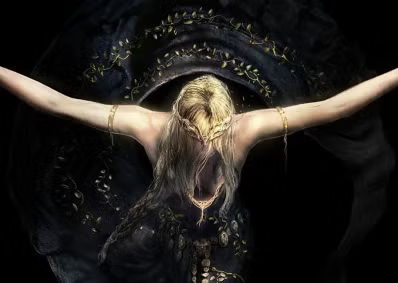
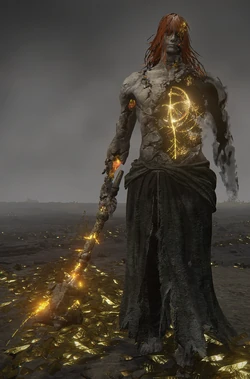
Queen Marika the Eternal (above) and Radagon (below)
In game, the red-haired Radagon was invited to wed white-haired Queen Marika the Eternal — the two were then fused together, becoming the Rebis and sharing a singular body if not singular will. When the player enters the final boss arena of the game, Queen Marika will collapse, her hair will redden, and Radagon will combat the player, signalling a fight for control over one body.
This concept of a divided divinity is a new spin on the alchemical Rebis, where both characters simply are the other yet differ in worldview. Should the player perform the ‘Law of Regression’ incantation before a statue of Marika, it will transform into Radagon and the message ‘Radagon is Marika’ will appear. The (non)distinction between these two characters raises a dilemma regarding communication of the difference in gendered identity – namely, are they a challenge to or proponent of a reductive gender binary?
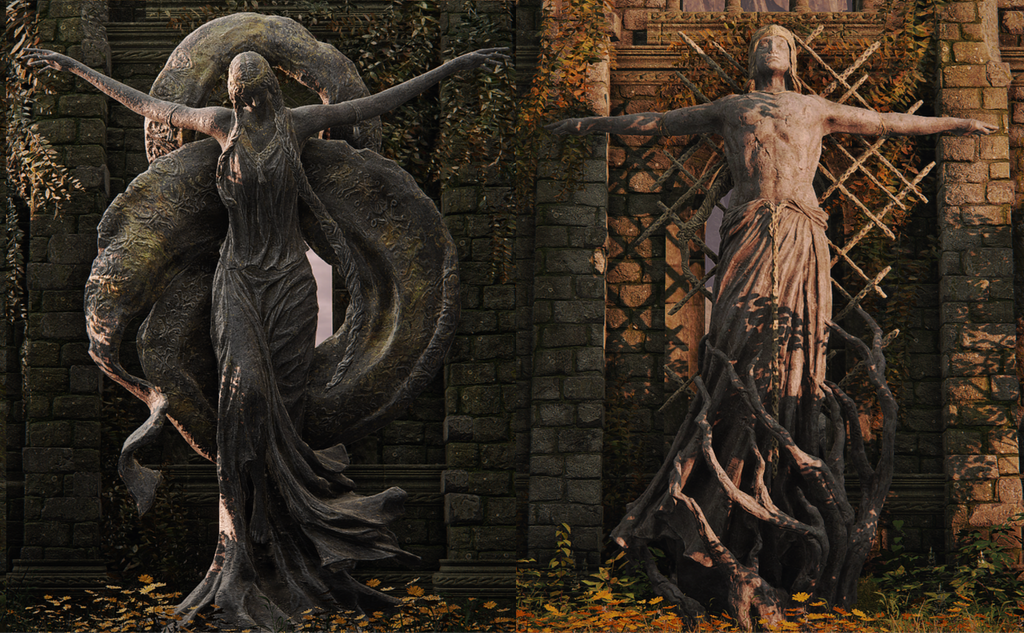
Statue before and after ‘Law of Regression’ incantation is performed
Gender identity
Game characters exist in a curious state of limbo; they are not real, but are designed to be perceived as such by the player; they are the embodiment of performing gender ‘through the stylization of the body… the mundane way in which bodily gestures, movements, and styles of various kinds constitute the illusion of an abiding gendered self’ (Butler, 1993, pp. 74). Design must communicate who the created character is at a glance, involving gendered shorthands such as hair, voice, and body shape. There are deep issues with this model (as highlighted by Bo Ruberg (2017, 2023), C. Riley Snorton (2009), and others) yet it remains central to video game design. Where Marika is depicted with a dress and blonde hair, once Radagon wrests control the dress becomes a kilt and their hair becomes bright red; while Marika and Radagon ostensibly share the same body a model swap occurs that erases Marika’s figure and breasts when Radagon is in control.
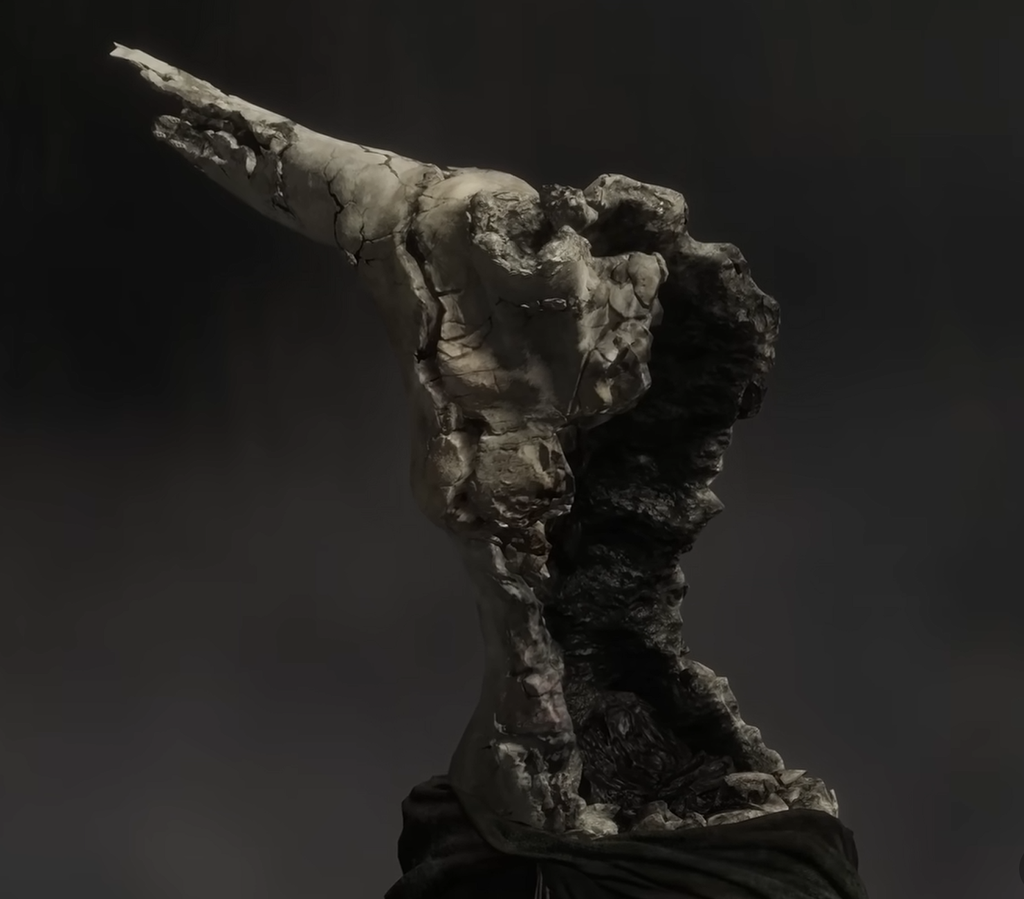
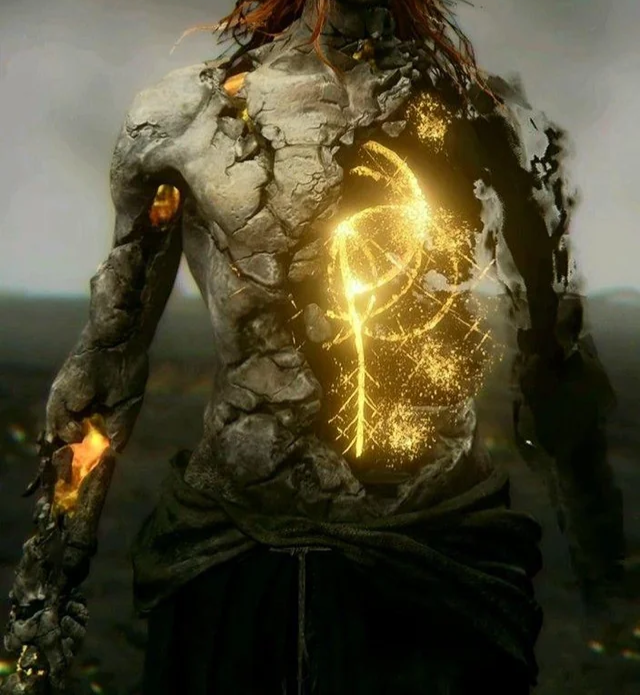
Torso of Marika (left) and Radagon (right)
Yet despite these gendered stylizations, Marika and Radagon are recognizable as the same body due to baseline androgyny present in their design — prominent muscles, a loose hairstyle, and flaking gray skin create a character over which masculine or feminine details are layered, both complicating and flattening Elden Ring’s representation of gender.
Much like their body, Marika and Radagon exist as a strange in-between of both queer challenge to and heteronormative upholding of gender. Taken together, the two encapsulate and discard the binary by creating an alchemically inspired androgynous being. Taken separately, the two uphold the gendered binary by playing into opposite ends of it. Instead of a complete being disrupting the gender binary, Marika and Radagon can be read as two binarily gendered individuals who happen to be piloting the same vessel. Both readings are valid, but the former encourages further gender trouble via alchemy in future games to ensure validity.
Citations
Butler, J. (1990). Gender Trouble: Feminism and the Subversion of Identity. New York: Routledge.
Cull, M. (2024). What Gender Should Be. Bloomsbury.
DeVun, L. (2021). The Shape of Sex: Nonbinary Gender from Genesis to the Renaissance. Columbia University Press. http://www.jstor.org/stable/10.7312/devu19550
Parasoulsus. (2021). Elden Ring’s deep connection to alchemy and the Ripley Scroll. r/Eldenring, reddit.
Snorton, C. R. (2009) A New Hope: The Psychic Life of Passing. Hypatia, vol. 24, no. 3. Hypatia Inc.
Ludography
FromSoftware (2022). Elden Ring. Digital game directed by Hidetaka Miyazaki, Yui Tanimura, and George R.R. Martin, published by Bandai Namco Entertainment.
I’d be really interested to know how folks who have a plural/system-style sense of self read characters like this…
A thing I’d be interested in more details on from you? Do you think seeing these characters as “simply” two binary gendered individuals in the same mutable body is really necessarily an ‘upholding’ of gender binarism – what do you see as being the requirements for a challenge to it/are you working with a model where either there is a clear third gender present or you consider the binary to have been upheld? Insofar as it still inherently breaks several concepts around immutability which are pretty heavy prerequisites for most common formulations of that binary, mightn’t it still present a challenge to that albeit without ending up with a singular, non-binary identity?
Another thought: what effect does it have on challenges to these systems to present them in the form of mythic or alchemical or monstrous beings like this? If this character had been a clearly singular non-binary individual, does that have the effect of normalising identity beyond the gender binary by presenting it, or of othering it by making it an artificial, alchemical, monstrous presence?
Hmmm… I think, as with all good art playing with / questioning gender, that there’s always a really broad swath of ambiguity. In Elden Ring’s case, I think the game does a really good job at incorporating the rebus specifically and opening up discussion on the mutability of bodies / performativity of gender in keeping with arguments like C. E. Mackenzie’s Achy Affects and Matthew Cull’s What Gender Should Be, who both argue for the abject transformation of our own selves and, by extension, our own bodies outside of capitalistic demands for homogeny. On the other hand, by setting Marika and Radagon so drastically against each other in terms of mannerisms, drives, and ideologies I think the game fumbles a little bit in drawing so heavily on gendered stereotypes of activity / passivity; Marika issues commands but Radagon fights battles, etc. It’s not super reductive, by any means, and if I had to hazard a guess these narratives are rooted in modern gender presentations because Elden Ring is really swinging for the fences (especially in terms of a Big Name Game tm) in regards to gender. I think it is still a challenge to the gender binary, but I would have really enjoyed seeing more about their dual identity rather than it being almost a ‘gotcha!’ at the end of the game. What if Marika and Radagon had actively switched control throughout the boss fight; what if we were privy to more of their ideological / interpersonal (literally) struggles beyond archaic lore tablets / statues scattered around the map; what if other characters commented on it at length and played around with the idea of a duology in their reigning monarch?
Monstrosity here is also interesting, as it is both a heavy source of inspiration for queer analysis / reclamation (see Susan Stryker’s My Words to Victor Frankenstein…) and also runs the risk of purposefully alienating genderplay / sexuality (as mentioned in the above Cull article). For Elden Ring, I think it is notable that every character who plays with the gender binary (Miquella / St. Trina, Marika / Radagon) are sympathetic enemies; one must fight them, but they are among the most memorable parts of their game because of that. Ultimately, though, I really like Elden Ring’s take on the rebus and character design at large; it’s a really strong opening move for such a mainstream game, but that doesn’t mean we can’t keep pushing for a character who, say, bases more interactions on such an interesting gendered situation. This is a great start, but there’s always another horizon to reach for.