
History in video games invariably belongs to the present. In recent years, a major consensus in historical game studies holds that games almost always reflect contemporary reality—arguably operating within “only one era: the present.” (Kerschbaumer and Winnerling 2014; Seiwald and Vollans 2023; Wright 2022) This poses a central challenge: how should we understand and handle the ubiquitous anachronisms of games, while still identifying within them questions relevant to professional historical inquiry? Yet history has never been merely a record of what happened in the past. It is also a way of imagining possible worlds. Long before history became a modern academic discipline, the past already participated in the present’s understanding of itself through metaphor and warning. When people look back on history, they also imagine their own present as one possible world of an earlier age, searching there for lessons, abandoned roads, and paths that were never allowed to be taken.
The Roman Empire is perhaps the most persistent example. Generation after generation has aspired to become a “New Rome,” while asking why Rome prospered, why its Republic failed, or was captured and transformed into empire, and why the Empire itself ultimately collapsed (Hell 2019; Murphy 2007). Rome has therefore never simply receded into the past. It remains a persistent point of reference for thinking about political destiny. Classical and Late Antique studies repeatedly encounter arguments about Roman crisis, imperial formation, and decline, arguments that spill far beyond the academy into political discourse, popular entertainment, and science fiction such as Star Wars (Elliott 2014; Cyrino 2005; Charles 2015). Which Rome ought to be restored, preserved, or overthrown? What kind of Pax Romana might thereby be secured, and what sort of Roma Aeterna imagined? These perennial questions continue to refract modern anxieties over political order, national prosperity, and social conflict.
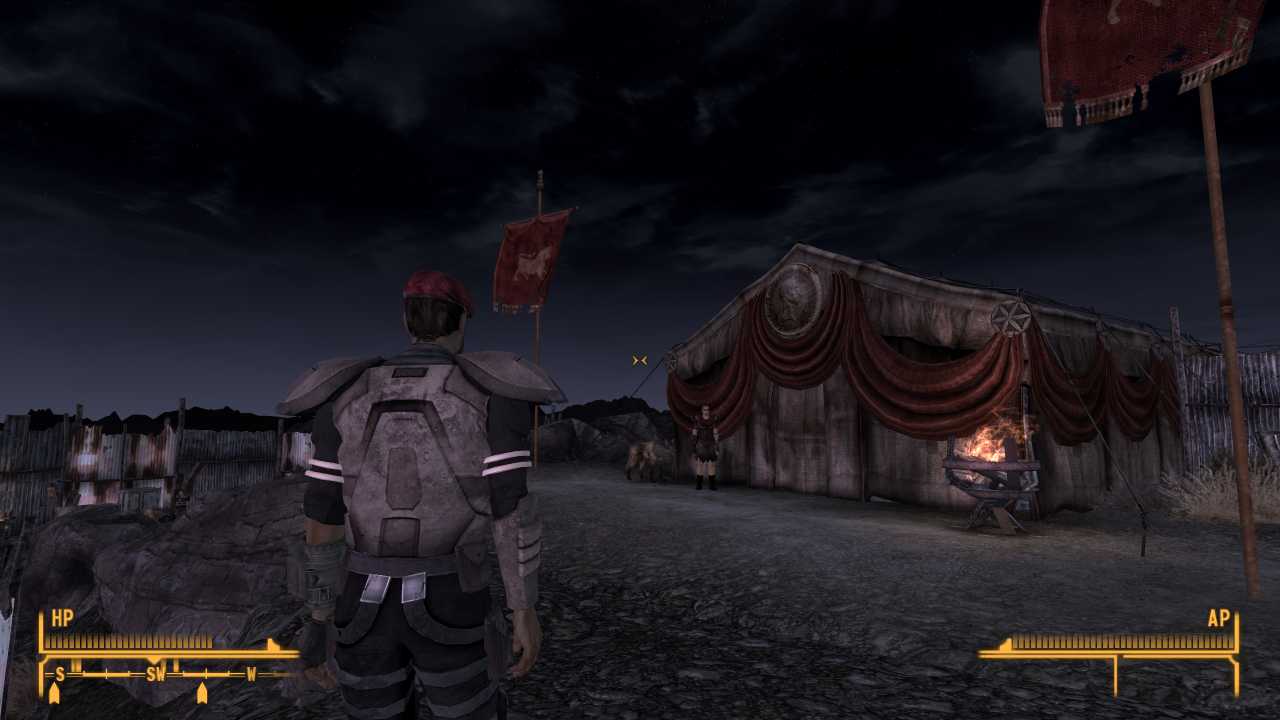
Similar metaphors are embedded in video games. Taking Fallout: New Vegas as a case study, this paper examines how the game reactivates this enduring Roman repertoire within a speculative future (Christopher 2025). The NCR presents itself as an imitation of pre-War America and, with it, inherits the American tradition of imagining the republic as a “New Roman Republic.” Caesar’s Legion, by contrast, constructs itself as a corrective to the consumerism, individualism, and corruption allegedly produced by that “democracy.” It seeks to become another Rome: a nationalist, statist, and centralized order that erases the identities of conquered peoples in the name of a new Pax Romana, promising durable peace and civilization through uncompromising political unity.
The Colorado River that Caesar’s Legion prepares to cross thus becomes another Rubicon. As with Caesar’s own crossing, the moment can be imagined as the “rescue” and reconstruction of a republic corrupted by aristocratic rule, while simultaneously marking the abandonment of the republic—and, increasingly, of civic traditions themselves—in the interests of imperial expansion and survival. Condensed into this single image are the later Empire’s turn toward monotheism, the sacralization of imperial rule, and the long succession of later polities that sought to become an “Eternal Rome” and to realize their own “Roman peace.” Yet the shadows of those traditions enter the game as well: total war, enslavement, cultural erasure, even genocide, together with forms of resistance that themselves draw upon Rome as historical metaphor and political inspiration.
As a metaphor of Roman history, then, New Vegas is simultaneously a metaphor of American history. The American republic fashioned its identity through resistance to empire—first and most obviously the British Empire. Slavery and abolition subsequently redefined the relationship among republicanism, citizenship, and freedom. After the Second World War, as the United States itself increasingly came to be described and imagined in imperial terms, the old anxiety over republic and empire returned with renewed force. New Vegas thus spatializes what Roman history narrates temporally. It places side by side processes that Roman history distributes across centuries, while also compressing into a single moment the many later variants of “Rome” and the longer, more complicated histories connecting them—much as political history, political thought, and popular historical imagination have repeatedly done. Why does a political community desire to become a new Rome? And why do Roman Republic and Empire seem condemned to wage an eternal war, both as political ideals and as their historical embodiments?
This paper therefore proposes a way of approaching history in video games that moves beyond identifying historical settings or tracing how modernity reshapes the past. Historians can also ask how particular historical epochs are condensed into powerful metaphors, and how anachronism becomes a means of working through contemporary anxieties. Through its openness to “possible worlds” and “possible pasts,” the video game offers an experimental space in which the present can repeatedly re-enter the past and reconsider political destiny, human choice, and unrealized possibilities—as people have always done when studying, invoking, and fighting over history.
Bibliography
Charles, Michael B. “Remembering and Restoring the Republic: Star Wars and Rome.” Classical World 108, no. 2 (2015): 281–298.
Christopher, Jordan Thomas. “‘Caesar’s Legion’ in Fallout: New Vegas: Re-enactment as Reception.” Classical Receptions Journal 17, no. 4 (2025): 365–383. https://doi.org/10.1093/crj/claf010
Elliott, Andrew B. R., ed. The Return of the Epic Film: Genre, Aesthetics and History in the 21st Century. Edinburgh: Edinburgh University Press, 2014.
Hell, Julia. The Conquest of Ruins: The Third Reich and the Fall of Rome. Chicago: The University of Chicago Press, 2019.
Kerschbaumer, Florian, and Tobias Winnerling. “Introduction: The Devil Is in the Details: Why Video Game Analysis Is Such a Hard Task for Historians, and How We Nevertheless Try.” In Early Modernity and Video Games, edited by Tobias Winnerling and Florian Kerschbaumer, ix–xx. Newcastle upon Tyne: Cambridge Scholars Publishing, 2014.
Morley, Neville. The Roman Empire: Roots of Imperialism. New York: Pluto Press, 2010.
Murphy, Cullen. Are We Rome?: The Fall of an Empire and the Fate of America. Boston: Houghton Mifflin Harcourt Publishing Company, 2007.
Obsidian Entertainment. 2010. Fallout: New Vegas. Bethesda Softworks. Video game.
Seiwald, Regina, and Edwin Vollans, eds. (Not) In the Game: History, Paratexts, and Games. Berlin/Boston: De Gruyter Brill, 2023.
Winkler, Martin M., ed. Gladiator: Film and History. Oxford: Blackwell, 2005.
Wright, Esther. Rockstar Games and American History: Promotional Materials and the Construction of Authenticity. Berlin/Boston: De Gruyter Brill, 2022.
Biography
Lu Yahuai is Associate Professor at Yangtze University in China. She received interdisciplinary training in Late Antiquity Studies and Patristics at the Department of History and the Center for Classical Studies at Peking University, as well as in the history and philosophy of science and technology at Peking University’s Department of Philosophy. She later conducted postdoctoral research in game studies at Beijing Normal University under the supervision of Espen Aarseth. Her research focuses on game history, historical game studies, and digital public history, particularly the relationship between games, media memory, and narratives of modernization in contemporary China.
Whilst I’d thought plenty about the Romanitas (or lack thereof) of the legion, weirdly – probably because the element of Caesar’s backstory that’s emphasised in the game is him as a unifier of tribes, he’s not an NCR military leader – I’d never really thought of the whole setup of FNV as being a mock-up of Caesar crossing the Rubicon. That probably should have been more obvious to me as an analogy!
And I agree there’s a lot of power in thinking about where we build contested spaces in this stuff: if you read e.g. Bret Deveraux’s writing on Rome, he’s very much writing public stuff on the Roman army in to push back on the Caesar’s Legion view of Roman history (and in consequence to win that contest over who owns Rome and what was good about it in favour of the values of the modern American republic). So I think the parallel there with real-world politics is very direct and has become more so since FNV was published.
I’ve got a couple of questions. The first is on the role of the developers, who very obviously get to constrict the sorts of possibility-spaces that gamers get to see. Does your understanding of games as carriers of Grand Metaphor change how we should think about their role? To what extent do games need to reflect the imagined conflicts around them to make their cultural comments impactful, and to what extent can they construct alternate reimaginings of those conflicts – for example, could you rewrite New Vegas, or write a post-game to it, that delivered a stronger structural critique of how the Legion works? How well does the TV show (which I’ve not seen) do when it kind of tries that?
The second question is getting back to the not wholly but slightly absent medieval. Does thinking about medieval interaction with and memorialisation of classical Rome help us to think about how these contests over New Rome can be framed? What about the role of Byzantium, which is increasingly being brought back into popular concepts of the Roman world but also, with that, is getting deployed at times as a way to present fascist ideas of a New Rome (and thus the brutality of something like Caesar’s Legion) in a more explicitly Christian religious framework? I don’t think these were particularly in mind when they were making New Vegas, but do you think they have the potential to change how its metaphors might be read in future?
Anyway that’s probably too much and too vague a set of vaguely question-shaped thoughts, but any thoughts you have I’d be interested to read 🙂
Yes, the Legion’s lack of Romanitas was also my first reaction. But “the Colorado is my Rubicon” is Caesar’s own line. Another wonderfully strange thing is that he brings it up while discussing what Hegelian dialectics means — which feels especially funny to me (given that I’m teaching Marxist philosophy this semester! I was literally teaching the German classical philosophical tradition today.)
I haven’t read Bret Devereaux, so thank you very much for this~ I’ll definitely go and read his work!
As for the parallel with real-world politics… I think I first felt this very strongly, even with a kind of melancholy, when I was reading about how, from around 2005 onward, “fall of Rome” discourse returned quite forcefully to Late Antique studies, and the debates that followed from it (The discussions in the first issue of Journal of Late Antiquity were particularly helpful as well). That was also one of the starting points for this paper: this almost instinctive popular way of reaching the past through “history as a mirror” or using antiquity to comment on the present, and the cycle it can create — seeing the past as a metaphor for the present affects reality, which in turn changes how the past is recorded and interpreted. It made me wonder whether we sometimes underestimate how sensitive historians of the late antiquity and medieval past can be to the present, and how quickly they respond to it.
And thank you very much for the questions! On the first one, I’ve also been thinking a lot about the role of developers ( orperhaps, the “authorship” of games ). Obviously J. E. Sawyer, and Chris Avellone, who made major contributions to the writing of New Vegas (if I remember correctly — I remember reading reports of his contribution), had much stronger agency in shaping and communicating meaning. But I’m not sure how far that is generally true of commercial games.
So one very preliminary understanding I have at the moment — and I really haven’t tested this properly yet — is that if games are carriers of Grand Metaphor, they may be so within a tradition of popular history that has, in some sense, gained a relative autonomy from academic history. And perhaps precisely because popular history is less into retails and precision, and circulates through affect and through making relevance visible, it can be even more inclined toward Grand Metaphor (than games with stronger “authorship”). Those Grand Metaphors may also be harder to recognise. If games want to make cultural comments of their own, perhaps the first step is to become conscious of what they are already repeating, and to what extent.
I still need to think more about your question of whether one could “rewrite New Vegas, or write a post-game to it”. But there is already something strongly tragic and ironic in Caesar’s original intended ending: he chooses a highly un-Roman — or perhaps more precisely, non-civic — form of organisation as a condition of wartime, with the goal of ending that wartime condition and returning to civic life in order to become a “truer” Rome. Yet his successor does not understand how to value the very thing Caesar abandoned in order to welcome it back more fully later — civic life and its civilisation.
On your second question: medieval interactions with classical Rome and their implications for contests over “New Rome” — this is a really, really good question and one worth thinking about much more deeply. Thank you! It needs much more detailed treatment, and I don’t think I have a valid view on it yet. I can only think of two things at the moment.
The first is still the question of empire. A colleague of mine used to point out that whether in the Roman Empire itself, in early medieval Western Europe after it, or in Byzantium, res publica continued to appear frequently in languages of self-identification — rather than “empire”. This of course also seems to echo the way modern nation-states can be willing to claim the language of a “new republic”, while feeling much more uncomfortable or reluctant about the label of a new “empire”. The desire for territory, unity, influence and strength, and even an acceptance of force as their support, while simultaneously desiring an identity as res publica — perhaps that is a very long-running thread, and one that can also be seen in the mixed and conflicting Romanitas of New Vegas.
The second is a moral question. When I first encountered Caesar’s Legion at Nipton, I was genuinely a little shocked by the strongly moralistic position in the dialogue: what supposedly brought destruction upon the inhabitants was their corruption and moral degeneration, almost a judgement that they were all sinners. But I haven’t yet worked out how to rethink this through the line you suggest, of ideas of a New Rome being placed within a more explicitly Christian religious framework.
Thank you so, so much for these questions! And ah, sorry I accidentally ended up writing a very long stream of thoughts in reply~
What a solid paper! If it were any other type of game I’d say 10/10 no questions, but by Fallout being what it is, I think I need to ask, and it may well be that there’s no effect but I want to defer to you: what role does player choice have? Does the ability of the player, for example, choosing to side with another faction or ignoring the lore as a whole and focusing on the action affect your proposition in any way?
Thank you so much for the comment and the question! Yes~ this is also something I’ve kept asking myself: how large is the gap between what historians can “analyse” out of a game, and what players can actually see, recognise, and be affected by, especially once we take player agency seriously? That autonomy is both something we value in a good game, and something we hope can still be preserved under commercial logics.
I completely agree that if players choose a different faction, focus almost entirely on action, or devise their own forms of “counter-play” — which is of course something of an honourable tradition among Fallout series players — their experiences may differ enormously. And if they skip all the dialogue and textual material… hmm, well, I’m honestly not sure what happens then~
But I still think my point of entry can stand, because republic-empire may be a somewhat more particular case. A player might not even know what Rome or who Caesar were, but I’m very curious how many regions and cultures there are in which players really have no prior assumptions at all about this seemingly eternal struggle between republic and empire. These ideas seem to permeate discussions almost everywhere (though perhaps, as a Late Antiquity scholar, I am simply taking my own object of study too seriously and finding it too meaningful)!
What players may not be able to recognise is how many vague historical threads they are taking in at the same time. Perhaps one thing historians can do is to untangle that ball of threads and make those different strands visible.
Yes, the Legion’s lack of Romanitas was also my first reaction. But “the Colorado is my Rubicon” is Caesar’s own line. Another wonderfully strange thing is that he brings it up while discussing what Hegelian dialectics means — which feels especially funny to me (given that I’m teaching Marxist philosophy this semester! I was literally teaching the German classical philosophical tradition today.)
I haven’t read Bret Devereaux, so thank you very much for this~ I’ll definitely go and read his work!
As for the parallel with real-world politics… I think I first felt this very strongly, even with a kind of melancholy, when I was reading about how, from around 2005 onward, “fall of Rome” discourse returned quite forcefully to Late Antique studies, and the debates that followed from it (The discussions in the first issue of Journal of Late Antiquity were particularly helpful as well). That was also one of the starting points for this paper: this almost instinctive popular way of reaching the past through “history as a mirror” or using antiquity to comment on the present, and the cycle it can create — seeing the past as a metaphor for the present affects reality, which in turn changes how the past is recorded and interpreted. It made me wonder whether we sometimes underestimate how sensitive historians of the late antiquity and medieval past can be to the present, and how quickly they respond to it.
And thank you very much for the questions! On the first one, I’ve also been thinking a lot about the role of developers ( orperhaps, the “authorship” of games ). Obviously J. E. Sawyer, and Chris Avellone, who made major contributions to the writing of New Vegas (if I remember correctly — I remember reading reports of his contribution), had much stronger agency in shaping and communicating meaning. But I’m not sure how far that is generally true of commercial games.
So one very preliminary understanding I have at the moment — and I really haven’t tested this properly yet — is that if games are carriers of Grand Metaphor, they may be so within a tradition of popular history that has, in some sense, gained a relative autonomy from academic history. And perhaps precisely because popular history is less into retails and precision, and circulates through affect and through making relevance visible, it can be even more inclined toward Grand Metaphor (than games with stronger “authorship”). Those Grand Metaphors may also be harder to recognise. If games want to make cultural comments of their own, perhaps the first step is to become conscious of what they are already repeating, and to what extent.
I still need to think more about your question of whether one could “rewrite New Vegas, or write a post-game to it”. But there is already something strongly tragic and ironic in Caesar’s original intended ending: he chooses a highly un-Roman — or perhaps more precisely, non-civic — form of organisation as a condition of wartime, with the goal of ending that wartime condition and returning to civic life in order to become a “truer” Rome. Yet his successor does not understand how to value the very thing Caesar abandoned in order to welcome it back more fully later — civic life and its civilisation.
On your second question: medieval interactions with classical Rome and their implications for contests over “New Rome” — this is a really, really good question and one worth thinking about much more deeply. Thank you! It needs much more detailed treatment, and I don’t think I have a valid view on it yet. I can only think of two things at the moment.
The first is still the question of empire. A colleague of mine used to point out that whether in the Roman Empire itself, in early medieval Western Europe after it, or in Byzantium, res publica continued to appear frequently in languages of self-identification — rather than “empire”. This of course also seems to echo the way modern nation-states can be willing to claim the language of a “new republic”, while feeling much more uncomfortable or reluctant about the label of a new “empire”. The desire for territory, unity, influence and strength, and even an acceptance of force as their support, while simultaneously desiring an identity as res publica — perhaps that is a very long-running thread, and one that can also be seen in the mixed and conflicting Romanitas of New Vegas.
The second is a moral question. When I first encountered Caesar’s Legion at Nipton, I was genuinely a little shocked by the strongly moralistic position in the dialogue: what supposedly brought destruction upon the inhabitants was their corruption and moral degeneration, almost a judgement that they were all sinners. But I haven’t yet worked out how to rethink this through the line you suggest, of ideas of a New Rome being placed within a more explicitly Christian religious framework.
Thank you so, so much for these questions! And ah, sorry I accidentally ended up writing a very long stream of thoughts in reply~