
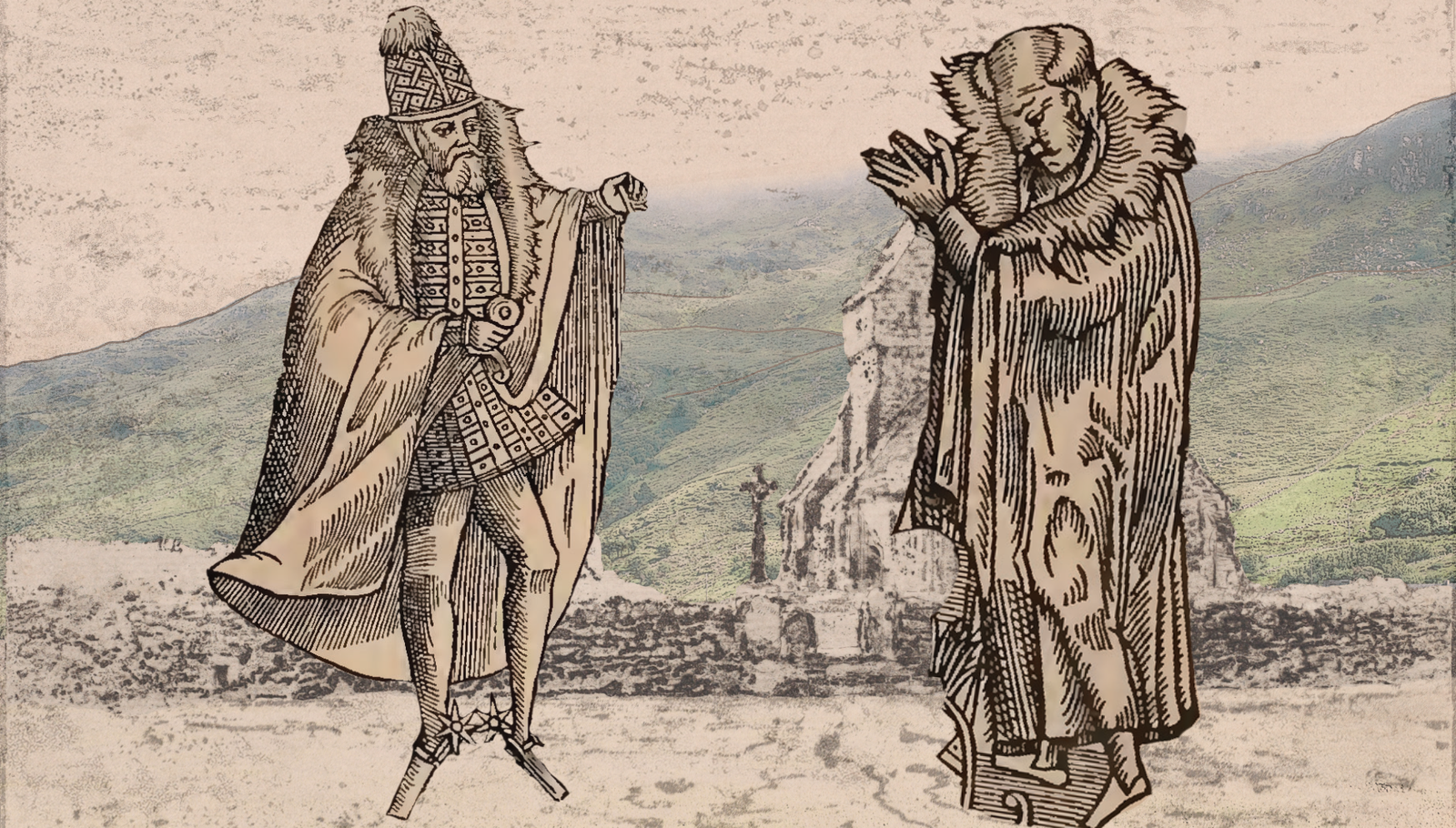
Today I wish to talk about my upcoming game, Galar. It is visual novel about the memorialization of the Black Death in Late Medieval Ireland.
It is divided into three chapters, each addressing a step in our collective process of assimilation of the non-human into cultural narratives: from raw appreciation of the forces of nature to the abstractions and calculations of contemporary history. The first chapter – the prototype of which can be played here – takes a posthuman, philosophical approach to our relationship with more-than-human hyperobjects [1]. The second, discussed here, discusses how Late Medieval writers wrote down the history of the plague.
Like any medieval source, annals were not neutral accounts. Among other things, they promoted political narratives highlighting the careers of their sponsors, as well as other matters of regional interest. Consequently, their subject matter was selective: the plague – or anything else, for that matter – was important to the extent that it helped frame or substantiate their agenda. Whence numerous mentions of aristocrats victimized by the plague, as well as accounts of plague outbreaks during wartime – an aristocratic activity chronicled in great detail – but only terse descriptions of its impact among the general population.
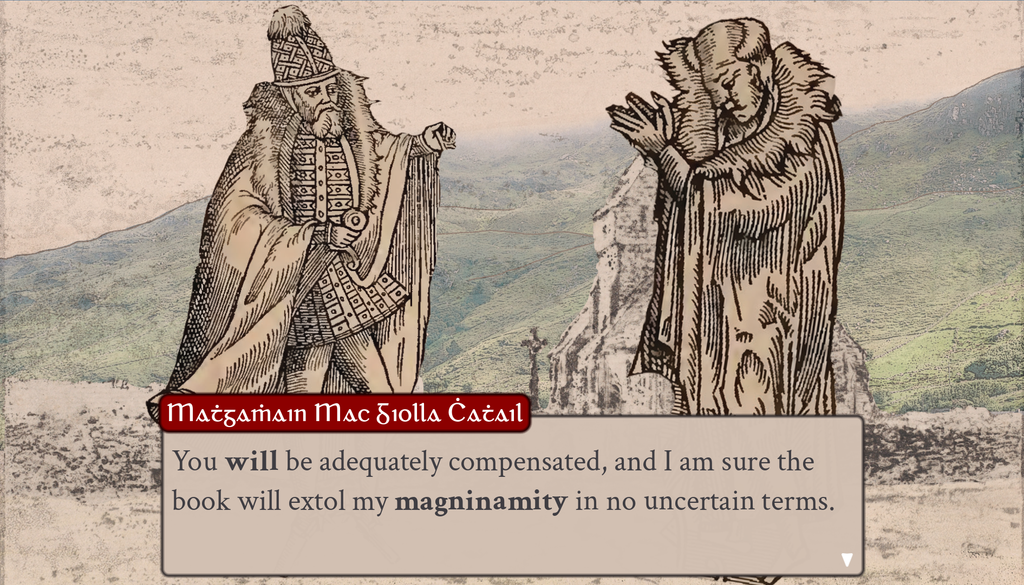
In the second chapter of Galar, the player character is an ollamh in seanchas: a high-ranking literato tasked with compiling annals to chronicle the last century of his patron’s lineage’s history.
Deciding how to fulfill these demands comprise the core of the gameplay experience. The ollamh protagonist must ensure the king is pleased with his work, deal with conflicts of interest among members of its oireacht (the local aristocracy), and add his own voice to the material – exercising what Conrad Hirschler [2] called narrative agency. There are no fail states, but different characters will attempt to encourage or dissuade the player into including certain passages and writing them down in certain ways.
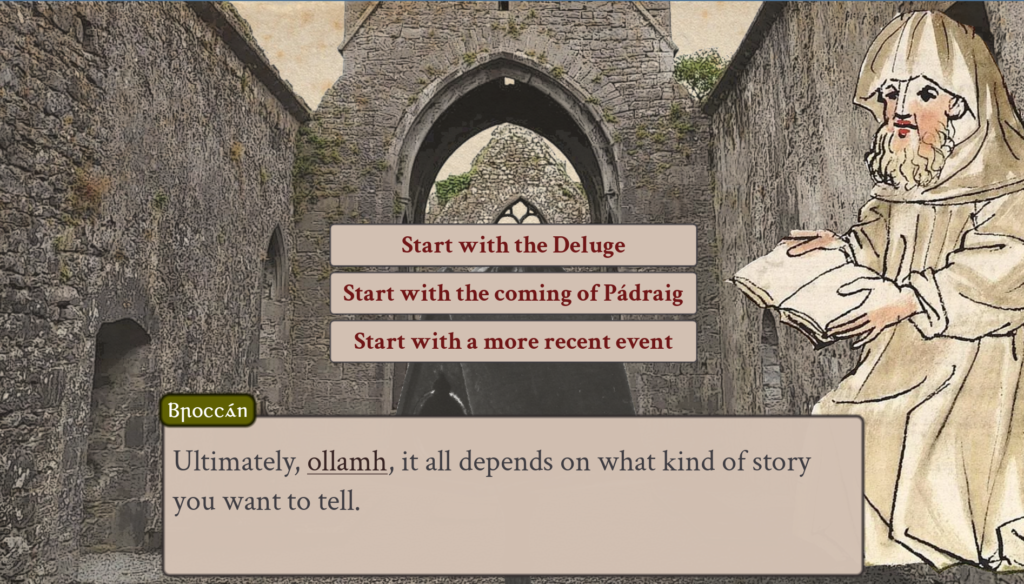
Structurally, the game is an example of the ‘gamic mode of history’: an attempt to map game mechanics directly into historiographical procedures. [3][4] This style of scholarly game design was much criticized by historical game scholars for its unwillingness to explore the unique affordances of the ludic medium [5][6]. However, it can be useful if employed critically, as a way to denaturalize and deconstruct ‘crystallized’ [7][8] historiographical biases.
In this particular case, such a critique can – to invoke this conference’s theme – help us reflect on medieval historiography as one surviving record of a broader space of possibilities, which document a society’s relationship with the non-human in ways that were neither simple nor set in stone. The game allows such possibilities to be explored to almost humorous level – for example, although the annal segment is supposed to cover the years 1315 to 1426, it is possible to complete the task without a single mention to the plague!
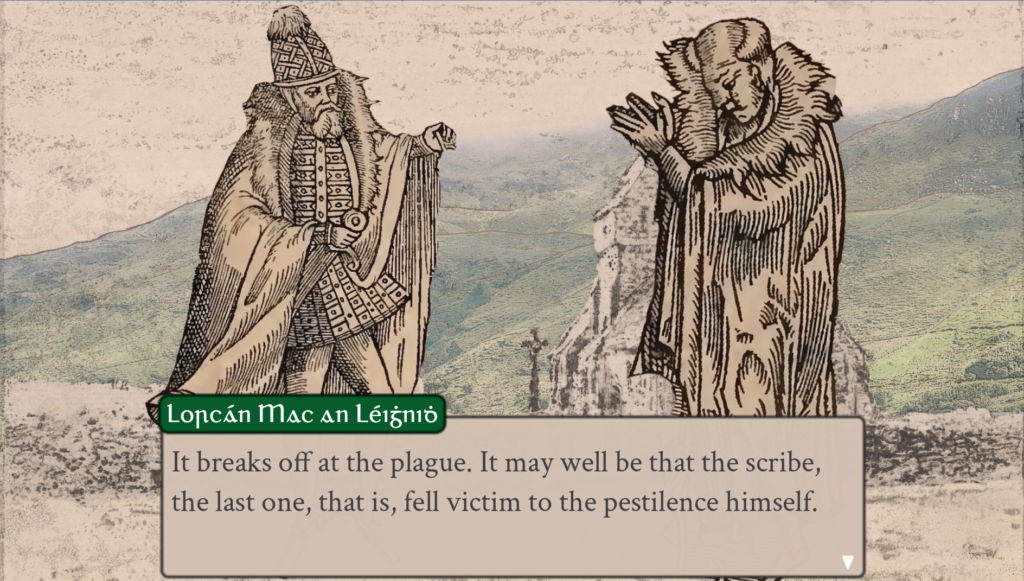
You can read more about the project here – and also here: [9]. Although the game is still in an early state, I’m very grateful to any feedback!
Thank you very much!
Ludography
Marino Carvalho, V. Galar. 2025-
References
[1] Morton, T. Hyperobjects: Philosophy and Ecology After the End of the World. Minneapolis: University of Minnesota Press, 2013.
[2] Hirschler, C. Medieval Arabic Historiography: Authors as Actors. New York: Routledge, 2026
[3] Clyde, J. et al. ‘Beyond the “Historical” Simulation: Using Theories of History to Inform Scholarly Game Design. Loading… , v.6, n.9, 2012, pp. 3-16
[4] Clyde, J. & Wilkinson, G. “More than a Game…Teaching in the Gamic Mode: Disciplinary Knowledge, Digital Literacy, and Collaboration”. History Teacher, v.46, n.1, pp.45-66
[5] Antley, J. ‘Going Beyond the Textual in History”. Journal of Digital Humanities, v. 1, n.2, 2012 https://journalofdigitalhumanities.org/1-2/going-beyond-the-textual-in-history-by-jeremy-antley/
[6] Houghton, R. ‘Beyond Education and Impact: Games as Research Tools and Outputs’ In: Houghton, R (Ed.) Teaching the Middle Ages through Modern Games. Oldenburg: De Gruyter, 2022, pp. 279-298
[7] Nguyen, C.T. Games: Agency as Art. Oxford: Oxford University Press, 2020, p.13
[8] On crystallization, cf. also Dewey, J. Art as Experience. New York: Wideview-Perigree 1934.
[9] Marino Carvalho. ‘History and More-than-Human Agency in Videogames’. Rethinking History, 2026. https://doi.org/10.1080/13642529.2026.2629215
Author bio
Dr. Vinicius Marino Carvalho is a postdoctoral researcher at Universidade Estadual de Campinas and one of the convenors of the Middle Ages in Modern Games conferences.
So excited to play this, thank you so much for your paper Vinicius! I was wondering if you could talk about the use of language in the game in relation to our theme this year – how does the use of the Irish language and names, especially where it is visually very different and so stands out, fit into the ideas we’re exploring here about possibility and futures? Is the intention that this language is read and used in gameplay? Is it language that is used now or is it an older form of the language that is revitalised in a way through play here?
Great question!
Many things in medieval Ireland are not easily translatable to English, so using Irish terms is a necessity (even and especially in academic scholarship). In the game, I’m currently using a glossary feature to help players navigate these words. You can see this in the word ‘ollamh‘ in figure 2. Hovering over the term opens the definition.
So far, entries are very basic. But I’d like to elaborate on the glossary feature and give them a ‘point of view’ – e.g. the glossay for Chapter 2, whose protagonist is a member of the old Gaelic learning classes, won’t be the same as the glossary in Chapter 3, whose playing character is a modern historian. That way, I hope to discuss how things and ideas get lost/misremembered/reinterpreted throughout the centuries.
I’m mostly using Modern Irish spelling in the game – whence ‘ollamh’ rather than ‘ollaṁ’, for example. But the meaning of the terms, in this part of the game at least, are specific to the 15th c. Thus ‘ollamh’ refers to the head of a bardic school, not a university lecturer (the current meaning of the word in Modern Irish).
The proper names also follow Modern Irish spelling, but I’ve decided to write them in cló gaelach in the name boxes. This is an older script with specific diacritics (that make the language much more intuitive to read and learn, if you’re familiar with it), that was used from the Middle Ages all the way to the mid-20th c. It’s meant to give a measure of temporal alterity, but it’s also my attempt to showcase this bit of the language’s history among people with little familiarity with it. To facilitate things somewhat, the names are written in Latin script in the text boxes.
I’ll have to give this a go and may have more to say then, but I like the idea of playing with reception of texts in games in this way.
I think my core question is who you see this as being pitched at – is it something you’re developing for classroom use, theoretical exploration, or would you like people outside those spaces to explore historiography in this way?
I originally envisioned it as a classroom exercise – specifically, for third-level and postgraduate history courses.
Yet, after showcasing it at the MAMG Workshop at the 2025 MAMO conference, I saw that it had a huge appeal as a ‘conference’ game of sorts. I.e. a game that is played and debriefed collectively by an academic audience – more like a performance than a solo game, if you will.
So this is the direction I’m leaning towards now!
I do see broader appeal for this!
It almost feels, in reverse, like how many Americans first learned of the Tulsa race massacre from the 2019 Watchmen TV series, and became more open to the fact their history books had omissions.
[…] Iceland)’– Emilio Marx & Ginebra Raventós de Volart, Acoustic Heritage Collective14h20 – ‘Playing the Irish Annals: Narrative Agency and the Gamic Mode of History’– Vinicius Marino Carvalho14h40 – ‘Sources and Serendipity: Experimenting with randomisation […]
I’ve played through your demo this several times now, and it is appropriately chilling given the subject matter. I wasn’t expecting such a poetic approach for a “novel,” and I enjoy how it leaned on more nebulous imagery. It left me feel like I wasn’t in control without the game itself seeming untethered – which can be difficult to achieve in an interactive medium. Between how interpretive and unsettling it is, I think this is a great foundation to demonstrate history isn’t as complete and objective as it’s often presented.
The second section sounds fascinating. I like the factors you want the player to weight, and the fact they can go kind of wild and still not “fail.” (Particularly on contrast to Chapter 3’s possible fail states.) One way or another, they’ve established the history that will be shared, and I could see this being eye-opening for students. Especially anyone who tries to omit the plague and still “wins.”
Is the plan to retain a fairly linear path, or allow for more haphazard research with the player able to move between various points to investigate and set information in stone. As natural as the latter feels, this also feels like a project that could lose cohesion with too few guardrails.
Thank you for this, and extra kudos for making it in Godot!
Thank you so much, Andrew! I means a lot to hear that!
Chapter 2 is relatively linear, in that it always starts with the player character receiving a commission, and always ends with the death of his patron. (His obituary is the last entry of the annal).
Whatever happens in between varies depending on the choices taken in part 1. The basic loop in these segments is: 1) the player’s assistant (the monastery’s scribe) brings up an episode, 2) the player makes a choice about it, 3) they move on to a following passage.
Some loops will have a small intro of their own, in which someone in the kingdom approaches the player character with a particular demand. The PC can chose to either accept or ignore it, and if it’s the former, it opens up new possibilities in the choice node (but doesn’t change the overall loop structure).
As for Chapter 3, it will also be relatively linear, but I want to create space for a good, a bad, and a bad (but actually best) ending. If the player character ‘survives’ (in a Reigns-style series of impossible choices), they will craft a perfect, but soulless and/or problematic dissertation (this is the ‘good’ ending). If they don’t survive, this triggers the bad ending.
The third ending, however, rewards players for ‘playing-to-lose’. To get it, it won’t be enough to simply fail your dissertation, but to act on some broader concerns regarding the nature of knowledge – very much what Leandro Wallace said in his keynote regarding ‘official’, written knowledge versus folk/alternative traditions!
I hope that answers it?