
I. Framework
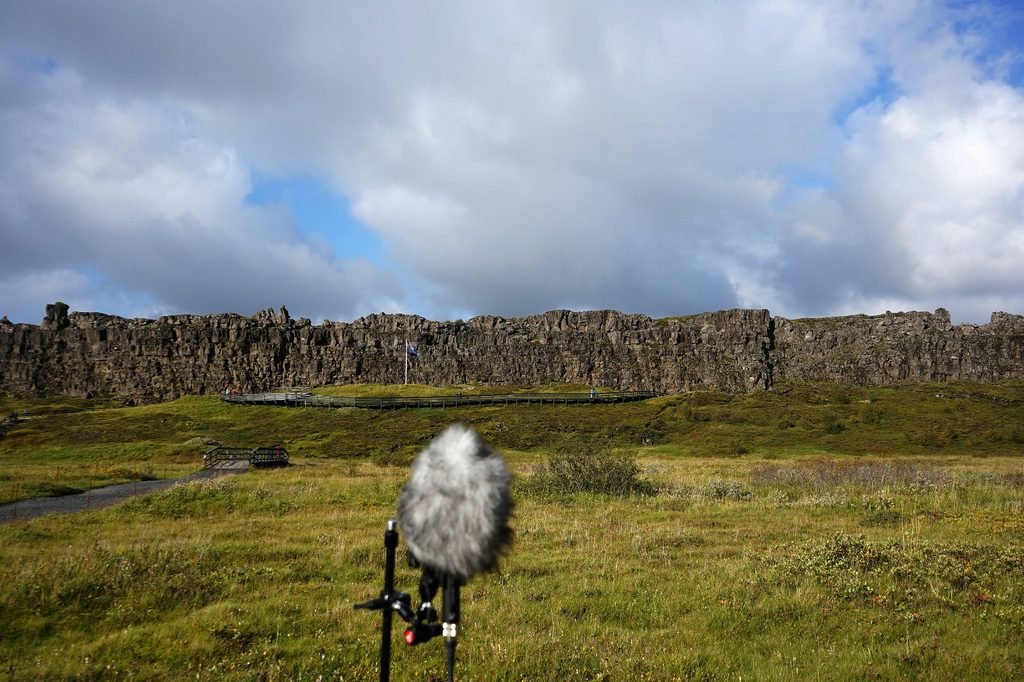
Þingvellir, or “the plains of the assembly,” sits on the Mid-Atlantic Ridge, one of the few places on Earth where you can walk between the North American and Eurasian plates as they pull apart a few millimetres a year. The rift and the cliffs of Almannagjá and Heiðargjá are the result of millennia of tectonic movement, eruptions and subsidence. Despite that instability, it was chosen as the political and spiritual centre of the nation.
In 930 Norse settlers founded the Alþing here, the first parliament in Europe. For more than three centuries Iceland was governed entirely through the spoken word: laws were recited from memory. At its heart stood the Lögberg, the Law Rock. The law speaker recited the law before hundreds of people; his voice had to carry some 20 metres from the cliff to the crowd. The amphitheatre-like shape may have acted as a stone auditorium, but this had never been verified scientifically.
II. The research
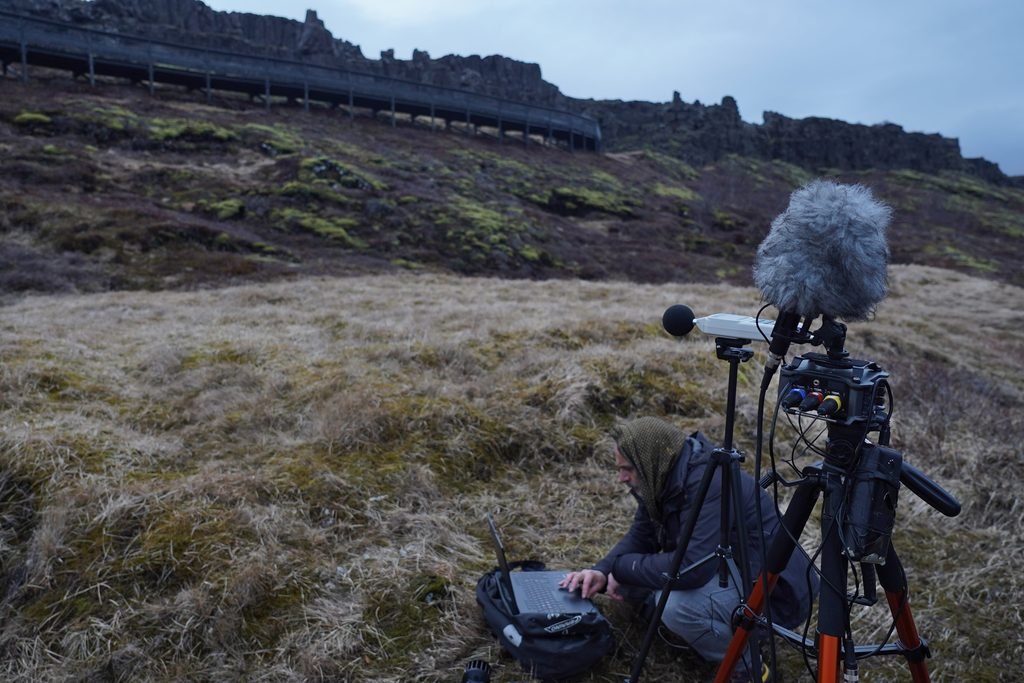
Over the past six years the Acoustic Heritage Collective has carried out a hybrid archaeo-acoustic study, combining in-situ measurements and digital simulations. On our first visit we made impulse response recordings that let us virtually reconstruct the voice at the Lögberg. This second visit explores its historical and symbolic dimension, combining acoustic engineering with humanity resources.
We also looked for clues in the sagas, working with chapter 141 of Njáls saga, which describes a scene at the Lögberg full of voices and tension. The word is an instrument of power, and is human fragility. The Lögberg is not merely a rock: it is a space of acoustic memory.
III. The Results
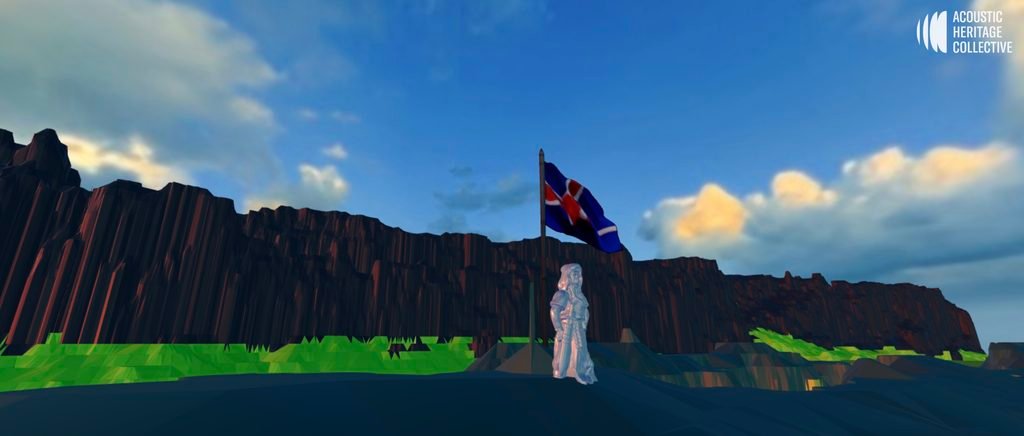
From these measurements and GIS models we have begun to reconstruct the auditory experience of a tenth-century assembly. The topography could indeed amplify and distribute the voice naturally. Echoes and reflections from the rock face acted as an invisible architecture, an ancestral acoustic technology. The experience presents the main findings of that research and invites the user to discover how sound behaves in this landscape and how its acoustics may have shaped one of the most experiences in Icelandic history.
IV. The Videogame Prototype (Beta)
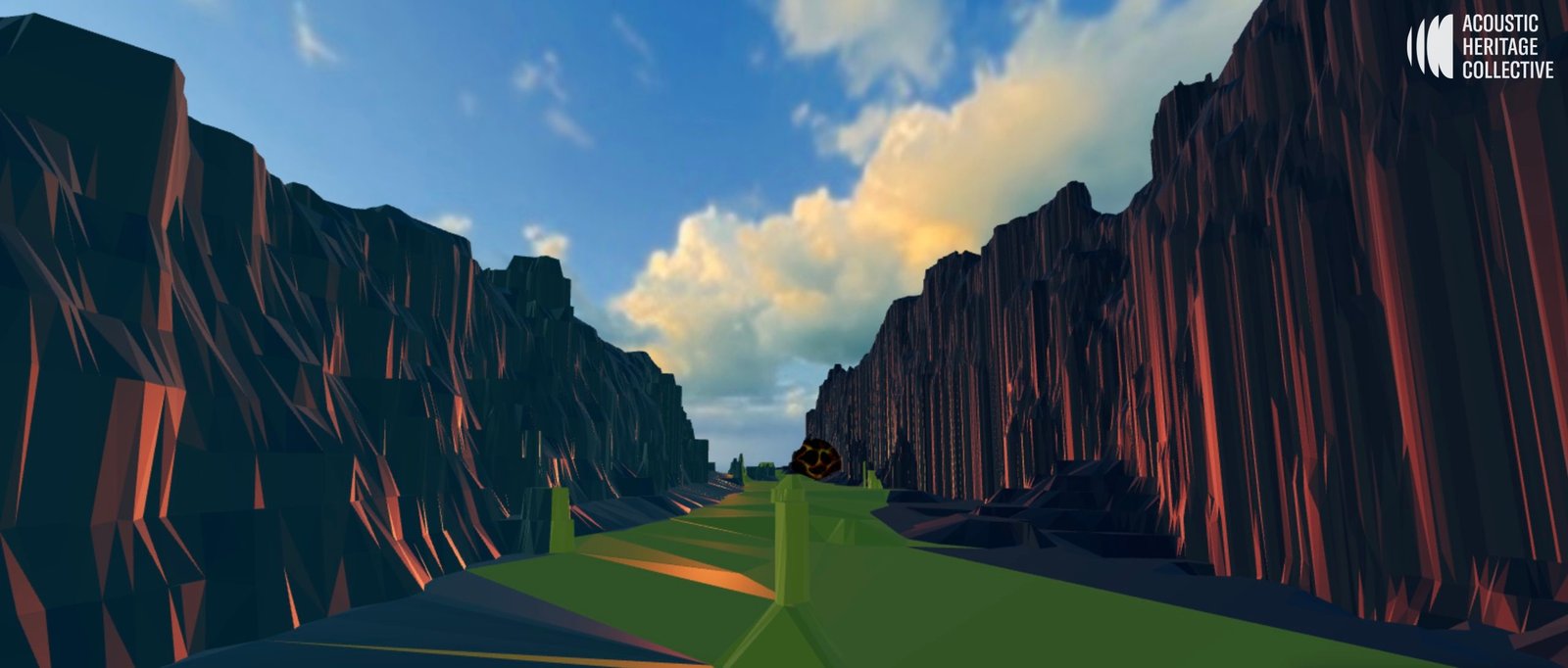
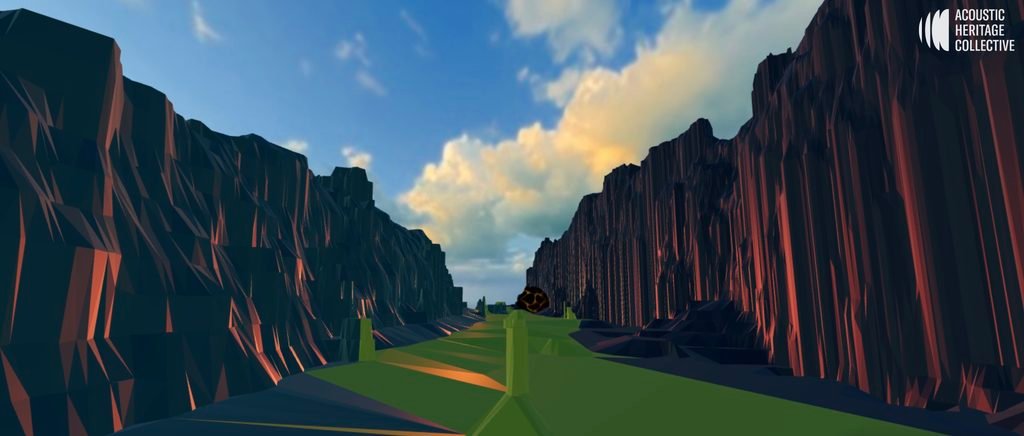
The user walks between the two plates. Along the way, objects attract attention visually and sonically. Picking them up reveals historical and acoustic context, and further information appears in the sky. The walk leads to the Lögberg, where the voice of the lögsögumaður proclaims Kafli 141. On the esplanade where the audience would have gathered, six numbered pink diamonds mark listening points. Moving between them, the user hears the full chapter and compares how the voice changes with the acoustic conditions at each position.
Kafli 141, it is still in development and not officially published. It is programmed in JavaScript with the Web Audio API to run in a browser. It can be used with VR glasses, but it is designed to democratize immersive and spatial audio for those who don’t have VR equipment. Heritage has to be accessible to all.
Availability
The prototype can be experienced at https://acousticheritagecollective.org/thingvellir/3d-vr/
Source code: https://github.com/acousticheritagecollective/thingvellir-3d-vr
Suggested Reading
Þingvellir, the Alþing and oral law
Bell, A. (2010). Þingvellir: Archaeology of the Althing (Doctoral dissertation).
Dennis, A., Foote, P., & Perkins, R. (trans.) (1980, 2000). Laws of Early Iceland: Grágás (2 vols.). University of Manitoba Press.
Einar Ól. Sveinsson (ed.) (1954). Brennu-Njáls saga. Íslenzk fornrit XII. Hið íslenzka fornritafélag.
Gísli Sigurðsson (2004). The Medieval Icelandic Saga and Oral Tradition. Harvard University Press.
Hálfdanarson, G. (2000). Þingvellir: An Icelandic “lieu de mémoire”. History & Memory, 12(1), 4–29.
Hannah, L. Þingvellir: A Place of Assembly and a Market?
Mehler, N. (2005). Þingvellir og þinghald að fornu: Framvinduskýrsla 2005.
Njáls saga, ch. 141. English translation: Cook, R. (trans.) (2001). Njal’s Saga. Penguin.
Sanmark, A. (2017). Viking Law and Order: Places and Rituals of Assembly in the Medieval North. Edinburgh University Press.
Þingvellir National Park (2021). https://www.thingvellir.is
World Heritage Committee (2004). Decisions adopted at the 28th session of the World Heritage Committee, Suzhou (WHC-04/28.COM/26). Þingvellir National Park, World Heritage List ref. 1152, criteria (iii) and (vi).
Geology of the rift
Guðmundsson, A. (1987). Tectonics of the Thingvellir fissure swarm, SW Iceland. Journal of Structural Geology, 9(1), 61–69.
LaFemina, P. C., Dixon, T. H., Malservisi, R., Árnadóttir, T., Sturkell, E., Sigmundsson, F., & Einarsson, P. (2005). Geodetic GPS measurements in south Iceland: Strain accumulation and partitioning in a propagating ridge system. Journal of Geophysical Research: Solid Earth, 110, B11405. https://doi.org/10.1029/2005JB003675
Sæmundsson, K. (1992). Geology of the Thingvallavatn area. Oikos, 64(1–2), 40–68.
Þingvellir National Park. Tectonic movements. https://www.thingvellir.is/en/education/nature/tectonic-movements/
Sound, space and acoustic heritage
Blesser, B., & Salter, L.-R. (2007). Spaces Speak, Are You Listening? Experiencing Aural Architecture. MIT Press.
Boren, B. B. (2015). Outdoor oratory and performance space. The Journal of the Acoustical Society of America, 137(4_Supplement), 2427–2428. https://doi.org/10.1121/1.4920282
Đorđević, Z., Dragišić, M., Manzetti, M. C., & Novković, D. (2020). Digitization of acoustic heritage in a service of protection, research and promotion of European cultural heritage. In Digital Cultural Heritage (pp. 433–447). Springer.
Mattioli, T., Farina, A., Armelloni, E., Hameau, P., & Díaz-Andreu, M. (2017). Echoing landscapes: Echolocation and the placement of rock art in the Central Mediterranean. Journal of Archaeological Science, 83, 12–25.
Murphy, D., Shelley, S., Foteinou, A., Brereton, J., & Daffern, H. (2017). Acoustic heritage and audio creativity: The creative application of sound in the representation, understanding and experience of past environments.
Rindel, J. H. (2025). Acoustical aspects of the development of Greek theatres in the 4th century B.C.E. The Journal of the Acoustical Society of America, 157(3), 2042–2066. https://doi.org/10.1121/10.0036255
Vorländer, M. (2020). Auralization: Fundamentals of Acoustics, Modelling, Simulation, Algorithms and Acoustic Virtual Reality (2nd ed.). Springer.
Zotter, F., & Frank, M. (2019). Ambisonics: A Practical 3D Audio Theory for Recording, Studio Production, Sound Reinforcement, and Virtual Reality. Springer (open access).
Tools and technical references
Cabello, R., & three.js contributors. Three.js (r161). https://threejs.org
Deppisch, T., Meyer-Kahlen, N., Hofer, B., Łatka, T., & Żernicki, T. (2020). HOAST: A higher-order Ambisonics streaming platform. 148th AES Convention, e-Brief 590. Source: https://github.com/thomasdeppisch/hoast360
Kerbl, B., Kopanas, G., Leimkühler, T., & Drettakis, G. (2023). 3D Gaussian splatting for real-time radiance field rendering. ACM Transactions on Graphics, 42(4).
Khronos Group (2021). glTF 2.0 Specification. https://registry.khronos.org/glTF/specs/2.0/glTF-2.0.html
Politis, A., & Poirier-Quinot, D. (2016). JSAmbisonics: A Web Audio library for interactive spatial sound processing on the web. Interactive Audio Systems Symposium, York.
W3C (2021). Web Audio API, W3C Recommendation, 17 June 2021. https://www.w3.org/TR/webaudio/
Author Bio
The Acoustic Heritage Collective is an independent group of artists and researchers who have collaborated for years under various names (Patrimoni Acústic, Sound Heritage Collective, Hoarfrost, Sessions Nocturnes). Their work spans sound installations, artistic residencies, music production, sound poetry, heritage preservation, and 3D/VR design, with support from Culture Moves Europe and the Government of Catalonia. Their pieces have been presented at IRCAM Centre Pompidou (France), MONOM Studios (Germany), Experimental Sound Studio Chicago (USA), Wave Farm, NY (USA) and Fundació Phonos (Spain), and their research showcased at La Sorbonne, the University of Iceland, King’s College London, the University of Kent, and Europeana.
Thank you so much for sharing this project with us – this is so fantastic! If I might ask a pretty simple question to kick us off: I’m curious about your choice to title this as an ‘Interactive and Immersive Heritage Gamification Experience’, could you explain a little more about why you went with this phrasing and what it covers?
What a fascinating project!
This question is more of a curiosity of mine: how ‘pristine’, for the lack of a better word, is present-day Þingvellir compared to medieval times? Have any changes – from environmental ones to more directly anthropogenic factors, like contemporary human occupation and sound pollution – changed how sound propagates in the valley compared to how it did in the past? (Given that it’s a UNESCO heritage site, I presume it’s reasonably well preserved, but still.)
Speaking of long-term changes, were there any *other* sounds associated with the place in the sources – e.g. the call of a particular bird species – that perhaps isn’t as common nowadays?
Thanks for this!
Which elements of the soundscape do you think are better and worse captured by this sort of work, and do you have thoughts on how to get that across to users? One of the main issues I’m thinking on looking at your demo is directionality, where my experience (besides having whole extra background noise levels from e.g. electronics in the room) is really shaped by the fact it’s coming out of a single speaker rather than a surrounding experience.
Also, one thing that I really noticed regarding the soundscape is that there’s no other/secondary people noise, which if there were hundreds of people around you would presumably have been very significant both as an extra source of direct noise and in the way that being in a crowd would mean lots of rough surface/cloth surrounding you to dampen the main noise? What were your choices guided by there?
My final question is about what you do and don’t choose to include visually – I get that the soundscape is the main question, but is there a reason why you a) chose to represent a very pared down, angular version of the landscape and b) chose to include a specifically anachronistic identity symbol in the form of the Icelandic flag? How does that play into how you represent the interactions of medieval and modern landscapes and identity, in your eyes?
Anyhow, thanks all round and I’d be super interested to hear thoughts on any of that – very interesting project 🙂
[…] 1 – Design case studies14h – ‘KAFLI 141”: An Interactive and Immersive Heritage Gamification Experience of the Acoustics of L…– Emilio Marx & Ginebra Raventós de Volart, Acoustic Heritage Collective14h20 – ‘Playing […]
Wow! What a fascinating project!
In our encounters with heritage, we often see the sound as secondary, and here it’s right at the heart of experiencing history. Sorry, I don’t have a question, just wanted to say it’s really cool and I would love to see/hear more projects like this!
Thank you very much for the paper. Do you think this game can be integrated in the undergraduate or perhaps even undergraduate history courses? If what, in what format?
This is an cool project. I can’t begin to describe how cool. Do you intend to branch out and make other locales or texts playable?
Such a cool project! I have often come across quite abstract discussions about how different senses carry different weight in the production of knowledge across societies and historical periods, so it is so wonderful to see a project that actually tries to make this experiential.
Most of the questions I had were already raised by others, especially about undergraduate teaching. One thing I was also wondering about is whether this kind of work might become even more interesting if put into conversation with the history of the senses and cognitive neuroscience. For example, in my home region, features of the local dialect shape which sound distinctions people become especially good or poor at perceiving in adulthood. That made me wonder whether societies in which law and political life depended so heavily on oral performance and collective listening might also have cultivated different forms of auditory attention or listening expertise.
I would be very curious whether there is any way to think about such differences historically, even cautiously, and whether a videogame or immersive reconstruction might be able to represent not only how the soundscape differed, but also how people may have learned to listen differently.