
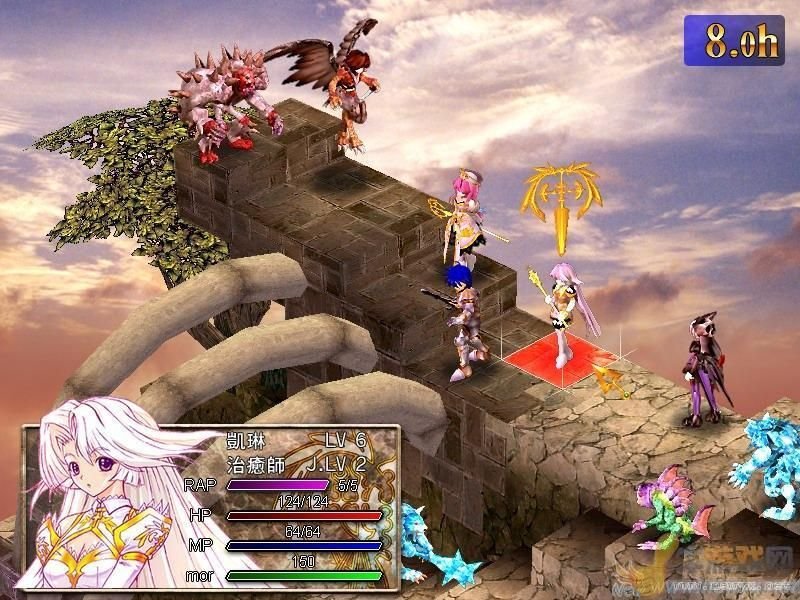
The Wind Fantasy series is a line of SRPGs developed by FunYours Technology, first released in 1999. It combines click-driven interactive narrative with turn-based tactical combat. In the early 2000s, the Chinese-language single-player market was dominated by Wuxia titles; its anime-style visuals and sword-and-sorcery worldbuilding attracted interest. It became a representative SRPG in early Chinese-language gaming. This article focuses on the third installment (The Song of Sin and Punishment, 2004) and the fourth (The End of F.L.S.D, 2005), which form a complete FLDS story arc.
Helen Young (2015) notes that “the Middle Ages” in fantasy carries “multiple meanings,” shifting with genre conventions and cultural contexts. In Wind Fantasy, kingdoms, churches, and knights are not replicas of European history but recombined cultural symbols. This article argues that the game constructs a distinctive fantasy medievalism, evident in the subverted relationships between the Holy City Niru, the supreme goddess Yemila, and secular polities.
The game is set on a continent created by Yemila. Niru’s leader, Archbishop Fain, does not aim to maintain divine order or protect human society. His true goal is to rebel against the goddess by triggering the “Original Sin Catastrophe,” ending the eternal curse imposed by Yemila after her betrayal. Fain’s disciple Fonie impersonates Archbishop Aisia and infiltrates the Sacred Flame Duchy. Discovering Fain’s intentions, she manipulates the Duchy’s king into assassinating the Winter Night Empire’s emperor, sparking war between two powers. The chaos delays Fain’s plan, forcing him to mediate among warring factions.
The narrative core is a revelatory reversal: the church appears to be a spiritual arbiter above secular states, but it is actually Fain’s political machine to defy divine law. Lars de Wildt (2015) argues that religious elements in games are often stripped of faith context and instrumentalized to add solemnity and mystery for worldbuilding. Holy City Niru exemplifies this: religious symbols are reorganized for a subversive narrative.
If Fain’s conspiracy desecrates religious authority, the ending contrasts it: theocracy is overthrown, but Niru does not disappear. Fain fails to kill the goddess; Yemila sheds her hatred and returns to the world; and Niru, led by the true Archbishop Aisia, turns toward reconstruction and neutral peace arbitration. This reflects Varini and Costalunga’s (2025) “double gesture”: the game “profanes the symbolic power of religious institutions while preserving the emotional meaning of spiritual practice.” Wind Fantasy criticizes the church as a tool of political manipulation without denying religion’s value as solace and civilizational carrier. Niru exists as a divine representative but as a neutral platform for cooperation.
Ultimately, Wind Fantasy does not reproduce medieval Europe. Geoffrey B. Elliott (2021) notes that mainstream fantasy has long been constrained by a “Nordic and Western European-centric” framework. Wind Fantasy offers a Chinese-language gaming perspective: it appropriates empire, church, and deities but assigns them an unconventional narrative of “the church resisting the divine.” It is not a copy of the European Middle Ages; within early Chinese-language RPG logic, it recombines these symbols through fantasy medievalism, experimenting in cross-cultural interpretation.
References
FunYours Technology, Wind Fantasy III: The Song of the Soul of Sin and Punishment, 2004.
FunYours Technology, Wind Fantasy IV: The End of F.L.S.D, 2005.
Helen Young, “Dreams of the Middle Ages,” in Fantasy and Science-Fiction Medievalisms: From Isaac Asimov to A Game of Thrones, ed. Helen Young, Cambria Studies in Classicism, Orientalism, and Medievalism, Amherst, New York: Cambria Press, 2015, pp. 1-9.
Michele Varini and Nicola Costalunga, “Sorrowful Be the Heart, Penitent One: Medievalism, Religion, and Cultural Memory in Blasphemous,” Actualdológica, vol. 8, no. 2, 2025, pp. 96-111, DOI:10.34135/actualdologica.2025-8-2.96-111.
Geoffrey B. Elliott, “Moving Beyond Tolkien’s Medievalism: Robin Hobb’s Farseer and Tawny Man Trilogies,” in Fantasy and Science-Fiction Medievalisms: From Isaac Asimov to A Game of Thrones, ed. Helen Young, Cambria Studies in Classicism, Orientalism, and Medievalism, Amherst, New York: Cambria Press, 2015, pp. 183-198.
Lars de Wildt, The Pop Theology of Videogames: Producing and Playing with Religion, Amsterdam: Amsterdam University Press, 2021, DOI:10.5117/9789463729864.
Very interesting, Lee! Do you see any relationship between the particular kinds of conflict depicted in Wind Fantasy and the narrative conventions of the Wuxia genre as a whole?
Is the church resisting the divine that unconventional at this point? The idea of evil or anti-divine systems having the trappings of the church as false prophets is a pre-medieval one in western thought, and there are certainly more recent versions of this trope in western games (see for example DOS2 as an obvious one, or godlikes opposing their own gods in Pillars/Avowed). I’d definitely say that this sort of anticlericalism in gaming has quite a wide background, and isn’t a million miles from mainstream western religious thought over the centuries, but if you have more thoughts on what other works this might be drawing on or reasons why this example is particularly outside conventional versions, I’d be interested to know.
Thank you for this perspective. In fandoms, the term “trope” often has a negative context, and at time justifiably so. But, that ignores it’s use in separating a media concept from its real world inspiration, and games like this really shine a light on that. Especially as Western fantasy already uses these as cultural symbols as well.
Out of curiosity, does this series also include elements explicitly derived from Chinese sources (history, legends, et cetera) and are they integrated with the Western fantasy elements, or separated?