

Introduction
Discourse surrounding Final Fantasy XVI (FF XVI) has framed it as medieval high fantasy (Medina 2020, Parrish 2023, Bowling 2025). The game seems to draw inspiration from dirtbag medievalism (Cook 2021). However, narratives and power structures reveal it as less medieval and more early-modern in nature. When FF XVI is analyzed through the lenses of early modern state formation and geopolitical competition over Mothercrystals, Valisthea’s it reveals a distinctly early modern political order where Dominants function as instruments of state power.
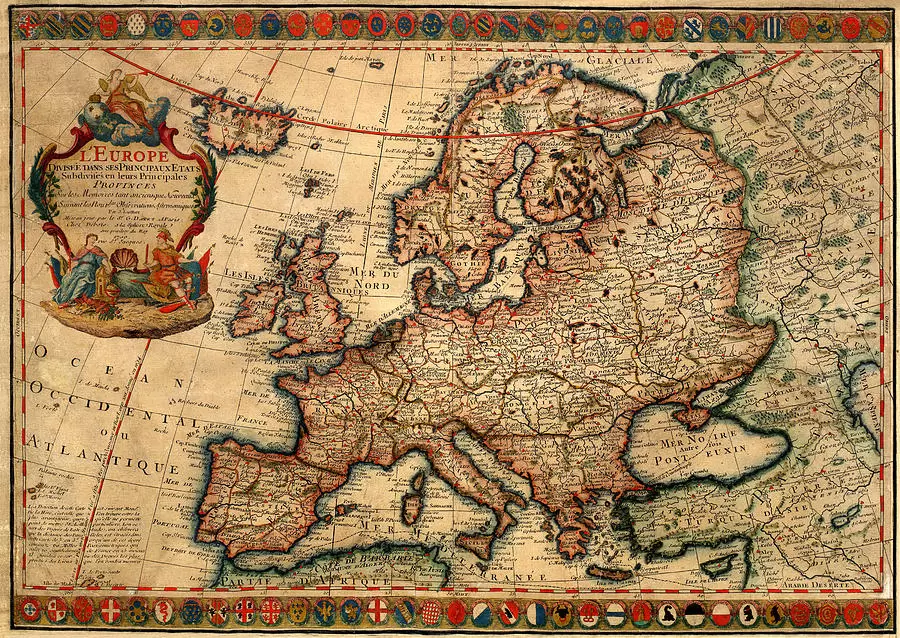
In the early Middle Ages warfare emerged from struggles for dynastic authority and tribute, with conflicts reflecting the personal and decentralized nature of political power and crusades offering a religious justification (Graff & Curry 2020). By the later Middle Ages, political warfare increasingly centered on dynastic succession and the territorial boundaries of kingdoms (Latham 2025). However, as Europe transitioned into early modern, warfare shifted toward competition among consolidating states for strategic territory, natural resources, and geopolitical dominance, supported by centralized systems of taxation and military power (Dunn 2000).
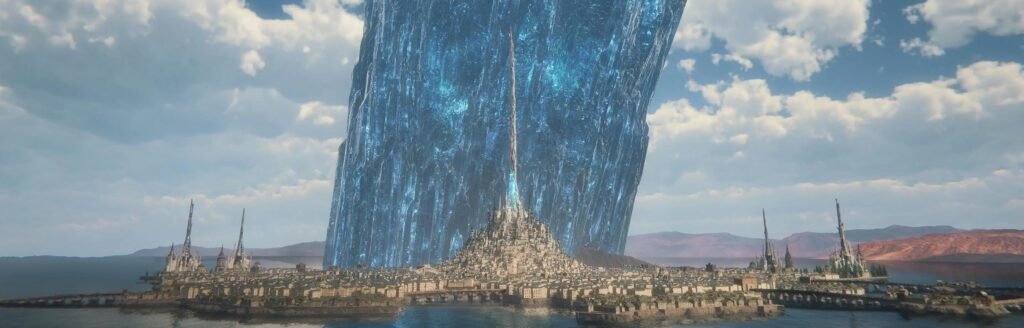
This early modern character is particularly visible in Sanbreque’s occupation of the Crystalline Dominion. Emperor Sylvestre annexes strategically valuable territory, relocates his imperial court to Twinside, and uses Bahamut, the Dominant controlled by the imperial state, as instrument of military power.
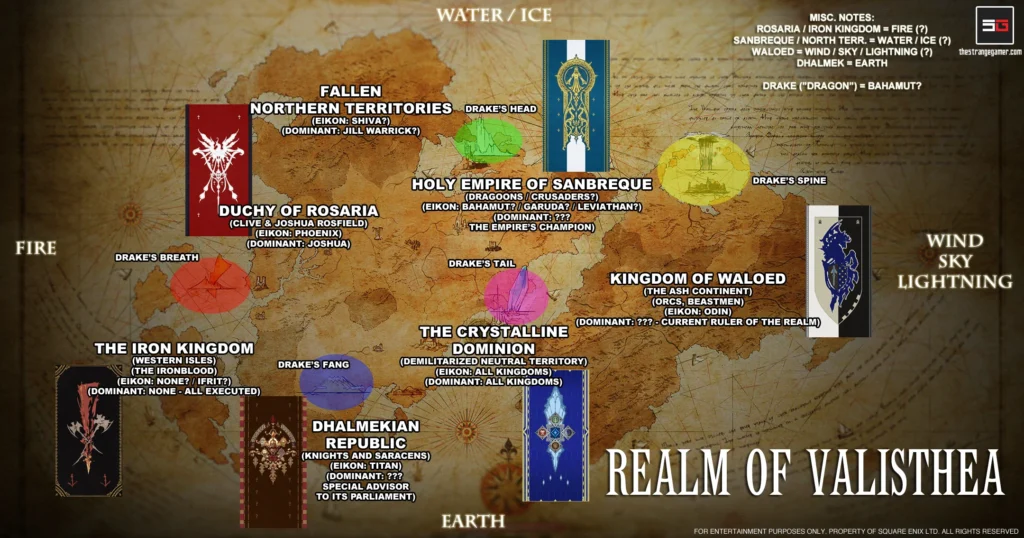
The game emphasizes this through scale. Dominants can destroy conventional forces and determine the outcome of an entire campaign. Their role resembles the increasing importance of state-controlled military technologies and specialized forces in early modern warfare. Obviously, Bahamut isn’t literally analogous to a cannon; but the important similarity is in who controls overwhelming military capacity and how it is incorporated into state strategy. More importantly, Mothercrystals function as strategic infrastructure that provide the aether that sustains the state, and they directly shape Valesthean political economy much like precious metals and resources shaped national development during the early modern period.
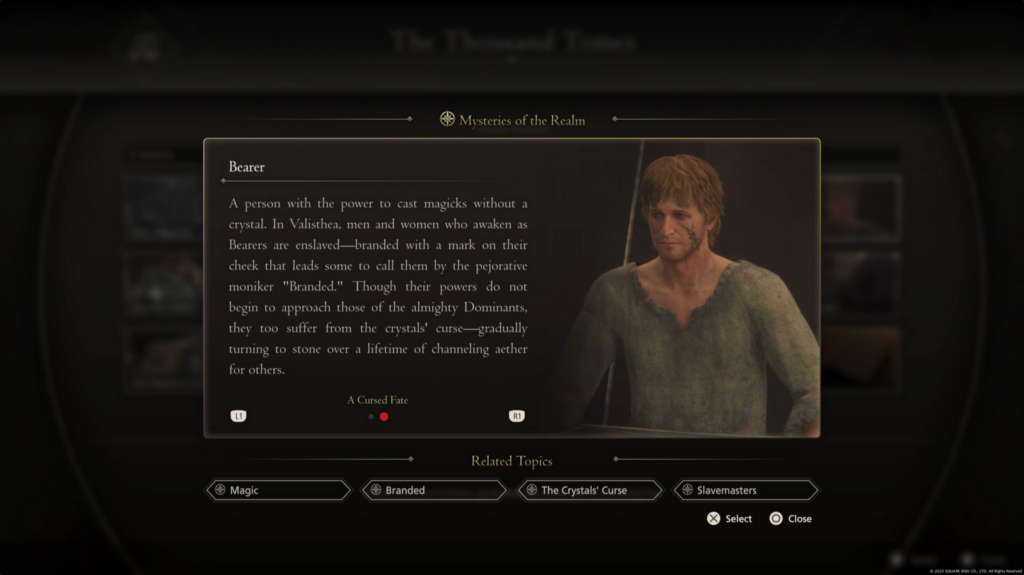
Valisthea’s political economy links environmental extraction to human exploitation. The Mothercrystals allow the extraction of aether while Bearers provide a parallel source of magical power through their coerced labor. Both forms of extraction are ultimately destructive: the crystals drain the land and contribute to the spread of Blight while the repeated use of magic gradually petrifies and kills Bearers. Valisthean prosperity thus depends on consuming both the environment and the bodies of an exploited population. By binding political authority to the exploitation of both natural and human resources, Valisthea transforms extraction itself into a foundation of state power.
In this context, Clive and Cid’s campaign against the Mothercrystals can be understood as more than a rebellion against individual rulers. Rather than redirecting the crystal’s power, they seek to destroy the material infrastructure upon which Valisthea’s political and economic order depends. Since the Mothercrystals sustain cities, economies, and military power while the states that control access to their aether convert that dependence into political authority, destroying them consequently the conditions that allow Valisthea’s extractive system to rearticulate itself.
Conclusion
Although this piece is, on its surface, just splitting hairs over whether a 21st century digital game is “medieval” or “early modern,” which might seem inconsequential, its importance lies in understanding that historical categories are not merely labels for dates. They describe power structures, economies, warfare, religion, and social organization. The boundary between the medieval and early modern worlds is specially messy since many supposedly modern developments emerged alongside institutions that remained recognizably medieval. Paying attention to those liminal spaces and contradictions allows us to examine transition itself rather than forcing a society into a category it only partially fits.
Game Cited
Final Fantasy XVI. Developed by Creative Business Unit III, Square Enix, 2023. PlayStation 5.
Works Cited
Bowling, Audra. “Final Fantasy XVI.” RPG Fan, 12 Feb. 2025, https://www.rpgfan.com/review/final-fantasy-xvi-2/.
Cook, Megan. “Dirtbag Medievalism.” Avidly, 14 July 2021, https://avidly.org/dirtbag-medievalism/.
Dunn, Diana E. S. War and Society in Medieval and Early Modern Britain. Liverpool University Press, 2000.
Faircloth, Kelly. “Why Are We so Obsessed with the Medieval Right Now?” History, Nov. 2025, https://www.nationalgeographic.com/history/article/dirtbag-medievalism-culture.
Graff, David A., and Anne Curry. The Cambridge History of War: Volume 2, War and the Medieval World. Cambridge University Press, 2020.
Latham, Andrew. “Why Medieval Wars Were Fought: Power, Borders, and Sovereignty.” Medievalists.Net, 3 Apr. 2025, https://www.medievalists.net/2025/04/why-medieval-wars-were-fought/.
Medina, Joseph Jammer. “Final Fantasy XVI Takes the Franchise Back to Medieval-Inspired Fantasy!” LRM, 16 Sept. 2020, https://lrmonline.com/news/final-fantasy-xvi-takes-the-franchise-back-to-medieval-inspired-fantasy/.
Parrish, Ash. “Final Fantasy XVI Has a Medieval Approach to Diversity.” The Verge, Mar. 2023, https://www.theverge.com/2023/3/1/23620217/final-fantasy-xvi-diversity-naoki-yoshida-interview.
Thank you for this, Johansen!
This whole discussing brings to my mind Josh Sawyer – and, in particularly, how he both positions himself as an authority voice for historical choices in Pentiment and Pillars of Eternity, as well as a ‘fan’ (for lack of a better word) of the Early Modern Period. (As seen, e.g. in Wright, 2024, ‘Layers of History’).
With that in mind, in the case of Final Fantasy, do you similarly see any historical arguments (or historical framings) in paratextual material? E.g. dev testimonies, artbooks, etc? Is this ‘tug-of-war’ between medievalism and reception of the Early Modern Period addressed in any particular way in such paratexts?
There is some paratextual evidence that the devs understood FF XVI through a Medieval-historical lens, but unlike Sawyer they don’t seem to articulate the Medieval/early modern distinction that I identify in the game itself. I recall interviews in Game Informer and elsewhere during the lead up to release where Yoshi-P was asked about the lack of diversity in the game and he doubled down saying it was Medieval-themed, and because he wanted a “medieval European classic fantasy look” (a line I will never forget) he wanted all characters to have that “European” look (as if medieval Europe wasn’t diverse, but that’s a whole other conversation). Maehiro has said likewise regarding the overall framing of the game. But what I find interesting is that, like public perception of Pentiment as medieval and the liminality of that medieval > early modern transition, devs (and often anyone without the full historical context) will make a distinction along the lines of “swords = medieval, guns = early modern” as if hand canons and other firearms did not exist in the late medieval period. But going back to Final Fantasy 16, I would not argue that devs consciously frame Valisthea as caught between medieval and early modern in the same way my analysis does, but it is implicit in the result (as they say “the proof is in the pudding”). But in the end, my reading is not so much to figure out “what is the dev’s intention?” as it is to identify the historical tension produced by the game’s porous construction of “medievalism.”
Yoshi-P’s statement about ‘classic European looks’ ties in neatly with something I just commented on Hanjun’s paper: on how people of European descent in many Japanese games are often coded as blonde and/or fair skinned, regardless of where they come from!
Thank you very much for this paper! I don’t know if I have a question so much as I have enthusiasm for the conclusion you’ve drawn. Far from splitting hairs about periodization, I think this case study succinctly identifies a key difficulty that Medievalists encounter when media that people engage with is called “medieval” but mobilises early modern, antique, or modern sociopolitical and economic structures of power.
Your suggestion to look at transition itself is really food for thought. I suppose I’m wondering (as much to myself as “out loud”) what strategies or benefits for looking at transition as an educational tool might be offered by games like FFXVI (and others mentioned throughout this conference) in particular?
I think the benefits are contingent on what we’re studying. When looking at history, they serve as a launchpad for the kind of framework students need to problematize and disrupt the neatness of periodization. In the case of FF 16, deciding whether Valisthea is medieval or early modern can in itself be the pedagogical tool. This also holds true when studying literature (what are the genre boundaries?) or, really, any type of media. If we’re studying games (think as in more traditional game studies), the question of genre is wide open to the point where games fit into several mechanical genres (LoZ:TotK being and action-adventure role playing puzzle sim, for example), but the question of temporality a lot less so. More often than not, things get classified neatly as “inspired by the classics” if it has greco-roman aesthetics, medieval if swords, modern if guns, or sci-fi if lasers and/or light swords, when the reality is a lot more complex. And if we’re discussing the learning experience as a whole, it is a tool for thinking outside the box. Instead of having students understand that things fit neatly into boxes, it teaches that some things either tick enough boxes in multiple lists to be considered more than one thing, or none at all. But ultimately, going back to history, my hope is that once students break away from neat labels they don’t see the in between periods as arbitrary movement from one age to another and instead conceptualize it as uneven coexistence and transformation of historical systems.
I’m a little wary about the simple sketch you give of decentralisation to tax-based centralisation being a quintessential medieval progression – at least insofar as the early to high medieval world absolutely did have pretty centralised tax-based states, they just weren’t in western Europe. Do you think there are ways in which you can easily identify the statism here as early modern in a way that differentiates it not just from, say, 10th century France, but middle Byzantium or Song China? And would that be a productive hair to look at splitting here?
100% in agreement that this is a simple sketch! I love the event but would love for the possibility of maybe double the word count to account for caveats like that. I think that is a productive hair to split, and I would concede that centralization and taxation by themselves are insufficient markers of early modernity. My initial formulation risks treating a specifically western European trajectory from comparatively fragmented feudal authority toward more centralized territorial states as though it were a universal medieval-to-early-modern progression. Byzantium and Song China rather obviously complicate that model. But to me the early-modern quality of Valisthea lies less in the existence of centralized tax-collecting states than it does in the particular constellation of behaviors those states exhibit: territorial consolidation and expansion, interstate competition, increasing concentration of military capacity, and especially the systematic mobilization of populations and strategic resources toward geopolitical power. That distinction might actually strengthen the argument because it prevents “early modern” from becoming synonymous simply with “strong state.” Middle Byzantium or Song China then become useful counterexamples rather than problems to avoid as they force us to ask which characteristics of Valisthian state behavior are genuinely diagnostic of the particular historical transition I am describing and which belong more broadly to the history of complex premodern states.
But I think there’s a more interesting argument hidden in your question. I think it might be worthwhile to consider that, perhaps, periodization describes historical trajectories, not dates or stages of political development. Political complexity does not move along a universal timeline, and treating it as though it does risks turning European periodization into a theory of historical development. To your last question, yes, I think it is worth risking historiographical trichoptilosis.
My familiarity with the Final Fantasy series is decidedly second hand. However, I’m curious if the political systems, beyond their ties to the economic, also lean towards later periods. This wouldn’t surprise me, as “Medieval” fantasy tends to lean more towards Absolutism. Granted, as a Japanese series, I’m not sure if such alignment is pertinent.
I also share the hesitation about mapping a specifically European chronology too neatly onto a Japanese production. At the same time, the developers explicitly constructed Valisthea through a medieval-European imaginary, so I think comparison with European political development remains pertinent provided that I treat it as one historical framework the game draws upon rather than as a universal developmental model. I think the political structures in FF 16 do provide another avenue for that argument, although I would hesitate to characterize Valisthea as uniformly absolutist. Sanbreque comes closest: while the five cardinals formally possess political authority, the emperor can effectively override them, and under Sylvestre the empire combines increasingly concentrated monarchical authority with territorial annexation and an organized imperial military. Waloed offers a different version of the same tendency, having emerged through Barnabas’s conquest and political unification of previously divided peoples across Ash. What makes this particularly interesting is that Valisthea contains competing political forms rather than a single model. Dhalmekia is a federation governed through a parliament of ministers and Rosaria retains something closer to a dynastic and aristocratic polity. I think the later-period resemblance lies less in “absolutism” itself than in the coexistence and competition of increasingly territorialized states with quite different constitutional arrangements.
Other FF games, however, would require different models and analyses. 7 and 7 Remake, for example, depict a sort of neo corporatocracy or company rule, while 6 is closer to fascism / technofascism, and no one really knows what has happening in 8 with school directors making child soldiers. I think the strongest candidates for medieval Fantasies beyond aesthetics are Tactics and 9, but all others exist in this sort of liminal space.
[…] 6 – Morality & Ideology I14h – ‘Between Feudalism and Empire: Liminal Temporality and (un)Grounded Aesthetics in Final Fantasy XV…– Johansen Quijano14h20 – ‘Reimagining Medievalism in Chinese- Language Games: Wind Fantasy […]