
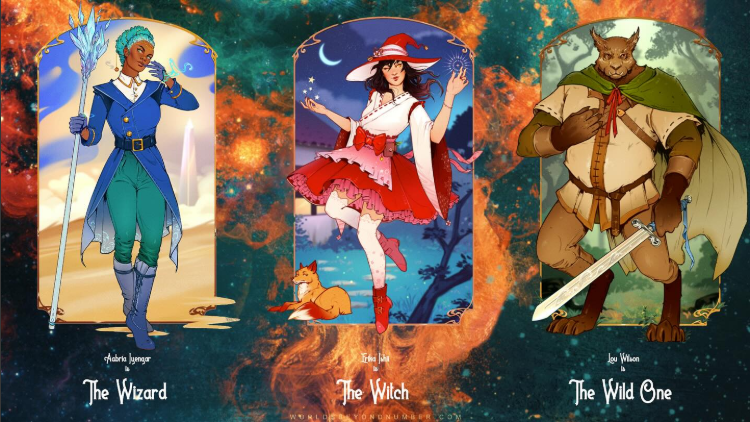
Works of high fantasy have long drawn on real-world historical and sociocultural phenomena for inspiration; The Wizard, the Witch, and the Wild One (Erica Ishii, Aabria Iyengar, Lou Wilson, and DM Brennan Lee Mulligan), is no exception. The inaugural DnD campaign of the actual play podcast Worlds Beyond Number exhibits thoughtful world-building grounded in multicultural historical and literary references for both the creative and mechanical inspiration behind the world of Umora. While implicit medievalisms litter WWW, this paper is interested in aspects of world-building explicitly called “medieval” by the cast. In two instances, artistic choices inspired by medieval Christianity communicate a sense of institutional domination, revealing how the medieval aesthetic remains an image of Church oppression and violence in popular media.
Mechanically, Brennan expunges the Cleric Class, moving away from the difficultly monotheistic nature of divine pantheons in the DnD system in favour of a Japanese and Celtic-inspired world of spirits mediated by the homebrewed Witch Class (WWW#5, 1:30:58-1:31:32). Moving away from Christian-coded religious mechanics echoes a main theme in the campaign’s narrative: opposition to oppressive universalistic institutions. This theme is reiterated through explicit medievalisms deployed in the imagery and musical motifs used in the descriptions of both the Kassov collection and the city of Carrow: sites of imperial oppression perpetrated by the Citadel wizards to control magic as a resource of the Empire.
In the Kassov collection, an art gallery in the Citadel where spirits declared “dangerous” are incarcerated (WWW#18, 1:46:21-1:51:44), the PCs enter an immense space with freestanding walls upon which hang “ancient” artworks. It is reminiscent of the interior of a cathedral – a sense exacerbated by the Gregorian chant overlaying the scene (WWW#19, 0:56:21-0:59:15). Mulligan describes “medieval style” paintings of bizarre creatures: imprisoned spirits. Together, the Gregorian music and explicit reference to the strangeness of medieval art styles contribute to a sense of Otherness and unease in this space where the PCs glimpse divine-adjacent entities within a prison designed to entrap the divine.
The implements of incarceration resound with the medieval, as does one of the more malevolent spirits the PCs encounter there: Obalfind, a “gargoyle-esque figure” who has spilled “wine red as blood” (WWW#19, 1:18:43). Gargoyle imagery reappears later in the description of Carrow with its “tall spires, oppressive stone, architecture both gothic and absurd.” Its architecture results from the war between future Citadel wizards and wizards opposed to joining the Empire, during which “the thousand, thousand gargoyles of this city were animated to service.” After the war, “the gargoyles returned to stone in the midst of their endeavours,” leaving buildings “crenelated with imposing beaked grotesques and gothic figures of monsters” (WWW#50, 0:25:00-0:28:49). In such imagery, the oppression of imperial expansion and the monstrosity of exploitation which won the Citadel wizards their war are made explicit.
These are not the only instances where imperial oppression or that of other institutions in Umora are depicted. Nevertheless, the ‘medieval’ here, particularly the medieval religious, is employed in its popular capacity as an aesthetic of violently oppressive hegemonic institutions.
I think it’s fascinating to see how people project contemporary fears of oppression onto the medieval past. Especially when such fears are not really obvious, or involve contentious elements (e.g. I’ve had several students associate medieval oppression with “taxes”, which is arguably a symptom of our morality bankrupt neoliberal society more than anything else).
Anyway, I digress! About the actual play itself: I’m curious about the Celtic-coded religion chosen in lieu of a Christian inspired faith. I have a forthcoming chapter on depictions of Irish mythology in games, and these sorts of associations always pique my interest! Can you share more about this bit of lore in the campaign?
Thank you for your question, it would be a delight to talk about the world of spirits.
I’m going to try to condense hours of really rich world-building that isn’t “complete” because the podcast is ongoing, so I am sorry if anything is incoherent. In game mechanics terms, Umora is the material plane where the humans live, and then there is a world of spirits which is assimilable to the Feywild of DND. But narratively is very inspired by the spirit worlds we see in studio Ghibli films. In their Fireside talkbacks, the cast (and Brennan in particular) have talked about how studio Ghibli & Irish folklore are the direct Inspirations for the spirits and the spirit world. There isn’t a specific pantheon of spirits that act on Umora, but different spirits that are recognised in different parts of the world, ranging from Great Spirits, such as Naram of the Gentle Sea who taught the humans how to fish in the sea and who can control the currents and ocean storms, or his wife Orima of the Reaching Green who is depicted as a forest of devorous kudzu choking villages in her anger, to lesser spirits such as a coal spirit they find forgotten in a corner of the ice palace of the Witch of Wind and Stars. Though the spirits live in and come from the spirit world, some of them (such as the great spirits) also “have responsibilities in”, live in, and act upon the world of humans.
In that sense, the spirits are not “gods” in the human world; they did not create it and many of them are actively hostile towards it (this is both plot related and part of the multifaceted nature of spirits in Umora). Brennan has assimilated them frequently to they fey people of celtic legend. They can also be “wayfared” or cut off from access to the spirit world if they, for example, are fed or bathed (“tamed”) by humankind. Spirits are called “wild ones” and “honoured friends” by humans, and great and small spirits should be respected and honoured. Though I think a defining factor is that the cast wouldn’t call it a “religion” as such, there are elements of the power of spirits to act in the world and their out-of-time-and-space-ness that makes them divine in a fantasy world that is trying, it seems to me, to show how the world itself and everything within it is divine. And to that end, part of the witch’s job of mediation is the maintenance of ritual temples or altars throughout the land, and teaching the people of Umora how to honour the local spirits with offerings (e.g. food left on Orima’s altar which, in honouring her, also magically restrains her from doing harm to humans so long as the offering is maintained).
Some elements of how spirits exist in Umora that are especially influenced by Irish mythology (especially as recognised by the cast and to which I can speak a bit) is (1) the importance of naming and the idea that names hold power or the ability to exert power over someone, so many spirits have many names which are not necessarily their true names; and (2) that passage between the spirit and the human world, or in some cases the exertion of spirit magic in a space, distorts temporality experienced by the characters.
I don’t know if I have really commented so much on the Irish and Japanese inspiration as much as synthesised some lore but I hope this has been helpful in some way. I’m definitely happy to talk more about it!
It definitely has been helpful! I’m less interested in how ‘accurate’ the lore is as a representation of mythology (if such a thing is possible at all) than in what kinds of associations get brought up by it. For example: I find it interesting that the matter of naming came to the cast via Irish mythology. You can find this in many distinctive and independently developed cultures, but this particular association is illustrative of the cast’s cultural background and/or research – and the influence of Irish mythology in contemporary pop culture!
A follow-up question (this time as a Ghibli fan, not an Irish scholar): Ghibli movies have acquired the reputation of being ‘wholesome’ – and, in fact, even in Japan, there’s an entire cottage industry reinforcing this interpretation. But I always thought this missed their point. In my reading, at least, they are less about balance and more about the fact of the human condition being incompatible with it. Whence Sen’s willingness to join Ashitaka in Princess Mononoke, the bath house from Spirited Away being populated by spirits of places that have been destroyed, Nausicaa letting nature run its course, humanity be damned; pretty much the whole of The Boy and the Heron. I come out of Ghibli movies desolated, not uplifted (maybe I’m the problem, but still…)
Does the world-building incorporate these darker sides of the Ghibli ouvre?
To your first comment, absolutely the Irish inspiration is a deliberate inclusion by Brennan who is American of Irish descent and talks very openly about how he tries to incorporate Irish mythology in all his (at least public) DND world-building.
Concerning the Ghibli inspiration, I am unfortunately the last person on earth to watch these movies it seems, but what I have come to understand is that all the films (even the so-called cozy or whimsical ones) have growing up during war as an underlying theme. Which is ultimately also an underlying theme of WWW. As someone who hasn’t seen Ghibli films, I can’t say what of the darker themes WWW draws. However, the cast frequently jokes about how one of the characters, Suvi (the wizard), is “in a different Ghibli movie” to the others specifically in moments where a scene with Suvi is stressful, heavy, borderline horrifying in it’s involvement with different kinds of systemic violence and the making of war; a scene juxtaposed by one where Ame (the witch) and Eursulon (the spirit) are having what I can only describe as a whimsical, cottage-core experience. So my sense is that the creative inspiration of the podcast does indeed draw from the darker Ghibli themes. Off the top of my head I can’t pull specific time stamped examples, though, I apologise !
“the difficultly monotheistic nature of divine pantheons” is one of those exciting lines that’s both very understandable and in a literal sense a contradiction in terms – and I think that’s one of the complex elements at the heart of this, reading past religion into a very specific model of modern religion in a way that clearly brings meaning for people but I do sometimes worry loses a lot in the retelling. And the fact we do this to a point where D&D’s largely polytheistic religions are inherently read as pseudo-institutional-Christian is interesting.
All that said, I feel like this can maybe end up with a slightly misjudged prescription and I’d like your thoughts on this. In general spirit-based religion that doesn’t have the *trappings* of Christianity doesn’t actually leave behind a lot of the potential for individual oppression, it just potentially re-centres it on less institutionalised structures of community and leadership (if it even does that: whilst it’s far from my area, the interactions between traditional Japanese religion and the Imperial cult are something that feels like it might want unpacking if we’re looking at this dichotomy of religious centralisation).
So to try and turn all that into a question – are we partly here seeing people reacting to religious matter based more on vibes than a consideration of the power structures behind them, and do we risk ending up demonising past people by painting a religious backdrop that permeated their ways of thinking as inherently oppressive rather than also being in part a language through which both oppression and liberation could be expressed? On the same token, is there a risk of rejecting the trappings of the western medieval due to that instinctive connection with oppression (and the related themes of whiteness and colonialism and so on that it has long been evoked to support) but then ending up being relatively uncritical about any structure or system that is different from or opposes that?
Thank you very much for these questions – they are very much ones I have been asking myself in my reflections on WWW and it’s world-building. I’m not sure I have fully formed answers, but I do have some contemplations.
Re this: “In general spirit-based religion that doesn’t have the *trappings* of Christianity doesn’t actually leave behind a lot of the potential for individual oppression, it just potentially re-centres it on less institutionalised structures of community and leadership” – I completely agree, and the narrative of WWW such as it is at 54 episodes seems to as well. The Coven of Elders, made up of the 5 great witches of Umora at the time of the story’s telling, are essentially a non-institutional structure whose responsibility is to administer to “domains of great truths” (The Self, The Community, Flora, Fauna, Darkness/Unknown) that touch both the material world and the spirit world. And though they are not an institution of colonial power in the world like the Empire and it’s Citadel, they are shown to exert profoundly devastating oppression on individual levels between themselves, upon young witch apprentices, and upon members of domains they do not consider themselves responsible for. Which, of course, has ripple effects upon entities in the rest of the world. So, to come to a partial answer to your second question: something that WWW is doing quite consciously (Brennan speaks about it often on the Fireside talkbacks) is refusing the premise that just because there is an enterprise coded to white western industrial colonialism (the empire and it’s Citadel), that the other systems of power that exist in the world do not enact oppression or violence just as viciously in other ways. But remarkably, the way the non-institutional oppression is rendered aesthetically is not inspired so explicitly by medieval Christian aesthetics. At least, not to this point.
To your first question, it’s hard to say whether Brennan and their audio direction were responding to religion based on vibes or to the power structure behind it; I almost feel that the two are inseparable in some ways. Perhaps it is my subjective experience, but when my students reject religious aesthetics in medieval texts, it is based in some rejection of the institutions/power structures they associate with religion in our post-colonial, nominally secular world. Which I do think, whether consciously or subconsciously, motivated the aesthetic choices in WWW in the instances where they link specifically imperial oppression to religious aesthetics. That said, it’s specifically medieval religious aesthetics that get the short end of the stick in WWW, so to speak. “Secular” motifs (or, motifs perceived as secular by non specialists), such as knights and knightly quests for honour, play a really positive role in the world building and are a direct inspiration for one of the PCs: Eursulon, a spirit and the party’s paladin.
These are just some initial thoughts, so thank you for your questions, I am going to keep them in mind as I think more on the topic!
Yeah, I totally agree that it’s incredibly difficult for students (or indeed academics) to read religion with less of that modern lens.
That said, I think it’d be really interesting to try designing a game around or presenting students with texts chosen to help to read against that religious grain: things like focusing on the ways in which peasant rebellions addressed criticism of the state in explicitly religious terms, or indeed the ways in which some states used specifically religious framing as their reasoning for keeping the nobility in check and stop excessive surplus extraction against the peasantry (there’s some of this in Byzantium for example). Or some of the more esoteric and much harder to read as institutional-power-based religious writers: things like Julian of Norwich, or the Sufi hagiography of Rab’ia. Or things around exploring the role of the cleric as advocate, and by no means always on the wrong side of the argument, could also be interesting: the accepted institutional nature of the church is what gives those people the capacity to support their community and intercede with states and leaders in ways they couldn’t do otherwise.
I completely agree! My doctoral work was on female mystics (notably Hildegard of Bingen) and one of the many striking things about her as a historical figure is how she obtained and wielded institutional power that allowed her to move in the world in a way she couldn’t have otherwise. I absolutely think that greater exposure of students to these kinds of texts and figures is essential to deconstructing this anachronistic idea of medieval religion. And for an audience both inside and outside the classroom, a game deliberately designed to deconstruct modern ideas of religion when approaching the medieval is delightful and I think has so much potential creatively, intellectually, and politically.
[…] Medievalism in Chinese- Language Games: Wind Fantasy III and IV’– Quangang Li14h40 – ‘Medievalisms and Opposition to Institutionalised Religion in Worlds Beyond Number: The Wizard, th…– Hannah […]