
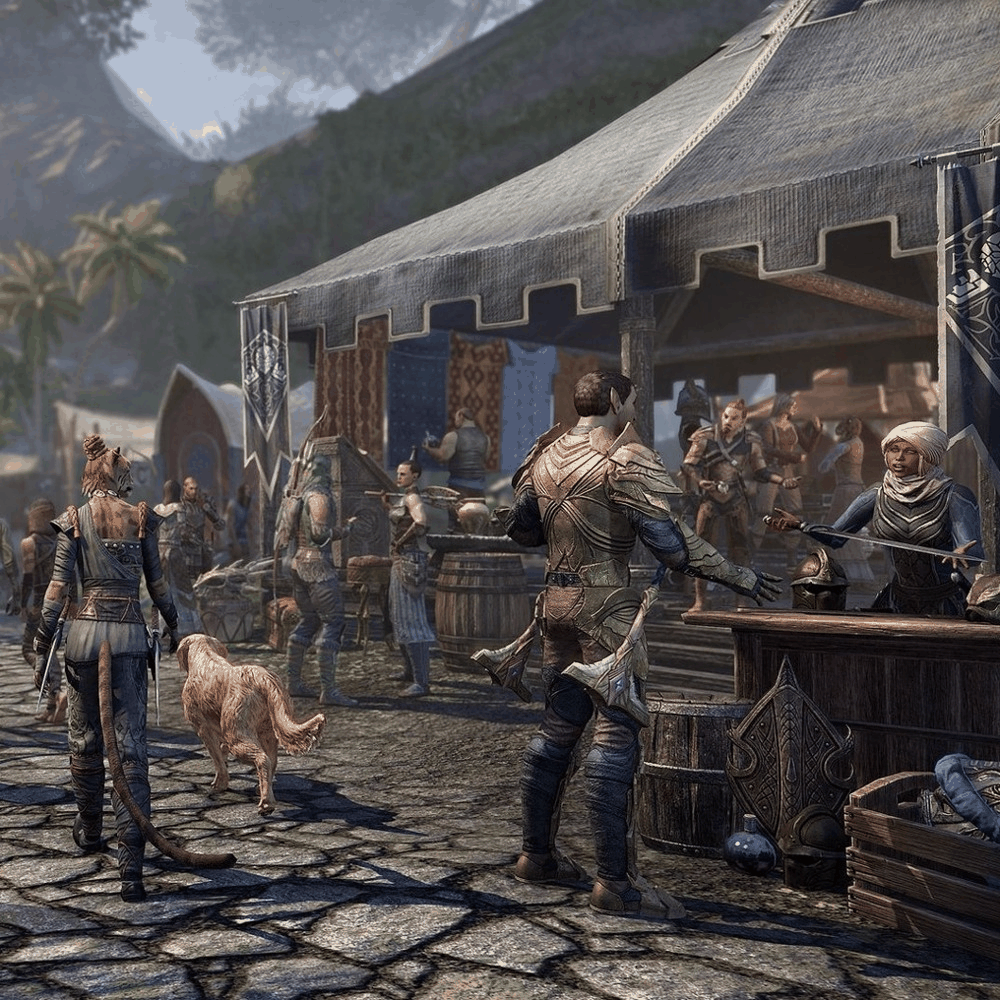
Trade is a fundamental but often overlooked element in the construction of Tamriel. Across The Elder Scrolls series, ports, markets, roads, merchants, and caravans do more than provide gameplay opportunities: they create the impression of a connected and inhabited world. Medieval commerce depended not only on the movement of goods, but also on the circulation of people, information, and relationships between distant communities. Rather than reproducing a specific historical economy, the series draws on recognisable forms of pre-modern exchange and mobility to construct a coherent medievalist possible world.
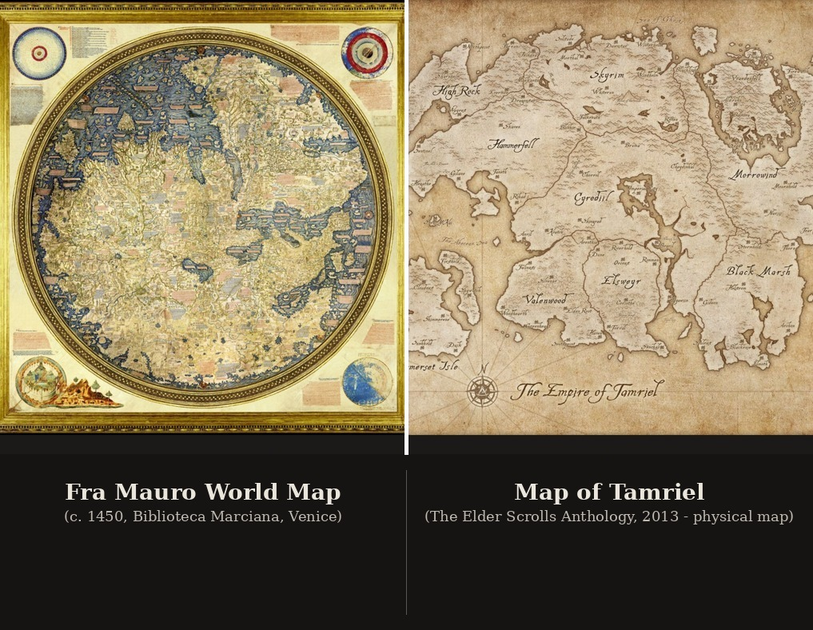
1. Ports and Maritime Networks: Connecting Tamriel by Sea
Medieval ports connected communities, merchants, commodities, and information through networks extending far beyond individual settlements. Although only fragments of these networks were visible at any given location, ports functioned as gateways to wider systems of exchange.
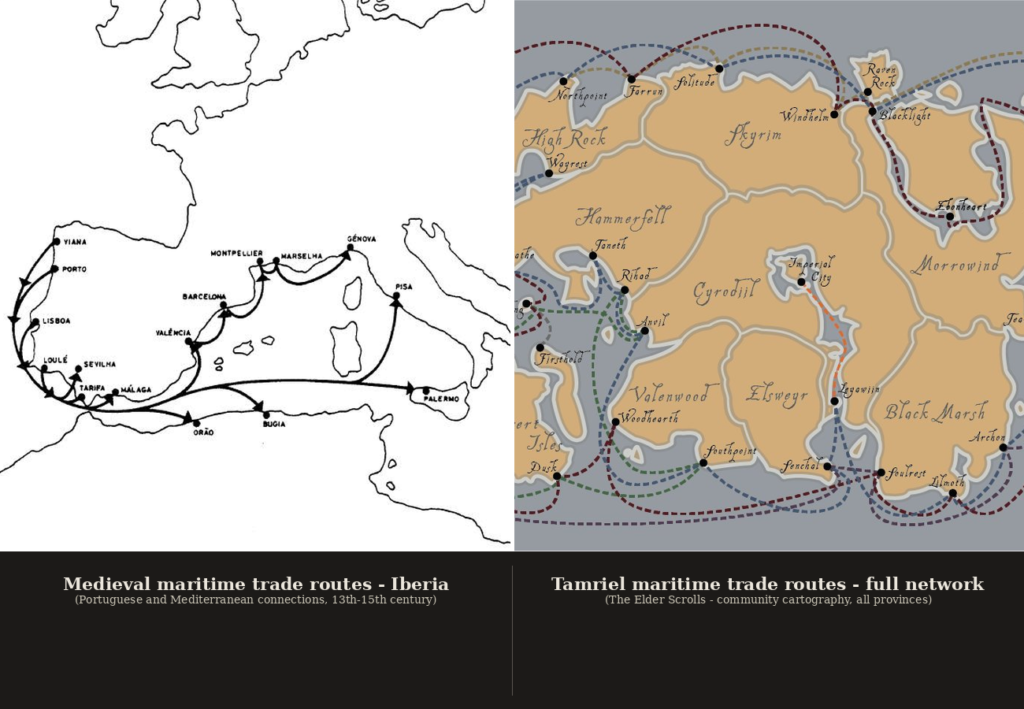
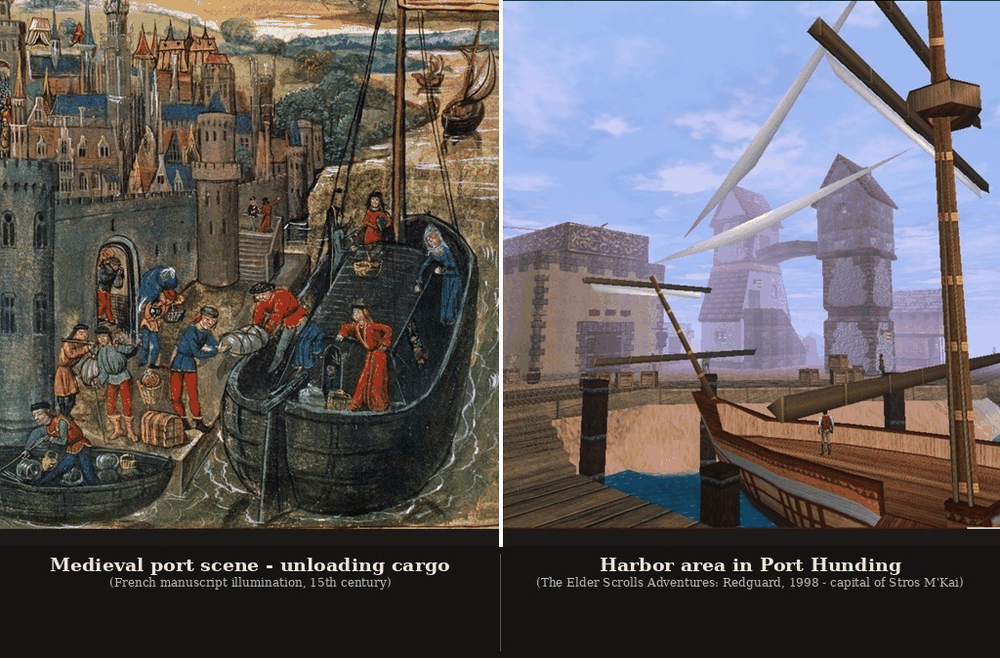
The Elder Scrolls employs a similar logic. In Redguard, Port Hunding presents Stros M’Kai as part of a broader maritime world, while Morrowind develops this idea through settlements such as Vivec and Ebonheart, as well as through the activities of the East Empire Company. The player encounters ships, merchants, and imported goods, but rarely the complete routes linking them together.
2. Cities and Markets: Making Commerce Visible
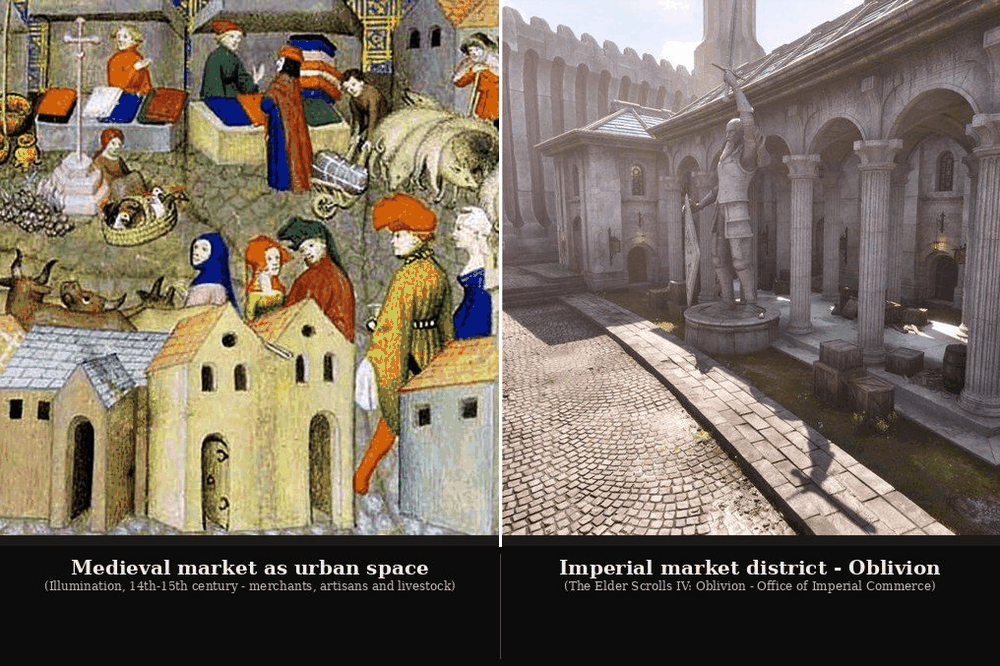
Medieval markets brought together merchants, consumers, and commodities, making economic relationships visible within urban space. This relationship is particularly evident in Morrowind, Oblivion, and Skyrim, where shops, guilds, and market districts create the impression of economies extending beyond individual transactions.
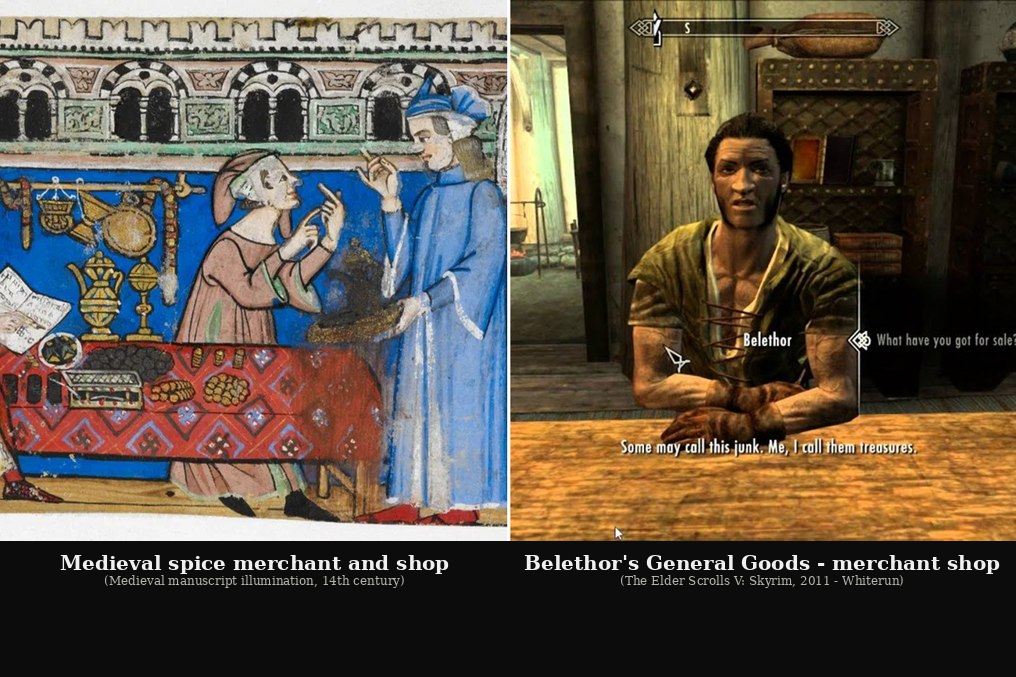
Belethor’s remark, “Some may call this junk. Me, I call them treasures”, presents the merchant as an intermediary who assigns value to objects through exchange. This role reflects the importance of merchants in many medieval urban economies, where commercial activity linked local communities to wider networks of circulation. The player sees the transaction, but not the wider network that produced and transported the goods.
2. Roads and Caravans: Mobility as Connectivity
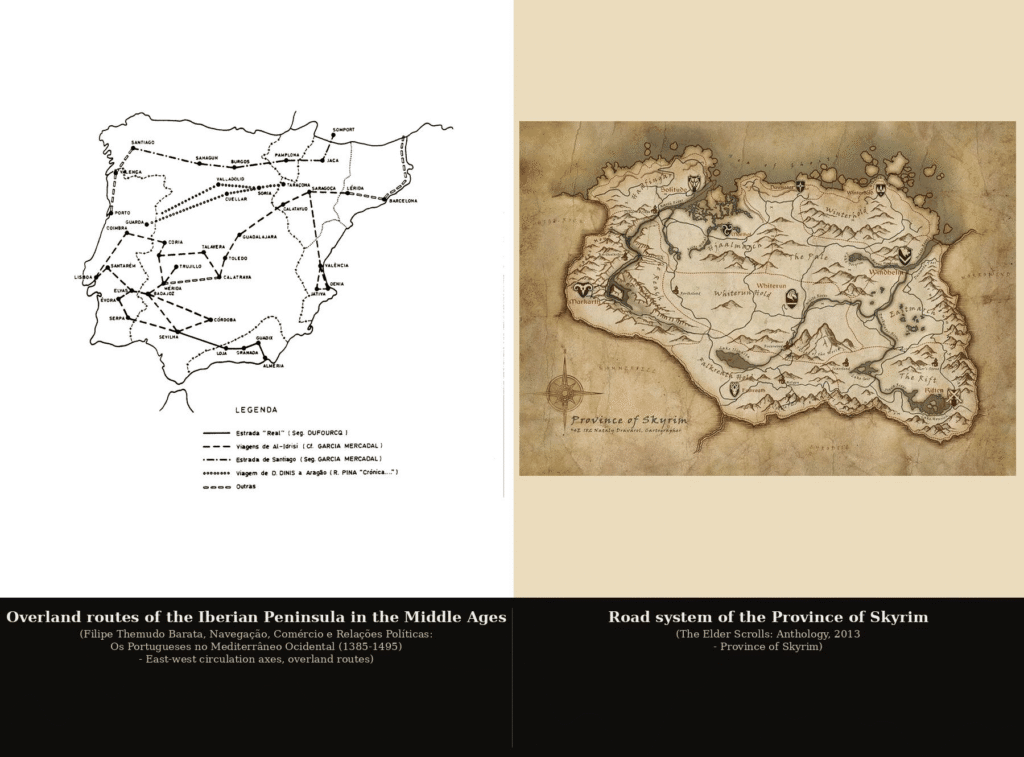
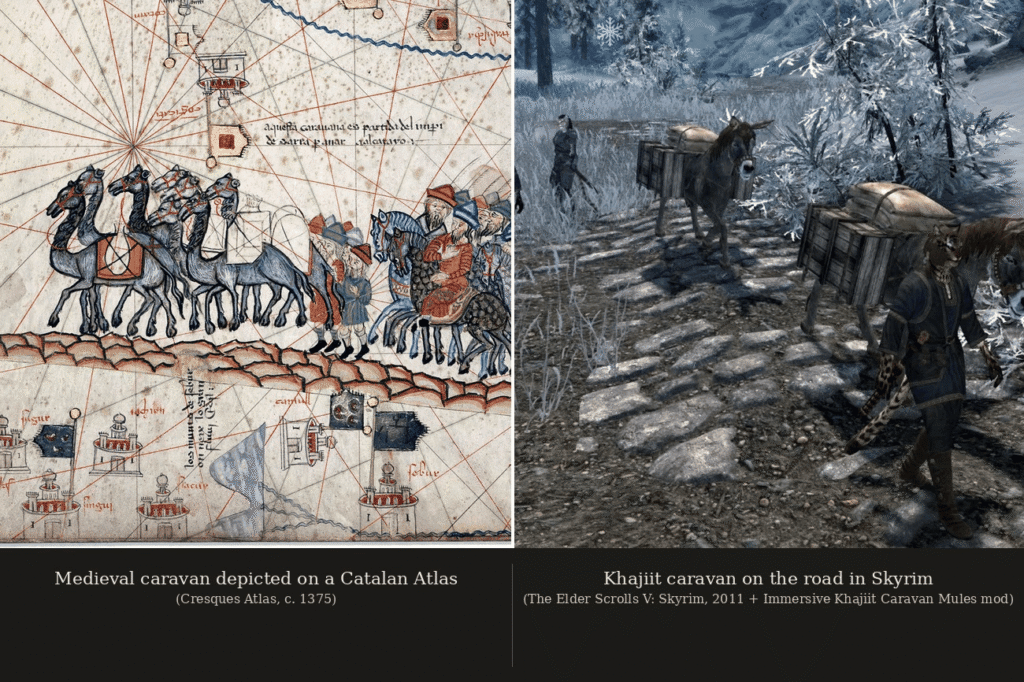
Overland trade depended on roads, merchants, and carriers linking economically connected places. Mobility was therefore essential to commercial exchange, allowing goods, people, and information to move between settlements. Daggerfall highlights this relationship through its geographical scale, while Skyrim offers a more concrete example through the Khajiit caravans. Their movement between settlements makes travelling commerce part of the landscape and suggests exchanges extending beyond what the player directly experiences.
The logistical dimension of trade remains partly invisible. The Immersive Khajiit Caravan Mules mod makes this infrastructure more visible by adding pack animals to the caravans, highlighting forms of transport that remain implicit in the base game.
Conclusion: Trade as Worldbuilding
Across The Elder Scrolls, ports, markets, roads, and caravans help construct Tamriel as a connected world. Rather than presenting complete economic systems, the games provide fragments through which players infer larger networks of circulation. Trade therefore functions not simply as backgrounds detail, but as a key element in the creation of a coherent medievalist possible world. By drawing on recognisable forms of exchange and mobility, the series encourages players to imagine connections extending beyond the limits of their immediate experience.
Suggested Reading
Abulafia, David. The Boundless Sea: A Human History of the Oceans. London: Penguin, 2019.
BARATA, Filipe Themudo. Navegação, Comércio e Relações Políticas: Os Portugueses no Mediterrâneo Ocidental (1385-1466). Lisboa: Fundação Calouste Gulbenkian, Junta Nacional de Investigação Científica e Tecnológica, 1998.
Chapman, Adam. Digital Games as History: How Videogames Represent the Past and Offer Access to Historical Practice. New York: Routledge, 2016.
Hodges, Richard. Dark Age Economics: The Origins of Towns and Trade – AD 600–1000. New York: St. Martin’s Press, 1982.
Ryan, Marie-Laure. Possible Worlds, Artificial Intelligence and Narrative Theory. Bloomington: Indiana University Press, 1991.
Short Biography
Ricardo Santana is a PhD candidate in Medieval History at the School of Arts and Humanities of the University of Lisbon and an integrated researcher at the University of Lisbon’s Centre for History. He is a member of the Cultural Encounters and Intersecting Societies research group. His doctoral research examines portuguese trade and commercial networks in Iberia between 1385 and 1495. His broader interests include medieval economic and social history, medievalism, historical representation in digital games, and historical worldbuilding. He has presented research at national and international conferences, including the International Medieval Congress and The Middle Ages in Modern Games.
I totally agree with your core premise here. I was wondering if you had any thoughts on the infrastructural side of trade: one thing we see in medieval texts is a good deal of interest in who owns and pays for bridges and market infrastructure, we see the construction of caravanserais across southwest Asia, and so on. Skyrim merchants tend to just go town to town much more, or are fairly static. Do you think the relatively low interest in those elements in Skyrim just reflect a lack of player expectations to that end, or do you think there’s something else going on there? It always felt to me like this was an area with quite a lot of storytelling potential, as repairing infrastructure could unlock new routes, the remote caravanserai is at least as good a location as a fantasy tavern (and oddly the Khajit don’t really seem to have non-urban stops so far as I can remember), and so on.
Thank you for your comment, James. I think your point about infrastructure is particularly interesting, and it is something I probably could have explored much further in the paper. One thing that struck me while researching medieval trade is precisely how often commercial networks become visible through the infrastructure and institutions that supported them. Medieval sources can tell us a great deal about who built, financed, maintained, or controlled roads, bridges, ports, markets, and other facilities. Toll records, municipal legislation, royal privileges, and similar documents can sometimes leave clearer traces of the infrastructure supporting trade than of the movement of goods itself. Looking at The Elder Scrolls from that perspective, I think the games tend to make the merchants, caravans, ports, and markets more visible than the infrastructure supporting them. However, there are some interesting exceptions. Bloodmoon’s Raven Rock is probably the clearest example for me, since the player participates in the development of a settlement that gradually becomes integrated into wider maritime and economic networks. Likewise, the destruction of Kvatch in Oblivion and the Civil War in Skyrim show how conflict can affect mobility and connectivity across the landscape. I also think the Khajiit caravans are an interesting case. Their exclusion from the cities means that they occupy a distinctive commercial space on the margins of urban centres. Their camps outside the gates and their movement between settlements suggest a wider geography of exchange that the player only partially sees. And I completely agree with you about the storytelling potential. Caravanserais, toll bridges, roadside markets, warehouses, or even infrastructure projects could make excellent locations and could give the player a much stronger sense of how these networks actually function. It would also make the world feel more responsive, with the condition of roads and infrastructure reflecting political and economic changes. From a research perspective, I actually find this particularly interesting because there is a certain parallel with how we reconstruct medieval commercial networks. We often have to piece together wider systems of exchange from scattered evidence, including infrastructure, regulations, fiscal records, merchants, and commodities. The Elder Scrolls does something somewhat similar from the opposite direction, as it gives the player fragments from which they can imagine a much larger network that remains mostly unseen.
Lovely paper, Ricardo! I do think trade gameplay mechanics are a fundamental aspect of games which portray the Middle Ages, irrespective of the way in which this is done. Do you think there are games of the kind in which immersion or playability are compromised because of the absence of trade (or trade-like) mechanics? Thank you!
Thank you very much, Jéssica, both for reading the paper and for your thoughtful comment. And first of all, my apologies for the delay in replying! I think your point about trade mechanics is particularly interesting because they can play an important role in making medieval or medieval-inspired worlds feel interconnected, even when trade is not the main focus of the gameplay. The movement of goods, people and information between places can make a game world feel much more dynamic and believable. Regarding your question, I do think there are cases where the absence of trade, or trade-like mechanics, can affect immersion. One way of thinking about this is what we might call the “empty world” problem. A game can present us with detailed castles, towns, markets and historically inspired societies, but without the social and economic systems that would make those places function as interconnected communities. The result can be a world that looks convincingly medieval, but feels strangely static once we start interacting with it. For example, in Skyrim, the economy itself is relatively simple. The Khajiit caravans, merchants, markets and the circulation of goods nevertheless help create the impression that settlements are connected through wider systems of exchange. At the same time, the game does not really simulate how a civil war might disrupt supply routes, affect prices or alter the availability of resources. The world therefore suggests a much more complex economic reality than its underlying systems actually represent. Something similar, although in a different way, can be seen in some of the Assassin’s Creed games. Their historical reconstructions can be extraordinarily detailed, but economic activity is often secondary to the main gameplay systems. In Assassin’s Creed II, for instance, investing in Monteriggioni gives the player a sense of participating in the town’s economy, but the economic consequences remain largely abstract and disconnected from the wider social dynamics of the world. On the other hand, there are games where trade is much more deeply integrated into the simulation. The Guild series is perhaps one of the clearest examples, as production, supply and demand, transportation and commerce are directly connected to the development of towns and to the player’s social and political ambitions. Medieval Dynasty also uses trade and the management of resources as part of the development and survival of a settlement, while Mount & Blade II: Bannerlord makes regional price differences, caravans and the movement of goods relevant to the player’s economic decisions. These examples make me think that the question is not simply whether a game has a trading mechanic, but how deeply trade and economic exchange are integrated into the wider simulation of the world. A merchant who is simply standing in a market selling the same goods at fixed prices gives us a sense that commerce exists. A system in which shortages, supply routes, production and demand actually affect settlements gives us a much stronger sense that we are inhabiting an interconnected world. In a way, trade also helps communicate scale. Even when players never travel beyond a particular region, references to imported goods, distant merchants or travelling caravans can suggest the existence of a much larger world beyond the spaces directly accessible to them. This is particularly important for the kind of “invisible” networks I was interested in exploring in my paper. At the same time, I do not think every game necessarily needs an explicit trading system. Some games can convey the existence of exchange networks through environmental storytelling, NPC behaviour, travelling merchants, caravans, or references to the circulation of goods in dialogue and world-building. In those cases, trade is still part of the world, even if the player cannot directly participate in it. From my perspective, what matters most is therefore not necessarily whether a game includes a complex economic simulation, but whether it conveys the sense that exchange networks exist and contribute to shaping the world the player inhabits. This is one of the reasons why I became interested in trade as a form of worldbuilding in The Elder Scrolls in the first place. Thank you again for the question! It is an aspect of medieval game worlds that I think deserves much more attention.
This is a wonderful breakdown. I have two questions, although they may be a bit outside the scope of what you have here.
1. I generally view the East Empire Company as inspired more by later periods. But, I am curious how it compares to medieval organization of trade. I’m aware they existed, but it’s not a topic I know much about.
2. You’ve focused on the single player games, which makes sense to me. But I’m curious if you have any thoughts specific to Elder Scrolls Online and it’s more robust economic systems.
Chipping in on question one in broad terms (though others will know more than me I expect) – you generally don’t get medieval trading companies on that scale quite, and I guess in a lot of cases you get more in the way of distinctive groups taking on trading roles which aren’t necessarily as tightly controlled by a big state – so thinking about eg the Genoese and Venetians. There’s a lot of state-elite funding of medieval merchants though, it’s just individual rather than institutionalised, so implementing a more medieval trade system in TES you’d be more likely to have a single big-name merchant who’d, say, been funded by Tullius or Elisif or someone in a calculated gamble to help fund their military campaign, and then that person would have the chance to make it big if their trading voyage paid off. One of the other narratively interesting impacts of that is that because merchants aren’t representing big state institutions, that means they can often pass over hostile borders and makes them more useful for spying and knowledge movement in both directions – eg we have Byzantine texts saying “don’t refuse to trade with your enemies, you shouldn’t pass up the information the merchants will bring with them”.
Thanks, James! And my apologies for the delayed reply! I think that is a really interesting way of framing the comparison, particularly the distinction between large-scale institutionalised companies and individual merchants or merchant groups operating through personal and political connections. The point about state-elite funding is especially interesting in relation to The Elder Scrolls. Your hypothetical example of a merchant being funded by someone like Tullius or Elisif actually fits quite nicely with the kind of more decentralised commercial networks we might expect in a medieval-inspired setting. It would also make the political context of trade much more visible, since the success of a merchant could directly affect the interests of the person or faction supporting them. At the same time, your mention of the Genoese and Venetians made me think that there is perhaps another interesting medieval layer to the East Empire Company itself. While its name and overall corporate structure clearly evoke the early modern East India Companies, some of its features can also be compared with the way medieval maritime powers combined private commerce with state interests. Venice and Genoa, for example, could closely connect commercial activity with political and military power. Long-distance trade was supported and protected by state institutions, while merchants and merchant groups operated through privileged trading communities, overseas settlements and commercial enclaves. Genoese and Venetian interests across the Mediterranean and Black Sea also relied on fortified trading posts and negotiated privileges, creating commercial networks that were simultaneously economic and political. That makes the East Empire Company particularly interesting to me. I would still see it primarily as an early modern-inspired institution, rather than a straightforward medieval equivalent, but it seems to combine elements from both periods. Its monopolistic relationship with the Empire and its overseas infrastructure have clear early modern resonances, while the combination of merchants, political patronage, privileged trading communities and armed protection also has some interesting medieval parallels. I also really like your point about merchants as agents of information. It fits very well with what I was trying to get at with the idea of “invisible” trade networks in the paper. The movement of merchants does not only imply the circulation of goods, but also connects communities that the player may never see directly. Your point actually made me think of the Khajiit caravans in Skyrim, which seem to work in a similar way. They are primarily presented as travelling merchants, but their movement between settlements helps suggest wider connections between communities beyond the player’s immediate experience. Their role could therefore be understood as extending beyond the movement of goods to the circulation of information as well. This also makes merchants interesting as intermediaries between political spaces. Even when communities are in conflict, commercial connections can create channels through which people, goods and information continue to move. The Byzantine example you mentioned is particularly interesting in this respect. It makes me wonder whether merchants in The Elder Scrolls could be understood not simply as economic actors, but as informal channels of communication between otherwise hostile or disconnected regions. Thanks for adding this to the discussion! I think this actually opens up another interesting way of thinking about how trade could contribute to worldbuilding in TES.
Thank you very much for your kind words, Andrew, and my apologies for the delay in replying. These are both excellent questions. Regarding the East Empire Company, I would agree that it seems to draw much more directly from early modern chartered companies, particularly organisations such as the English and Dutch East India Companies. Its monopoly privileges, close relationship with imperial authority, centralised corporate structure and ability to operate over considerable distances feel much more characteristic of the 16th to 18th centuries than of the medieval period. There are nevertheless some interesting medieval parallels. Medieval Europe was home to a wide range of merchant guilds, trading associations and commercial networks that could obtain privileges from rulers and municipalities. The Hanseatic League is probably the most obvious comparison. The Hansa connected merchants and cities across large geographical areas, facilitated long-distance maritime trade and possessed considerable political and economic influence. It could also use collective military power to defend its commercial interests. The crucial difference, however, is institutional. The Hanseatic League was a network or confederation of cities and merchants, rather than a centralised corporation operating as an arm of a single imperial authority. Medieval merchants and guilds could negotiate privileges with rulers, but they were not equivalent to a chartered company holding a state-backed monopoly. The East Empire Company therefore feels less like a direct medieval analogue and more like a hybrid that combines elements of medieval commercial networks with the monopolistic trading companies of the early modern period. What I find particularly interesting about the East Empire Company, from the perspective of my paper, is that it makes these otherwise invisible networks much more legible to the player. We see the organisation, its agents and its infrastructure, whereas much of the trade I discuss in the paper exists precisely in the background, inferred through merchants, goods, routes and references to distant places. In that sense, the Company gives the player a visible institutional framework for something that is often deliberately left implicit in the other games. As for The Elder Scrolls Online, I deliberately focused on the single-player games because I was interested in how trade contributes to worldbuilding and to the construction of possible worlds from the perspective of a single player moving through the environment. Interestingly, I did initially consider including ESO in the project precisely because of its much more developed economic systems. In fact, your question touches on one of the topics that I ended up setting aside during the writing process. However, as the paper evolved, I decided to focus on the single-player titles in order to keep the scope manageable and the discussion centred on worldbuilding, environmental storytelling and the perception of trade networks from the perspective of an individual player, rather than on player-driven economies. That said, I think ESO raises some fascinating questions precisely because its economy is shaped not only by the game world itself but also by interactions between players. In some respects, ESO arguably makes trade more visible than the single-player titles. Guild traders, regional markets, the circulation of crafted goods and the social organisation of trading guilds create economic networks that players actively participate in rather than merely observe. This introduces a layer of economic interaction that is largely absent from games such as Skyrim. At the same time, my impression is that ESO presents a somewhat different phenomenon from the one I was examining in the paper. My focus was on the way trade can contribute to the plausibility of a fictional world through the suggestion of invisible networks operating beyond the player’s immediate experience. In ESO, many of those networks become visible because they are generated and maintained by the player community itself. In that sense, ESO remained very much in the background of my thinking while writing the paper, but it would certainly be worth exploring in a separate study. Thank you again for the questions. They point towards some very interesting avenues for future research.
I loved uploading this paper, as I got to look at all these beautiful images!
My question pertains the maps, in fact. You included Fra Mauro’s Mappa Mundi, which interweaves quite a bit of morality into its cartography. If you read the captions, you’ll see many of them have very pointed judgments about the places in question. E.g. Ireland is described as a remote, miracle-prone land populated by monsters and barbarians, pretty much in line with Gerald of Wales’ description of it (which was read in Italy at the time). Same thing with Abraham Cresques’ atlas (Mansa Musa holding a gold nugget being a prime example).
Do you think games do justice to this moral dimension of geography – either in the worldbuilding proper, or in the way it presents ‘othered’ spaces to the player? We’ve had papers about this at MAMG before, but I’d love to hear your take.
Thank you very much, Vinicius! And first of all, my apologies for the delayed reply! I am very glad that the images made the paper enjoyable to upload as well. I actually wanted the paper to have a strong visual component, since I was interested not only in discussing trade networks in The Elder Scrolls, but also in exploring how those networks can be suggested and communicated visually through maps, landscapes and other forms of worldbuilding.
Your question about the moral dimension of geography is fascinating. Your example of Ireland also immediately made me think back to your paper on the Irish Annals and Galar, which I found particularly relevant here. I think there is an interesting connection between your discussion of narrative agency and the way games construct culturally “othered” spaces. In both cases, the player is not simply given a historical or geographical description, but is placed in a position from which they can encounter, interpret and potentially question a particular representation of a place and its people.
I think games can reproduce the moral dimension of geography, but often in rather different ways. In many cases, the moral and cultural judgments attached to particular places are not expressed through the map itself, as they are in Fra Mauro or in the Catalan Atlas, but through the way those places are represented in the game world. Descriptions in books and dialogue, the appearance of settlements, the behaviour of inhabitants, architecture, religion, monsters and even the kinds of resources associated with particular regions can all contribute to constructing a particular image of a place.
What I find particularly interesting in Fra Mauro is that the map does not simply distinguish between known and unknown spaces. It also assigns different kinds of meaning to them. Some places are associated with marvels, others with legendary origins, while others are presented through the testimony of travellers and navigators.
The island of Brazil is a particularly nice example of this. Of course, Fra Mauro’s Brazil is not the Brazil that would later become familiar to Europeans, but the legendary Atlantic island of Brazil. It is included within a tradition of “fortunate” or marvellous islands, which means that even a place represented geographically on the map is also being given a particular cultural and imaginative meaning. I thought this was especially interesting in relation to your question!
Portugal offers an interesting contrast. Portuguese navigators are not simply represented as inhabitants of a particular geographical region, but also as sources of geographical knowledge. Fra Mauro refers to information obtained from Portuguese navigators concerning their voyages along the African coast. So Portugal appears on the map not only as a place, but also through the people whose experiences helped shape European geographical knowledge.
The Elder Scrolls is actually quite interesting in this respect because Tamriel is full of geographically and culturally “othered” spaces. Different regions are presented through very distinct cultural identities, and these identities are often shaped by the perspectives of other groups. The representation of places such as Elsweyr, Black Marsh or Morrowind, for example, is not simply geographical. The player encounters layers of cultural assumptions, stereotypes and prejudices about these regions and their inhabitants. Some of these are reinforced by the game, while others are deliberately presented as prejudices held by particular characters or societies.
This is where I think games can do something particularly interesting with the moral dimension of geography. Rather than simply telling the player that a distant place is strange, dangerous or barbaric, they can allow the player to experience the assumptions associated with that place and sometimes challenge them through exploration. A region may initially be presented through the perspective of an “other”, but the player can then discover that the reality is considerably more complex than the stereotypes suggest.
And I think this is where your example of Ireland becomes particularly interesting. Fra Mauro’s map can present Ireland through a particular set of cultural assumptions, but a game can potentially make the player move through an “othered” space, interact with its inhabitants and experience the place beyond the initial description. In that sense, games can reproduce historical forms of othering, but they can also give the player an opportunity to question the perspective through which a place was initially presented.
There is also an interesting parallel with the maps you mentioned. Fra Mauro’s map does not simply tell us where places are. It tells us what kinds of places they are imagined to be, and what kinds of people are imagined to inhabit them. In a similar way, a game world is never geographically neutral. The placement of cities, the depiction of landscapes, the presence or absence of roads, and the descriptions given to the player all contribute to constructing a cultural geography.
That said, I think there is also an important difference. A medieval map such as Fra Mauro’s brings together a great deal of geographical, cultural and moral information in its annotations, presenting it from a particular perspective. Games are much more experiential. They can make the player move through an “othered” space, interact with its inhabitants and potentially revise their initial assumptions. Of course, this does not necessarily make the representation less stereotypical. Games can also reproduce or reinforce very powerful forms of othering precisely because the player experiences them rather than simply reading about them.
In the paper, I was primarily interested in how maps and references to distant places help create the impression of wider, interconnected worlds. Your question makes me think that there is another layer to this. Not only do games construct an imagined geography, they also construct imagined hierarchies of places and peoples. That seems like a particularly productive point of comparison with medieval cartography, and one that I would certainly like to explore further.
Thank you again for such a thoughtful question!
Thanks for the thoughtful response! And there’s no such thing as a delayed response. This is the beauty of an asynchronous conference 🙂
[…] 7 – Lore analysis & in-game histories16h20 – ‘“Some may call this junk. Me, I call them treasures”: Invisible Trade Networks and Possible W…– Ricardo Santana16h40 – ‘When an era comes to an end: agency, memory and micro-history in […]
What a great paper! My question is to build on it: how do fetch quests factor into your analysis? Do they complicate them, further cement your model, or have they already be accounted for?
Thank you very much, Johansen, that’s a really interesting question. I would argue that fetch quests mostly reinforce the model, while also complicating it in a productive way. They were not a central focus of the paper, but they fit naturally within the framework I proposed. In The Elder Scrolls, a fetch quest generally involves obtaining an item or resource and delivering it to an NPC in exchange for a reward. When viewed through an economic lens, these quests can function as simplified representations of delivery, trade, gathering, smuggling, or the movement of goods between different actors. For example, many quests in Skyrim require the player to retrieve ingredients, books, weapons, heirlooms, or other goods from distant locations. Gathering raw materials such as ores or alchemical ingredients similarly connects extraction, transport, and exchange. The Thieves Guild provides another variation, where the circulation of goods becomes associated with theft, smuggling, and the fencing of stolen property. These activities may be abstracted for gameplay purposes, but they still make the movement of goods and the role of intermediaries visible to the player. The East Empire Company questline in Dragonborn provides an especially useful example from the perspective of larger commercial networks. Restoring commercial activity in Raven Rock involves reconnecting a settlement to wider economic networks, making the relationship between a local community and a larger trading organisation explicit. The Khajiit caravans provide another example, as their movement between settlements highlights the importance of mobility and intermediaries in maintaining connections across Tamriel. This becomes particularly interesting when we consider games such as The Elder Scrolls Online, where crafting writs turn the collection of raw materials, production, and delivery into a recurring gameplay system. Here, the player is effectively placed within a small economic chain: materials have to be acquired, goods produced, and the finished products delivered in exchange for payment and other resources. From this perspective, fetch quests reproduce on a small scale the same logic that underlies ports, markets, roads, caravans, and other infrastructures of exchange. They remind players that goods do not simply exist in a location, they must be obtained, transported, exchanged, or delivered through networks of movement and relationships. At the same time, they can also reveal the limits of representation in game worlds. The player often performs tasks that, in a functioning economy, would normally involve merchants, carriers, sailors, caravan operators, miners, artisans, or other intermediaries. The game consequently compresses a much more complex chain of economic activity into a single player’s actions. This also means that fetch quests can make the invisible networks of a game world particularly tangible. In Morrowind, for instance, the absence of modern quest markers can make finding an item or reaching a destination depend much more explicitly on understanding the geography of the world and following directions. The player therefore has to engage more directly with the spatial relationships between settlements and routes. While my paper focuses primarily on larger trade networks and the infrastructures that sustain them, I think fetch quests fit very well within the framework I propose, while also opening up additional questions that deserve further exploration. In that sense, fetch quests may be understood as gameplay mechanisms that allow players to experience, however briefly, the same invisible trade networks that my paper seeks to identify and analyse.