
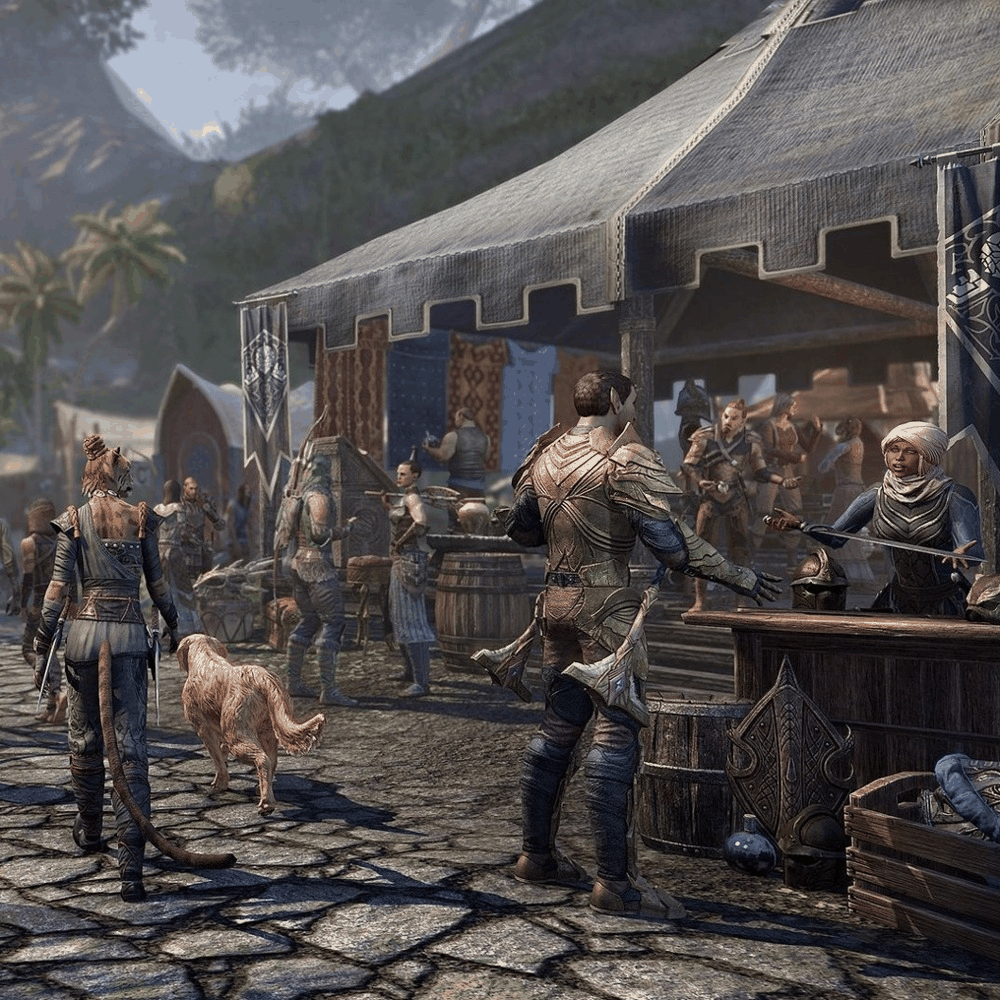
Trade is a fundamental but often overlooked element in the construction of Tamriel. Across The Elder Scrolls series, ports, markets, roads, merchants, and caravans do more than provide gameplay opportunities: they create the impression of a connected and inhabited world. Medieval commerce depended not only on the movement of goods, but also on the circulation of people, information, and relationships between distant communities. Rather than reproducing a specific historical economy, the series draws on recognisable forms of pre-modern exchange and mobility to construct a coherent medievalist possible world.
1. Ports and Maritime Networks: Connecting Tamriel by Sea
Medieval ports connected communities, merchants, commodities, and information through networks extending far beyond individual settlements. Although only fragments of these networks were visible at any given location, ports functioned as gateways to wider systems of exchange.
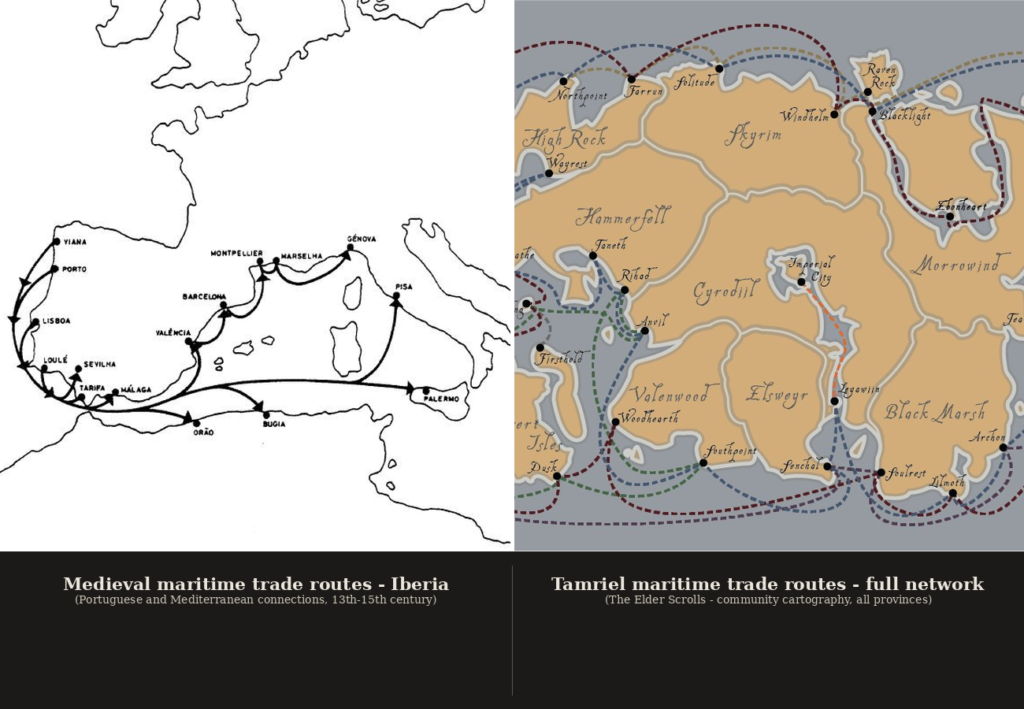
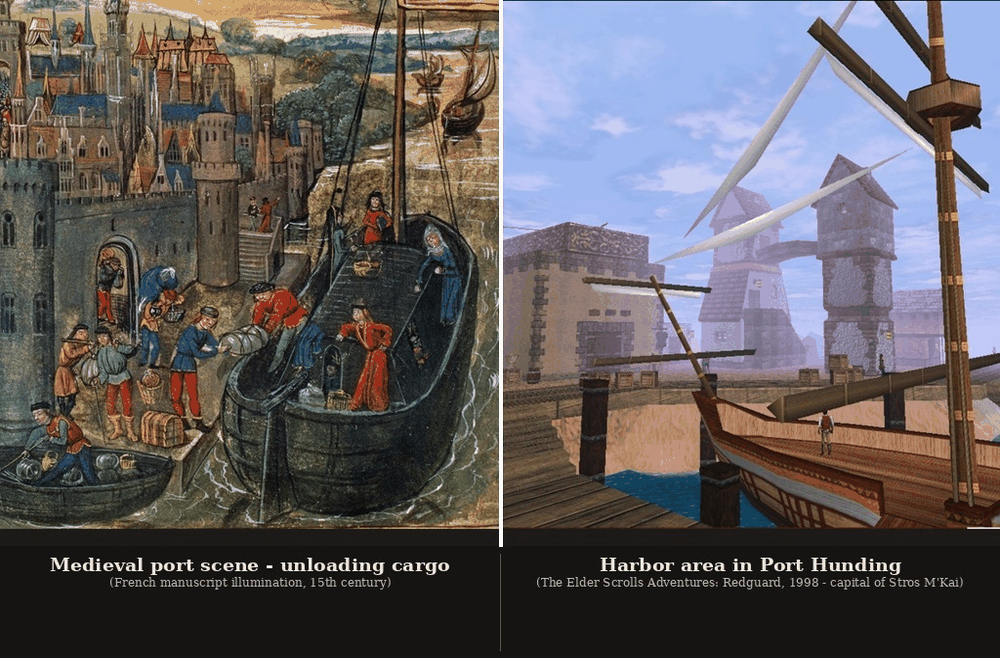
The Elder Scrolls employs a similar logic. In Redguard, Port Hunding presents Stros M’Kai as part of a broader maritime world, while Morrowind develops this idea through settlements such as Vivec and Ebonheart, as well as through the activities of the East Empire Company. The player encounters ships, merchants, and imported goods, but rarely the complete routes linking them together.
2. Cities and Markets: Making Commerce Visible
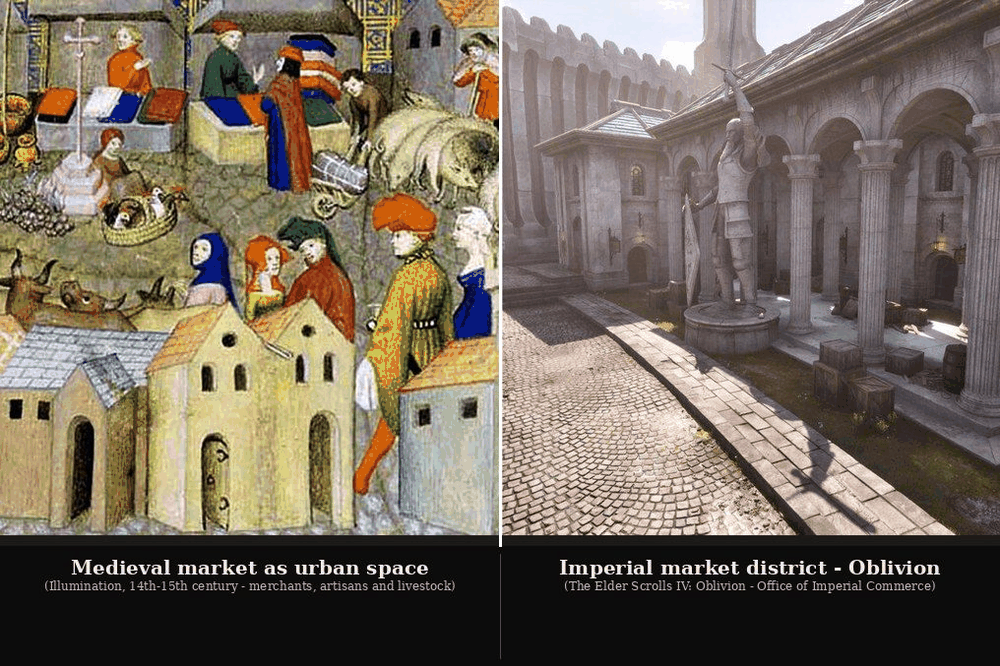
Medieval markets brought together merchants, consumers, and commodities, making economic relationships visible within urban space. This relationship is particularly evident in Morrowind, Oblivion, and Skyrim, where shops, guilds, and market districts create the impression of economies extending beyond individual transactions.
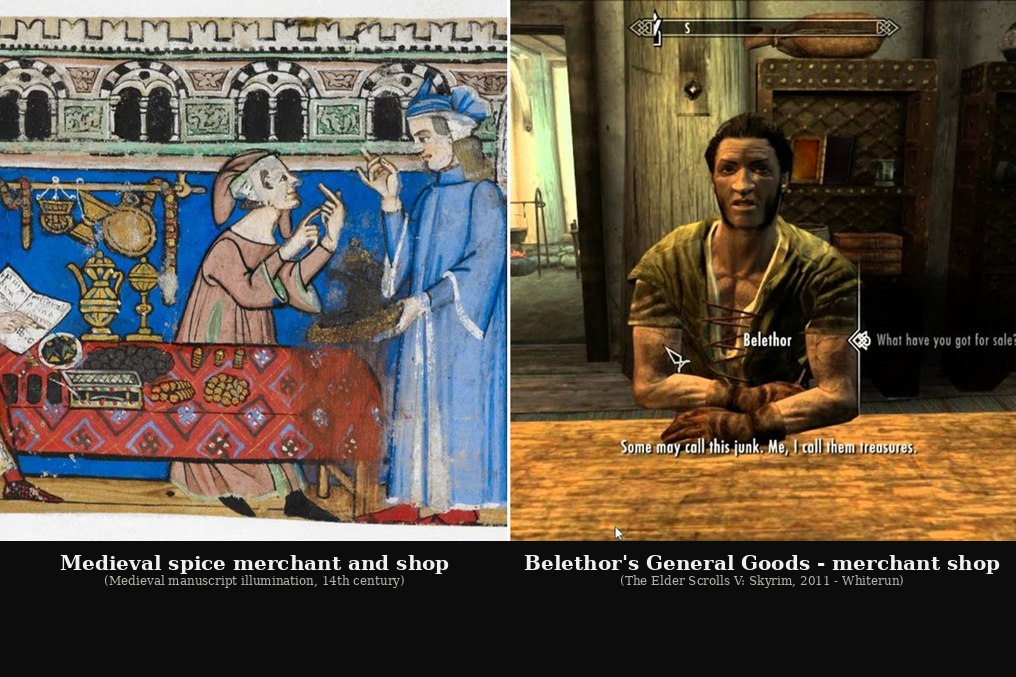
Belethor’s remark, “Some may call this junk. Me, I call them treasures”, presents the merchant as an intermediary who assigns value to objects through exchange. This role reflects the importance of merchants in many medieval urban economies, where commercial activity linked local communities to wider networks of circulation. The player sees the transaction, but not the wider network that produced and transported the goods.
2. Roads and Caravans: Mobility as Connectivity
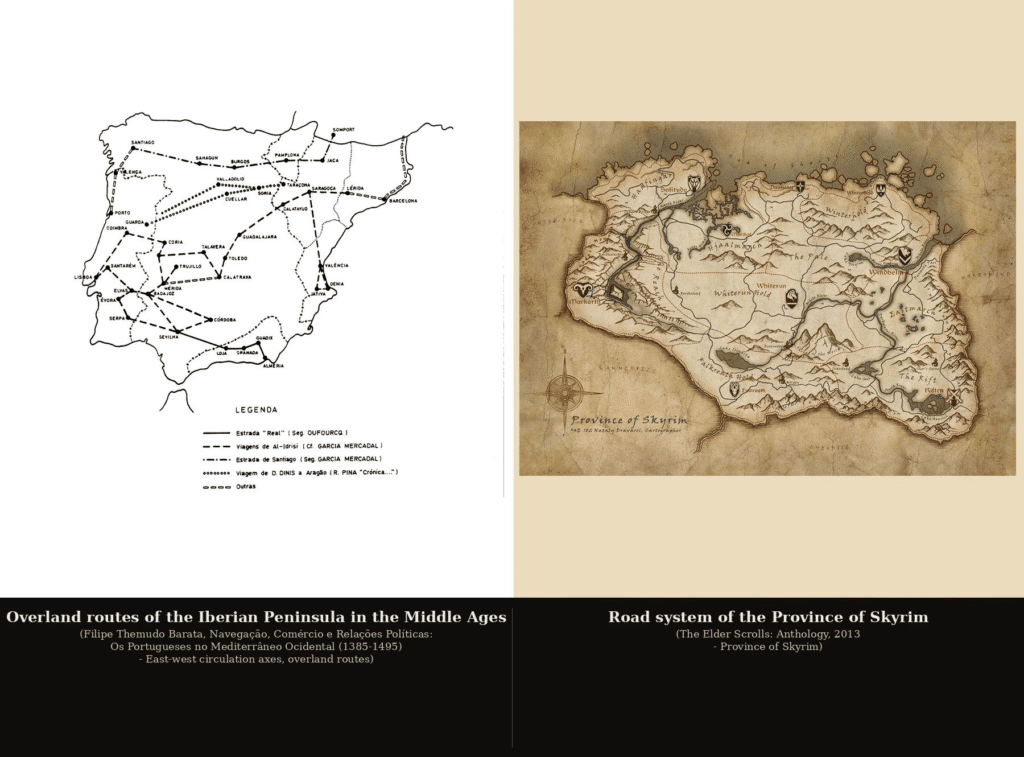
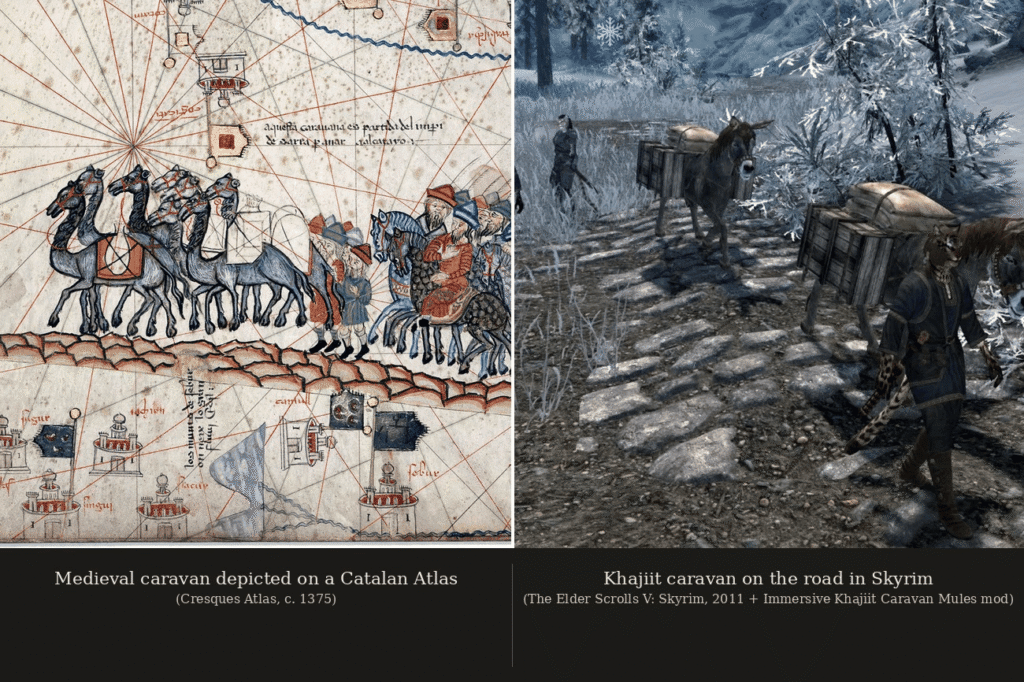
Overland trade depended on roads, merchants, and carriers linking economically connected places. Mobility was therefore essential to commercial exchange, allowing goods, people, and information to move between settlements. Daggerfall highlights this relationship through its geographical scale, while Skyrim offers a more concrete example through the Khajiit caravans. Their movement between settlements makes travelling commerce part of the landscape and suggests exchanges extending beyond what the player directly experiences.
The logistical dimension of trade remains partly invisible. The Immersive Khajiit Caravan Mules mod makes this infrastructure more visible by adding pack animals to the caravans, highlighting forms of transport that remain implicit in the base game.
Conclusion: Trade as Worldbuilding
Across The Elder Scrolls, ports, markets, roads, and caravans help construct Tamriel as a connected world. Rather than presenting complete economic systems, the games provide fragments through which players infer larger networks of circulation. Trade therefore functions not simply as backgrounds detail, but as a key element in the creation of a coherent medievalist possible world. By drawing on recognisable forms of exchange and mobility, the series encourages players to imagine connections extending beyond the limits of their immediate experience.
Suggested Reading
Abulafia, David. The Boundless Sea: A Human History of the Oceans. London: Penguin, 2019.
BARATA, Filipe Themudo. Navegação, Comércio e Relações Políticas: Os Portugueses no Mediterrâneo Ocidental (1385-1466). Lisboa: Fundação Calouste Gulbenkian, Junta Nacional de Investigação Científica e Tecnológica, 1998.
Chapman, Adam. Digital Games as History: How Videogames Represent the Past and Offer Access to Historical Practice. New York: Routledge, 2016.
Hodges, Richard. Dark Age Economics: The Origins of Towns and Trade – AD 600–1000. New York: St. Martin’s Press, 1982.
Ryan, Marie-Laure. Possible Worlds, Artificial Intelligence and Narrative Theory. Bloomington: Indiana University Press, 1991.
Short Biography
Ricardo Santana is a PhD candidate in Medieval History at the School of Arts and Humanities of the University of Lisbon and an integrated researcher at the University of Lisbon’s Centre for History. He is a member of the Cultural Encounters and Intersecting Societies research group. His doctoral research examines portuguese trade and commercial networks in Iberia between 1385 and 1495. His broader interests include medieval economic and social history, medievalism, historical representation in digital games, and historical worldbuilding. He has presented research at national and international conferences, including the International Medieval Congress and The Middle Ages in Modern Games.
I totally agree with your core premise here. I was wondering if you had any thoughts on the infrastructural side of trade: one thing we see in medieval texts is a good deal of interest in who owns and pays for bridges and market infrastructure, we see the construction of caravanserais across southwest Asia, and so on. Skyrim merchants tend to just go town to town much more, or are fairly static. Do you think the relatively low interest in those elements in Skyrim just reflect a lack of player expectations to that end, or do you think there’s something else going on there? It always felt to me like this was an area with quite a lot of storytelling potential, as repairing infrastructure could unlock new routes, the remote caravanserai is at least as good a location as a fantasy tavern (and oddly the Khajit don’t really seem to have non-urban stops so far as I can remember), and so on.
Thank you for your comment, James. I think your point about infrastructure is particularly interesting, and it is something I probably could have explored much further in the paper. One thing that struck me while researching medieval trade is precisely how often commercial networks become visible through the infrastructure and institutions that supported them. Medieval sources can tell us a great deal about who built, financed, maintained, or controlled roads, bridges, ports, markets, and other facilities. Toll records, municipal legislation, royal privileges, and similar documents can sometimes leave clearer traces of the infrastructure supporting trade than of the movement of goods itself. Looking at The Elder Scrolls from that perspective, I think the games tend to make the merchants, caravans, ports, and markets more visible than the infrastructure supporting them. However, there are some interesting exceptions. Bloodmoon’s Raven Rock is probably the clearest example for me, since the player participates in the development of a settlement that gradually becomes integrated into wider maritime and economic networks. Likewise, the destruction of Kvatch in Oblivion and the Civil War in Skyrim show how conflict can affect mobility and connectivity across the landscape. I also think the Khajiit caravans are an interesting case. Their exclusion from the cities means that they occupy a distinctive commercial space on the margins of urban centres. Their camps outside the gates and their movement between settlements suggest a wider geography of exchange that the player only partially sees. And I completely agree with you about the storytelling potential. Caravanserais, toll bridges, roadside markets, warehouses, or even infrastructure projects could make excellent locations and could give the player a much stronger sense of how these networks actually function. It would also make the world feel more responsive, with the condition of roads and infrastructure reflecting political and economic changes. From a research perspective, I actually find this particularly interesting because there is a certain parallel with how we reconstruct medieval commercial networks. We often have to piece together wider systems of exchange from scattered evidence, including infrastructure, regulations, fiscal records, merchants, and commodities. The Elder Scrolls does something somewhat similar from the opposite direction, as it gives the player fragments from which they can imagine a much larger network that remains mostly unseen.
Lovely paper, Ricardo! I do think trade gameplay mechanics are a fundamental aspect of games which portray the Middle Ages, irrespective of the way in which this is done. Do you think there are games of the kind in which immersion or playability are compromised because of the absence of trade (or trade-like) mechanics? Thank you!
This is a wonderful breakdown. I have two questions, although they may be a bit outside the scope of what you have here.
1. I generally view the East Empire Company as inspired more by later periods. But, I am curious how it compares to medieval organization of trade. I’m aware they existed, but it’s not a topic I know much about.
2. You’ve focused on the single player games, which makes sense to me. But I’m curious if you have any thoughts specific to Elder Scrolls Online and it’s more robust economic systems.
Chipping in on question one in broad terms (though others will know more than me I expect) – you generally don’t get medieval trading companies on that scale quite, and I guess in a lot of cases you get more in the way of distinctive groups taking on trading roles which aren’t necessarily as tightly controlled by a big state – so thinking about eg the Genoese and Venetians. There’s a lot of state-elite funding of medieval merchants though, it’s just individual rather than institutionalised, so implementing a more medieval trade system in TES you’d be more likely to have a single big-name merchant who’d, say, been funded by Tullius or Elisif or someone in a calculated gamble to help fund their military campaign, and then that person would have the chance to make it big if their trading voyage paid off. One of the other narratively interesting impacts of that is that because merchants aren’t representing big state institutions, that means they can often pass over hostile borders and makes them more useful for spying and knowledge movement in both directions – eg we have Byzantine texts saying “don’t refuse to trade with your enemies, you shouldn’t pass up the information the merchants will bring with them”.
I loved uploading this paper, as I got to look at all these beautiful images!
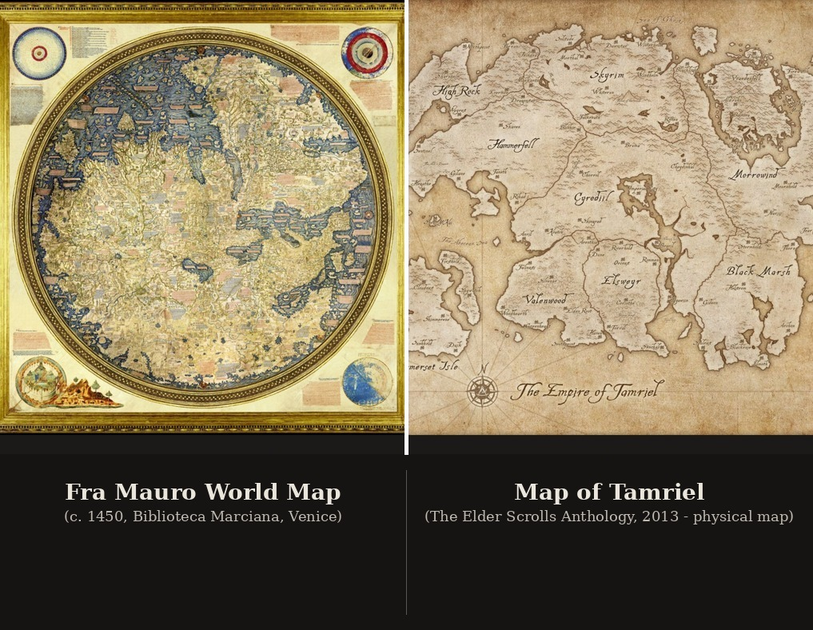
My question pertains the maps, in fact. You included Fra Mauro’s Mappa Mundi, which interweaves quite a bit of morality into its cartography. If you read the captions, you’ll see many of them have very pointed judgments about the places in question. E.g. Ireland is described as a remote, miracle-prone land populated by monsters and barbarians, pretty much in line with Gerald of Wales’ description of it (which was read in Italy at the time). Same thing with Abraham Cresques’ atlas (Mansa Musa holding a gold nugget being a prime example).
Do you think games do justice to this moral dimension of geography – either in the worldbuilding proper, or in the way it presents ‘othered’ spaces to the player? We’ve had papers about this at MAMG before, but I’d love to hear your take.