
Innistrad was since its conception synonymous with Horror in Magic the Gathering, yet the continuous development has expanded its reach and cultural inspirations. Despite its permutations, its connection to Gothic horror remains strong through featuring art and stories of classic gothic monsters, but also its worldbuilding and overall atmosphere. Many cards from Innistrad sets reference human life and struggle against the creatures, and even the game’s mechanics (emphasis on graveyard, transforming cards) were influenced to reflect this genre’s tropes. [1] Both Innistrad and Gothic Horror find themselves at the cross section of the 18th and 19th century, yet they also display connection to an earlier past; the medieval Gothic.
The original Innistrad block was to be among others inspired by 18th century Prussia, but the world itself draws on wider Germanic history. [2] Architecturally speaking, both secular and sacral buildings can be traced to this region in the High and Late Middle Ages. 15th century Fachwerk, a common trope in depiction of any “medieval house” is almost omnipresent in images of cities and even backdrop houses like Gavony Township and Archangel Avacyn.
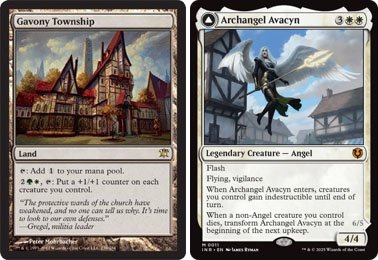
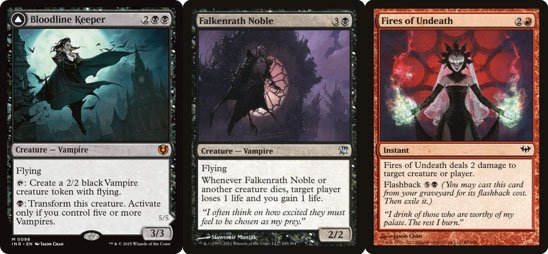
Most notably, the designs of grand cathedrals of Innistrad feature flying buttresses, rose windows and emphasis on verticality, as depicted in the cards like Bloodline Keeper, Falkenrath Noble and Fires of Undeath. The focus on sacral architecture is deliberate, pointing out the motif of holy mysticism, light versus dark and good versus evil dichotomies of Innistrad.
Callbacks to a more distant past cements Innistrad’s connection to that of Gothic literature. Sir Walter Scott and individuals like him with ‘historicist houses established a connection between Gothic architecture and a kind of sensationalist literature that often used medieval settings to heighten drama and suspense’. [3] Even themes of this genre like emphasis on very physical or literal presence of evil, even Christianity’s interpretation of angels and demons are tied to Innistrad’s lore and gameplay. However, it is important to distinguish that it was more medievalism, rather than the middle ages themselves that brought these influences. As Sir Walter Scott mentions with the case of Castle of Otranto, ‘it was not the existence of such that seeped into the Gothic, but the belief in these concepts itself’. [4]
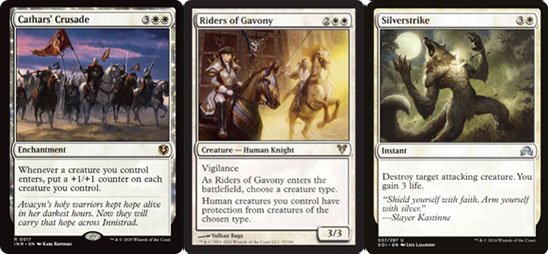
Many gothic authors who studied primary sources of the period, created a simulacrum of Middle Ages from their understanding that has been transplanted into their writing. This would often take the shape of historicising their present, which aligns with Innistrad’s monsters. Their characteristics, such as werewolves’ weakness to silver and their mental self overtaken by beastly instincts outside their control, are developments of the past century or so, while their chronological origin as an individual or species, dates beyond the Middle Ages. [5] Other interpretations of the medieval into Gothic lie in understanding of witchcraft, folklore or even Arthurian legends. Innistrad does not leave that behind either as the Cathar sect of 13th century France is reintroduced in this setting as crusaders against the evils of said world. Their design in fact encompasses the influences of Innistrad in a microcosm. The Riders of Gavony (itself likely a variation on the word Gascony, in southern France) blends in centuries of cultural influence with the depiction of knight of the High Middle Ages, dressed in 18th century military uniform, representing the fascination with heroic tales standing against evils of Gothic and Romantic literature of the 1800s. Even modern tropes make an impression as the knights wield silver swords (but no firearms) and portray themselves as monolithic defenders of humanity.
Bibliography:
de Borba, Alex. Origins of Dread: Gothic Horror in Twentieth-Century Literature,
Atmostfear Entertainment, https://www.atmostfear-entertainment.com/literature/books/origins-dread-gothic-horror-twentieth-century-literature/, August 26, 2024, accessed 20/09/2026
Carabine, Alex. ‘Decadence and Dark Ages’ Guest Post: Medieval Gothic’, Generally Gothic, https://generallygothic.com/2020/01/30/medieval-gothic/, January 30, 2020, accessed 20/09/2026
Carabine, Alex. Gothic Medievalism: How Medieval Culture Haunts Gothic Literature (1764-1900) Doctor of Philosophy thesis, University of Liverpool, 2024
George, Sam and Bill Hughes. ‘Introduction: Werewolves and Wildness’, Gothic Studies 21.1 (2019): Edinburgh University Press, 1-9
Linnemann, Mike. Architecture on Innistrad, https://www.coolstuffinc.com/a/mikelinnemann-032316-architecture-on-innistrad
March 23, 2016, accessed 10/09/2026.
Murphy, Kevin D., and Lisa Reilly, ‘Gothic’ in Elizabeth Emery and Richard Utz, Medievalism: Key Critical Terms, Boydell & Brewer, D. S. Brewer, 2014, 87-96, p. 92
Rosewater, Mark. ‘Innistrad Design Handoff Document’, Making Magic, https://magic.wizards.com/en/news/making-magic/innistrad-design-handoff-document-2021-08-23, August 23, 2021, accessed 10/09/2026
[1] Mark Rosewater, ‘Innistrad Design Handoff Document’, Making Magic, https://magic.wizards.com/en/news/making-magic/innistrad-design-handoff-document-2021-08-23, August 23, 2021, accessed 10/09/2026.
[2]Mike Linnemann, Architecture on Innistrad, https://www.coolstuffinc.com/a/mikelinnemann-032316-architecture-on-innistrad
March 23, 2016, accessed 10/09/2026.
[3] Kevin D. Murphy and Lisa Reilly, ‘Gothic’ in Elizabeth Emery and Richard Utz, Medievalism: Key Critical Terms, Boydell & Brewer, D. S. Brewer, 2014, 87-96, p. 92.
[4] Alex Carabine, ‘Decadence and Dark Ages’ Guest Post: Medieval Gothic’, Generally Gothic, https://generallygothic.com/2020/01/30/medieval-gothic/, January 30, 2020, accessed 20/09/2026.
[5] Sam George and Bill Hughes, Introduction: Werewolves and Wildness, Gothic Studies 21.1 (2019): Edinburgh University Press, 1-9.
Is Innistrad meant to be evocative of Innsmouth as a placename by any chance?
I think the use of the Cathars here is interesting too. Is that at all expressed with any more depth in terms of Cathar beliefs, or are they just exactly the same as if you’d said “Templars” but given the alternative name to make them… edgier, or something?
It is likely a portmanteau of Innsmouth and “Strand”, German meaning beach, which would befit the world inspired by a nothern Germany, whilst still evoking the spirit of horror – but we don’t have that confirmed by Wizards of the Coast. Similar naming conventions appear across the plane, like the Ulvenwald (notorious forest filled with werewolves, taking words for wolf from Danish and Forest from German), Verlassen (an isolated village in the woods, taken from the words ver-lassen, essentially meant as “left behind”) etc.
In terms of Cathars and their beliefs, they are closer to their Templar inspiration, and even that is rather surface level. In the stories of Innistrad, corruption of priests and warriors of the faith is “an open secret”, similar to rumours about organised religions closer to our time, It is part of the trope of gothic fiction to recall to the legends of the past, and comtrast knights in shining armour and how what the reality is today – but in the world of Innistrad they genuinely are the only thing left. One that is closer to the Cathars and their believes is leadership of women. There exist some notorious Cathars like Adeline and Thalia, who also resonate with the trope of Gothic Literature – seeing women in different positions of agency. I think it would be really interesting if there were more historical connections to them.
[…] […]
Thanks for this Jakub! You mention that gothic horror influenced the mechanics used in this deck – do we see something similar with the medievalist influences?