
Opening Address by Vinicius Marino Carvalho and Tess Watterson
Welcome to the seventh Middle Ages in Modern Games Asynchronous Conference! To those who have joined us before – thank you for tuning in again, and to those who are here for the first time – welcome to the party!
We have a jam-packed programme of written and recorded papers from speakers from around the world and across many different sectors of games and heritage industry and scholarship. We are gathering for MAMG at a different time of year than previous editions, meaning we are a few months following our organised strand at the International Medieval Congress (IMC) in Leeds in July, and we’re so excited to see many of our presenters from that event have brought their work into this space as well.
This is our third year hosting this conference on our own website. If you missed last year’s event, you can still access all of the fantastic papers and comment discussions here on the website and you can also read all of the previous years’ conference proceedings, going back to the very first MAMG then-Twitter Conference held in 2020.
As the papers are released as per the programme schedule, we will be sharing the posts across our various social media platforms, using the hashtag #MAMG26. Please feel free to share the papers as widely as you like, using the direct website links or sharing our posts if you’d prefer, as our goal is always to engage with the widest possible audience of colleagues, students, players, and more! The best future for history in/of games is one that is collaborative and accessible.
MAMG 2026 is sponsored by Exilian and the Centre for Medieval and Renaissance Research at the University of Winchester. Exilian provide wide ranging forums and articles addressing all aspects of the Middle Ages and medievalism (including, but not limited to, medievalist games). And the Centre for Medieval and Renaissance Research conducts research, public engagement, and teaching on several themes including the Middle Ages in Modern Games.

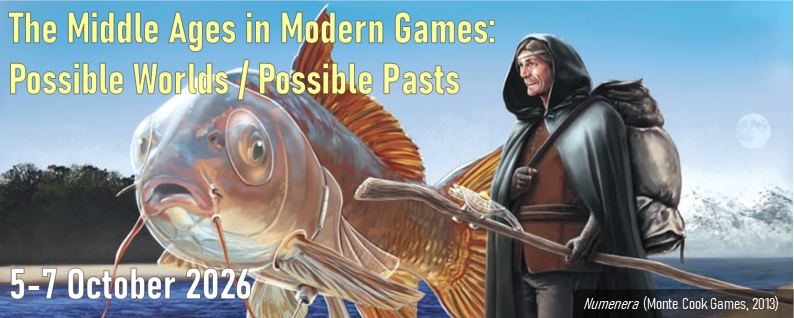
The background image in the MAMG26 programme and other materials is from the science fantasy tabletop roleplaying game Numenera, by Monte Cook Games (2013), funded originally by a record-breaking Kickstarter campaign. The world of Numenera is set one billion years in the future, and yet “theirs is a medieval world.” That world is filled with ‘numenera’ – the places and devices of the worlds from before theirs, which they call simultaneously “our legacy” and “our future.” We chose this image as the cover for MAMG26 because it is a game that so perfectly demonstrates the vast possibility of the medieval.
This year’s theme is Possible Worlds / Possible Futures. As demonstrated through all previous editions of this conference, the medieval has meanings far beyond a simple periodisation of years or geopolitical map of territories, and games are an incredible space of possibility for playing with the categories and borders that might seek to constrain those meanings.
Recent work by Indigenous and ally scholars in medieval studies and other ‘premodern’ history disciplines has shown how a transtemporal approach from Critical Indigenous Studies reshapes our ideas about the medieval in exciting ways. For example, see how Dr Tarren Andrews rethinks medieval English literature and law through a comparative study of the processes of the medieval Domesday Inquest and the Dawes Severalty Act of 1887, or Dr Madi Williams finds synergies between the medieval European world and Te Ao Māori (the Māori world). Breaking down the limitations of colonial categorisations and temporalities, these approaches to the medieval represent a future of possibility for medieval studies.
This is part of the scholarly context that inspired our theme this year, but our hope was to draw in a wide range of reinterpretations and reimagingings of the medieval and of how we study it, which we are excited to see across many different approaches and case studies in this year’s programme. So many games challenge these borders and categories already that we can’t possibly list them all here, but we hope you’ll find some new suggestions for your to-play list in the next few days, and follow some new and exciting projects in the works. Every day, around the world, people are finding new ways to play with these stories, and reimagining, as it were, the middle ages in modern games.
The most compelling thing about a theme like Possible Worlds / Possible Pasts is that not only does it invite discussion of new case studies – from indie games, to games in development, to ideas for games to develop, to play that expansively redefines ‘games’ – but also invites new discussion of any case study. So while there are many familiar examples in the line up of papers this year, these nonetheless represent possibility as well. Not only are stories always cyclical, created in the process of their telling every time, but the processes of game design especially defy any simple understanding of old or new texts, with re-designs, re-releases, patches, mods, and so many mode modes that we often take for granted when we spend so much time in this space.
Our Keynote presentation is at 10:00 (UTC+1) by Leandro Wallace, titled ‘Why we play the Middle Ages? A proposition for engaged thinking’, where Leandro will open MAMG26 by exploring these themes and more, all centred around how we can challenge colonial influences in medievalisms and in historical games. As you wait for this to begin, or perhaps after you read Leandro’s proposition, you can keep your mind buzzing around these topics by revisiting some of the papers from last year’s theme of globalities and regionalities!
And with that, we invite you to join us for three days of papers that exemplify the possible worlds and possible futures of this field of study.
We’ll see you soon!
[…] Call for Papers: MAMG 2026Possible Worlds and Possible Pasts: the Middle Ages in Modern Games […]
Looking forward to it! It’s a great theme this year.
Thanks Kate! Great to see you!
Looking forward to what I’m sure will be another lovely and engaging conference!