
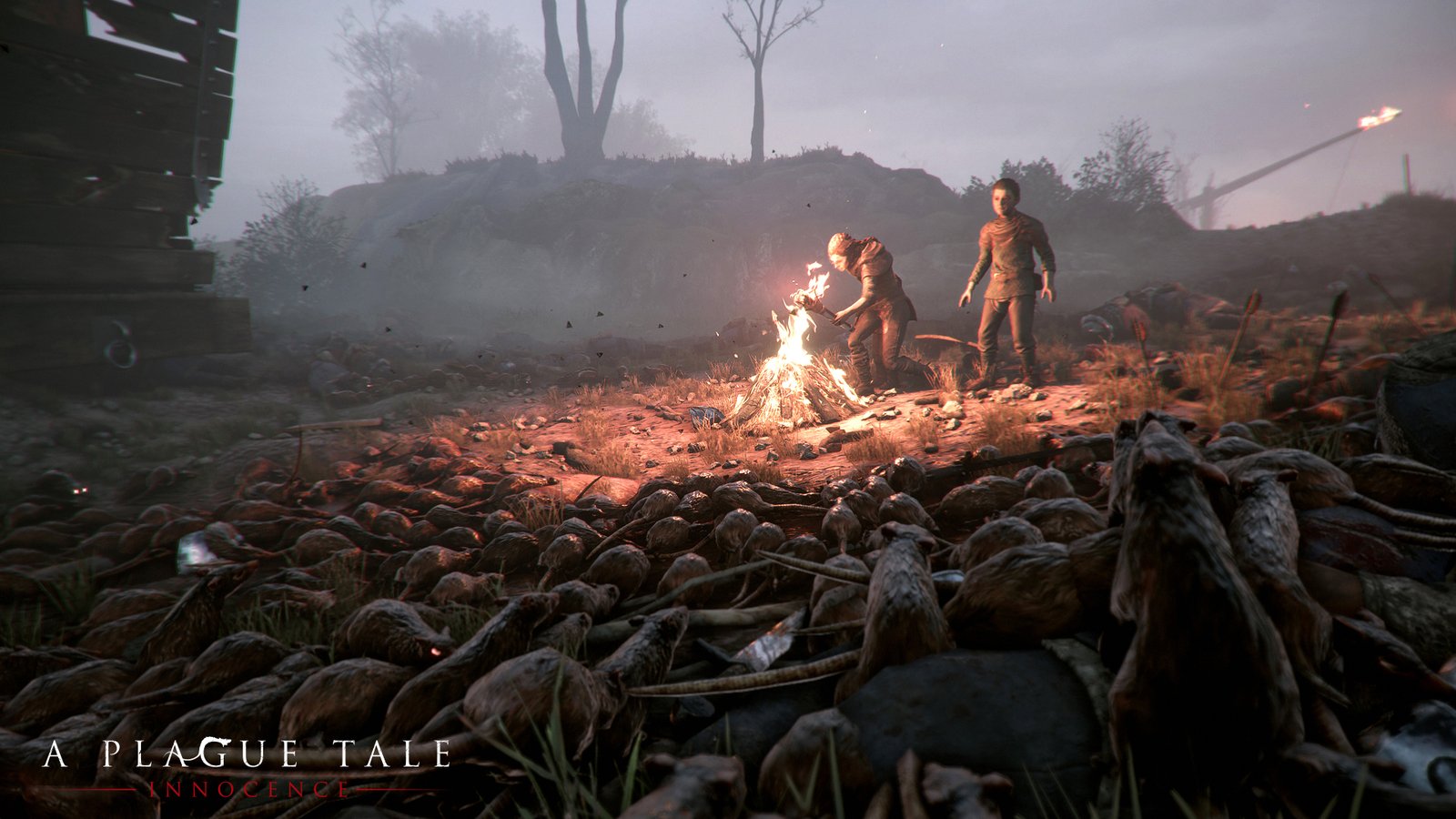
Pandemics are usually imagined as future catastrophes. A Plague Tale: Innocence (2019) and A Plague Tale: Requiem (2022), however, relocate the apocalypse to fourteenth-century France. Their world evokes the Black Death but does not attempt to reconstruct it. Instead, plague, war, social collapse and the supernatural “Prima Macula” merge into a deliberately unstable “possible past”: recognisably medieval, yet shaped by modern expectations of pandemic disaster.
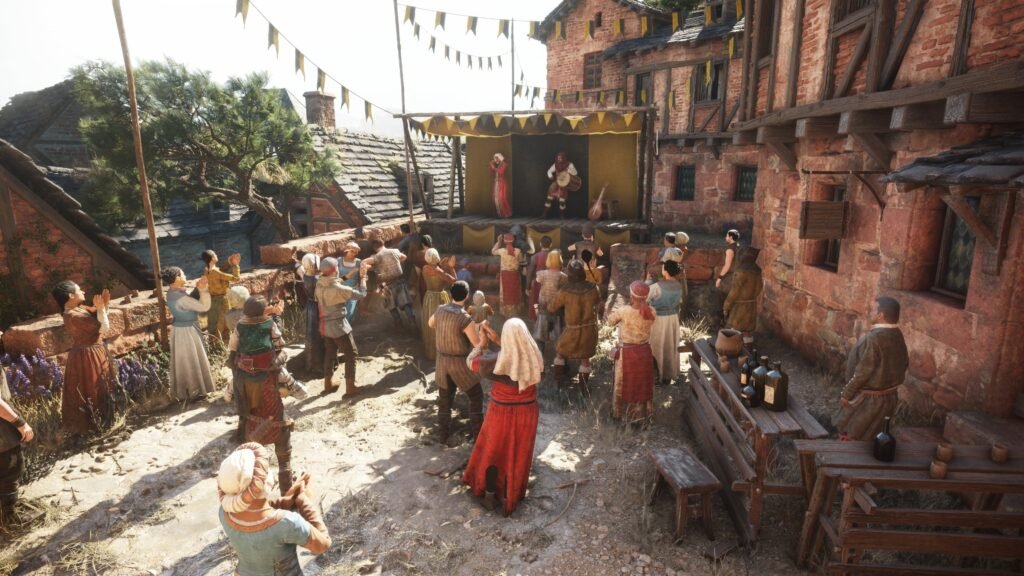
The series constructs this apocalypse by contrasting life before, during and after catastrophe. Before the outbreak reaches them, Amicia and Hugo inhabit a highly privileged noble household. In Requiem, the “Red City” similarly appears as a lively urban space of markets, trade and festivities. These brief moments of stability matter because they make the later collapse visible. Once plague and rats enter these spaces, everyday routines disappear, mobility becomes dangerous and entire districts are marked, isolated or abandoned.
Several of these images draw on historical experiences associated with the Black Death. Medieval communities did not understand bacterial transmission and frequently interpreted plague through religion, morality and social difference. In A Plague Tale, fear likewise strengthens religious authority, produces suspicion of outsiders and turns infected spaces into zones of exclusion. Yet the games intensify these processes into apocalyptic spectacle. Military and religious forces exercise extreme violence, towns lose social order with remarkable speed, and supernatural rat swarms materialise plague as an enemy that can be seen, avoided and manipulated.
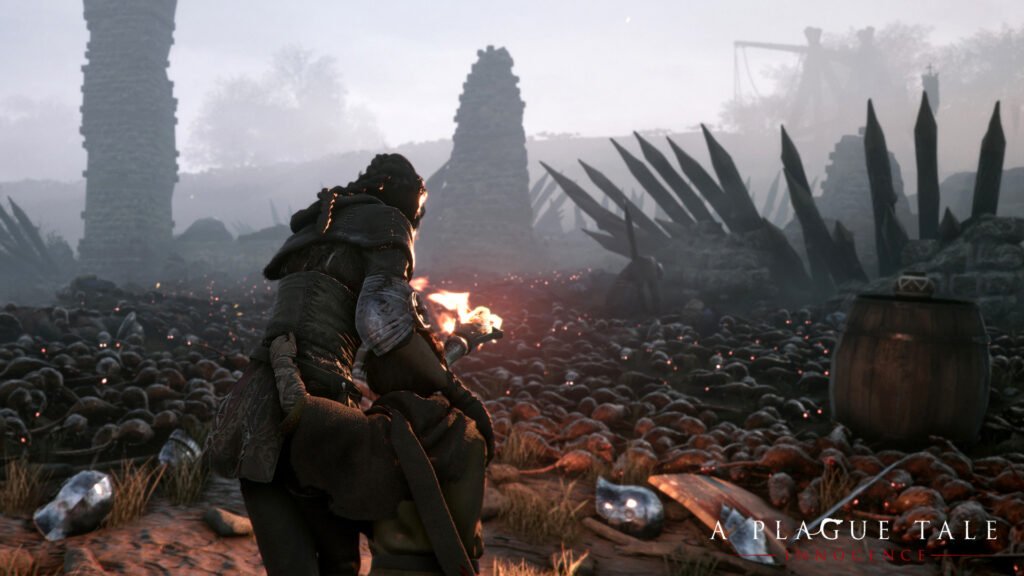
This transformation is crucial to the series’ gameplay. Historical pandemic experience becomes playable through light, darkness, movement and spatial restriction. Rats turn an invisible disease into an immediate environmental threat, while the recurring need to cross contaminated or abandoned spaces makes social breakdown something the player must navigate rather than merely observe.
The games also personalise mass death. Historical accounts often confront us with demographic figures, but A Plague Tale repeatedly focuses on individual losses: children without parents, parents without children, displaced families and destroyed communities. Even after immediate danger recedes, social scars remain. At the end of Innocence, Amicia and Hugo encounter a community attempting to celebrate again, yet they themselves are treated as potentially dangerous outsiders.
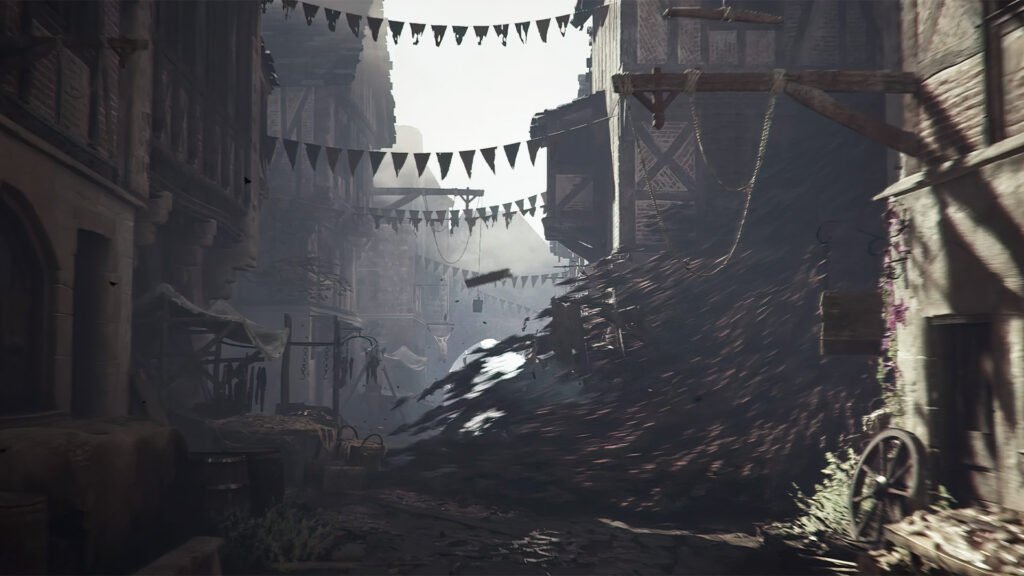
A Plague Tale therefore does not simply “set” a modern apocalypse in the Middle Ages. It combines historical plague imaginaries with narrative patterns familiar from twenty-first-century dystopias. Read after COVID-19, its isolated districts, mobility anxieties and fragile returns to normality acquire an additional contemporary resonance. The series’ Middle Ages become a mirror: distant enough to appear alien, but familiar enough to make modern fears about pandemic society playable.
Suggested Reading
Benedictow, Ole J.: The Complete History of the Black Death. Boydell & Brewer, 2021.
Beil, Benjamin; Freyermuth, Gundolf S.; Schmidt, Hanns Christian (ed.): Playing Utopia: Futures in Digital Games. transcript Verlag, 2019.
Stauffer, Isabelle; Dziudzia, Corinna; Tatzel, Sebastian (ed.): Utopien und Dystopien: Historische Wurzeln und Gegenwart von Paradies und Katastrophe. Bielefeld: Aisthesis Verlag, 2022.
Dodds, Ben: Myths and Memories of the Black Death. Palgrave Macmillan, 2022.
Naphy, William G.; Spicer, Andrew: The Black Death and the History of Plagues, 1345–1730. Tempus, 2000.
Author Bio
Ron Heckler studied history and history journalism at Justus Liebig University Giessen. From September 2022 to August 2026, he worked as a civic educator for historical and political education at Deutsche Gesellschaft e. V., implementing educational projects on historical remembrance. In 2024, he organised “GG!”, a colloquium on the social impact of digital games, and from August 2025 to August 2026 co-led “The Invisible Wall”, a serious game on the Peaceful Revolution and German reunification for visually impaired people. His research and publications focus on historical representation, authenticity, digital games, and media-based memory culture.
Thanks for this! I think one thing that is interesting here is this sense of making the apocalypse a very active, pressure-hose feature of things, in a way that differs from both medieval understanding and modern experience. Even with a relatively fast-acting disease like the plague, there’s an awful lot of quarantine and waiting involved in real experiences of it, and that isolation was also one of the most prominent features of COVID lockdowns. So how do you think the game navigates (if it does) that juxtaposition, and what effect does losing that time-lag element have on how people understand the medieval and modern systems it’s reflecting?
[…] 4 – Time and death10h – ‘Possible Medieval Pandemics? How A Plague Tale Constructs a Playable Apocalypse’– Ron Heckler10h20 – ‘Death as Procedure: Sacred Language and Undead Labour in Graveyard […]
Thanks for this Ron. I think you raise some really important points, but how do you think the supernatural elements associated with the games impact their depictions of the Black Death? Do they emphasise the horror? Or distance the player from the reality?