
The most revealing word in Graveyard Keeper may be “resurrection.” In Christian thought, resurrection evokes judgement, salvation, and the restoration of the body. In the game, however, resurrection names a procedure: the corpse is returned not to spiritual life, but to work. This displacement is central to the game’s medievalism. Graveyard Keeper does not simply populate a medieval-looking world with churches, graves, inquisitors, witches, and zombies. It converts the religious and social language of death into interlocking systems of management, extraction, and labour.
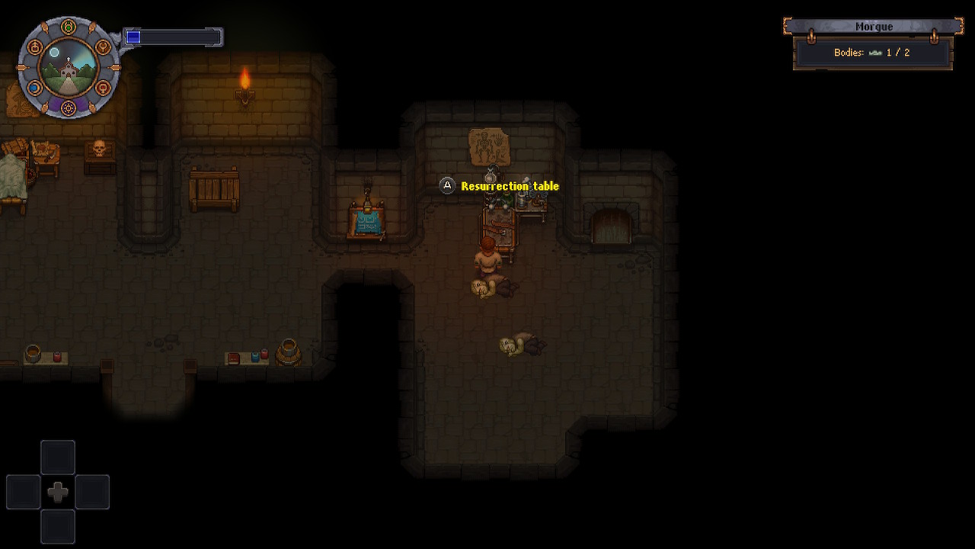
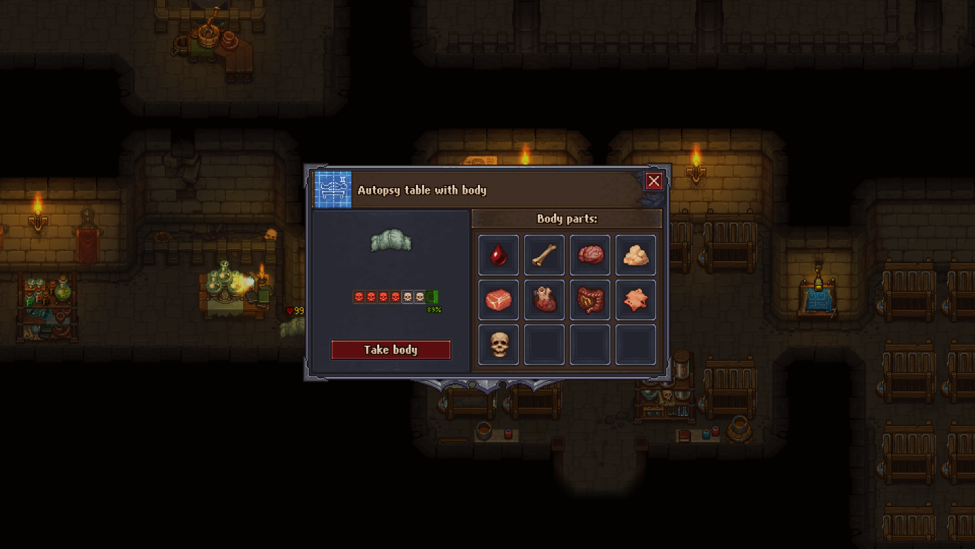
In Christian funerary culture, the dead body is not merely waste matter. It is ritually cared for, buried in consecrated ground, remembered by the living, and placed within a theology of judgement and resurrection. Graveyard Keeper keeps this vocabulary visible, but redirects it into procedure. Corpses are evaluated through skull ratings, modified through autopsy, decomposed into removable parts, buried, burned, discarded, or converted into zombie workers. The body becomes legible as data before it becomes meaningful as memory. Faith follows the same logic: it remains a religious word, but in play it becomes a resource to be collected, spent, and converted into progress.
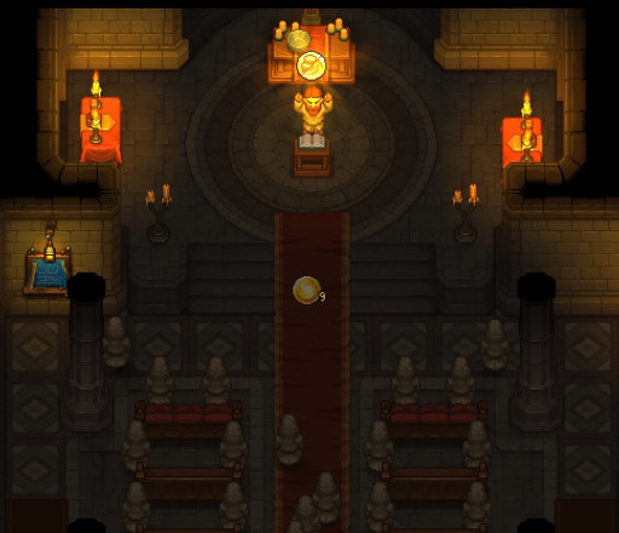
What begins as corpse management therefore becomes world-making. The graveyard is not an isolated sacred setting, but the organising centre of a possible world in which faith, labour, death, punishment, and production circulate through the same system. Sermons generate faith and donations, while the quality of the church and graveyard affects the rewards available to the player. The Keeper’s narrative desire to open the portal and return home further reorganises the world into a network of tasks, bodies, resources, and obligations.
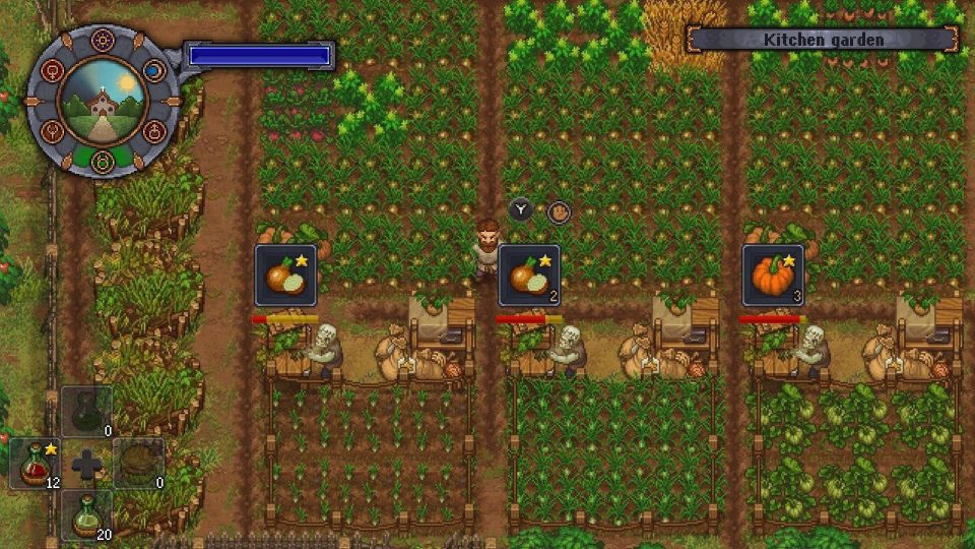
This logic becomes clearest in the zombie worker. Resurrection becomes conversion. The dead are not restored to community; they are redirected into productivity. The zombie literalises a possible medieval past in which care for the dead is absorbed into automation.
The same conversion of sacred language into procedure also shapes the game’s treatment of religious deviance. The Inquisitor’s burnings do not appear as a separate subplot, but as an extension of the same world-system. Heretics, pagans, and witches are framed through religious anxiety and social othering, yet their punishment is staged as spectacle, entertainment, consumption, and economic opportunity. Public violence becomes an event around which authority, popular approval, food, drink, and profit circulate. The line “Beer washes away all sins” captures the grotesque logic of this world: sin is not resolved theologically, but processed socially and materially.
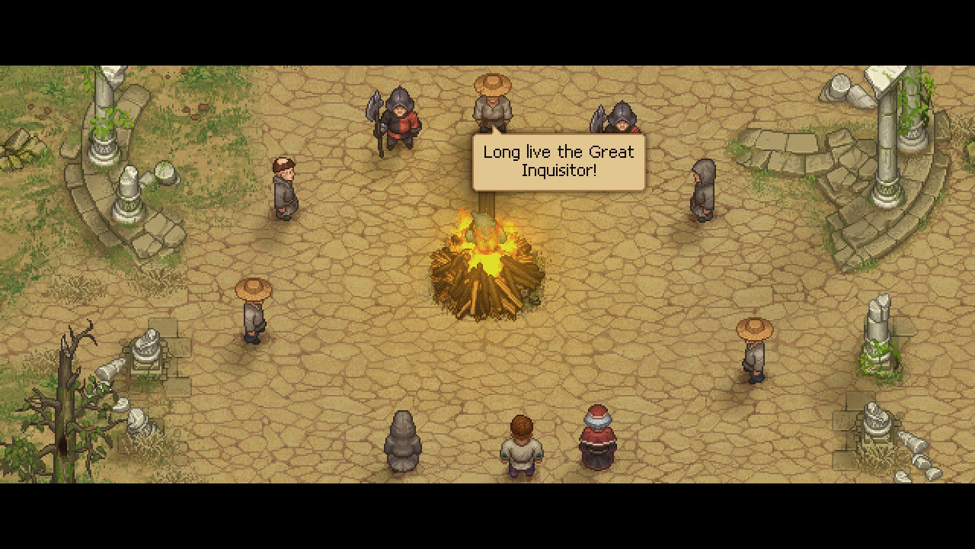
Through this comic brutality, Graveyard Keeper imagines a possible medieval past in which death culture is not abandoned but proceduralised. Its medievalism lies in this unstable mixture: it offers a possible world in which sacred meanings survive, but only by being translated into systems the player can optimise.
Suggested Reading
Adam Chapman, Digital Games as History: How Videogames Represent the Past and Offer Access to Historical Practice. Routledge, 2016.
Ian Bogost, Persuasive Games: The Expressive Power of Videogames. MIT Press, 2007.
Daniel T. Kline, ed., Digital Gaming Re-imagines the Middle Ages. Routledge, 2014.
Paul Binski, Medieval Death: Ritual and Representation. Cornell University Press, 1996.
Nancy Mandeville Caciola, Afterlives: The Return of the Dead in the Middle Ages. Cornell University Press, 2016.
Michael D. Bailey, Battling Demons: Witchcraft, Heresy, and Reform in the Late Middle Ages. Penn State University Press, 2003.
Charles Zika, The Appearance of Witchcraft: Print and Visual Culture in Sixteenth-Century Europe. Routledge, 2007.
Author Bio
Baykar Demir is an Assistant Professor in the Department of Digital Game Design at Istanbul Bilgi University, where he teaches both theoretical and practice-based courses. He holds a BA in Arts Management and an MA and PhD in Art History. His research focuses on visual culture, iconography, medievalism, and the intersections between art history and video game studies. Alongside his academic work, he has been active as a curator for over fourteen years and has recently begun developing games, bringing together scholarly research and creative practice.
I think this line of thinking about mechanisation of the sacred is really interesting and useful. Is there any voiced pushback in the game of NPCs objecting at all to things like using zombie labour (as there is in eg Avowed?)
And more widely, do you think there are better ways to approach this sort of mechanisation of the sacred? Do systems with less monetary “currencies” (hero tokens for honouring the dead in Return to Moria, or all the non-physical items like Memories of Light in Fallen London) actually work for this in separating the spiritual ‘economy’ more, or does that just end up being the economic model of death brought in by the back door?
Thank you, I think there is an important distinction here. In the first Graveyard Keeper, zombie labour is normalised primarily for the player and at the level of the game system, rather than through explicit social acceptance within the fictional world. Once zombies are unlocked, the game does not really frame their use as an ethical choice. The question becomes one of efficiency: where should they work, what should they produce, and how can their labour be optimised?
At the same time, most of this labour is relatively insulated from ordinary social scrutiny. We do not really get sustained NPC debate about whether using the dead as workers is acceptable. So perhaps I would revise “normalisation” slightly: it is not that the game shows society collectively accepting zombie labour, but that the system makes ethical objection largely unnecessary or invisible. The absence of pushback is itself part of the procedural framing.
That also makes the comparison you suggest particularly interesting, because a game does not need to turn sacred value directly into money in order to economise it. Honour, memory, faith, or other non-material values can still behave like currencies if they are countable, accumulable, spendable, or convertible into progression. For me, the crucial issue is therefore less monetisation than commensurability: whether qualitatively different sacred values are made measurable and exchangeable within the same optimisation system.
A system could resist that by making memory, honour, or ritual obligation contextual, relational, or irreversible rather than simply spendable. Otherwise, as you suggest, the economic model of death may simply return through the back door.
Yes, I think that makes a lot of sense – it’d be interesting to think more mechanically sometime about what one could do to keep that contextual element!
Thank you for this piece, is very interesting and it got me thinking.
I read this game as a modern interpretation of labour with a medieval dressing on top. Where as you mentioned in your previous response there are no visible objection and if we consider the grave digger to be a marginal figure there is the scapegoat there. But even in that sense is the labour of the very marginalized that is okey to use by forced and to put bodies into the production gear. Attached to this is the story of zombie as a non-European figure and one that symbolizes this exploitation in a creole Caribbean environment.
I haven’t played the game to be honest and I have done this reading from your own analysis, so I was just wondering how much have I misjugded and extrapolated from what is doable in the game from your own analysis of this mechanic.
Thank you very much!
Thank you. I actually think your reading gets very close to what the mechanic is doing, although I would make two qualifications. The labour reading is certainly there. Once zombies are unlocked, dead bodies are quite literally incorporated into systems of farming, quarrying, transport and production, and the game treats this primarily as a question of efficiency rather than consent.
I would be a little more cautious about the Keeper himself as a marginalised gravedigger or scapegoat. He is actually an outsider from the modern world rather than someone originally occupying that social position, and over the course of the game he acquires considerable religious and economic authority. So I think the more interesting asymmetry may be that an outsider very quickly becomes someone who can organise and exploit other marginal or abject bodies.
There is also one particularly strange complication in Gunter. He is a sentient zombie who was originally created by a previous Keeper to help with chores and was chained up after becoming too intelligent. That moment briefly gives the undead worker something like subjectivity, but Gunter does not become a voice against zombie labour. He actually teaches the player how to create more zombie workers. So even the character who could potentially expose the violence of the system ends up enabling it.
I also think your point about the Caribbean genealogy of the zombie is very important. The game itself does not explicitly racialise its zombies or invoke the Haitian and Creole history of the figure, so I would hesitate to say that it consciously represents that history. But the older zombie as an image of coerced labour, the body deprived of agency and compelled to continue working, inevitably makes the mechanic resonate differently. In that sense, I think your reading is less a misreading than an additional historical genealogy that my short paper did not have space to address.
Thanks for this, this was really interesting (and not a game I know, although now I am quite curious about it…) I was wondering if you could say a little more about where this extractivist approach comes from – that is, do you think this game is kind of imposing a modern capitalist (or neo-liberal?) set of ethics and mechanics on a medieval(ish) setting, or are there elements already in the medieval handling of death that have the potential for that kind of approach in them, that are just extended here? Quite a lot of these contexts in the medieval world, after all (at least burial, the role of the church, etc – not so much zombie workers) were significantly affected by financial means, so there being a commercial, extractive element here at all is perhaps not *totally* modern? Or do you think it is in the way it’s handled for this game?
Thank you. I think the answer is probably both, and this is where I would now want to make the distinction a little more carefully. I do not think the presence of an economic relationship to death is itself particularly modern. Medieval burial, commemoration and religious practice were deeply material as well as spiritual. Money, property and endowments could support churches, burial, prayers and masses for the dead, so there was already a very real relationship between financial means and the care or commemoration of the dead.
What feels more specifically modern to me in Graveyard Keeper is not that death has an economy, but the form that economy takes. The game makes very different things increasingly commensurable. Corpse quality can be measured, faith can become a resource, church and graveyard quality produce calculable rewards, and eventually the corpse itself can be converted into labour. So practices that historically involved exchange, obligation, status, ritual and salvation are flattened into a relatively transparent system of inputs, outputs and optimisation.
That is why I would probably be slightly cautious about calling the game simply capitalist or neoliberal. Those terms may be useful, particularly because the game is very consciously satirical about labour and efficiency, but I think the sharper distinction is between a medieval material economy of death and a modern managerial logic applied to it. The medieval elements provide genuine historical possibilities for exchange, but the game extends them until almost everything can be measured, converted and made productive.
So perhaps the extractive quality appears most clearly at the point where the corpse itself changes status. Paying for burial or endowing prayers for the dead still treats the dead person as the object of ritual and commemoration. In Graveyard Keeper, the body can also become the resource being extracted from. Its parts, its quality and finally its capacity for labour all enter the production system. For me, that is where the game moves beyond simply exaggerating a medieval economy of death and produces something recognisably modern.
Thanks for the thoughtful response – that’s really interesting!
[…] Medieval Pandemics? How A Plague Tale Constructs a Playable Apocalypse’– Ron Heckler10h20 – ‘Death as Procedure: Sacred Language and Undead Labour in Graveyard Keeper’– Baykar […]