
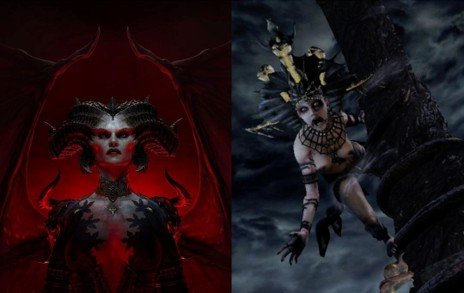
The monstrous-feminine has long populated our imaginations – the witch, the killer, the archaic mother, the demonic entity, the seductress and so on – serving as an allegory for the castration of women into socially preconceived, misogynistic norms. Kleopatra VII from Dante’s Inferno (2010) and Lilith from Diablo IV (2023) are two such examples, as demonic queenly figures of hell, who reinforce their medieval depictions and serve as a wider allegorical dichotomy between gendered medievalism and modernity, colliding the past and present together.
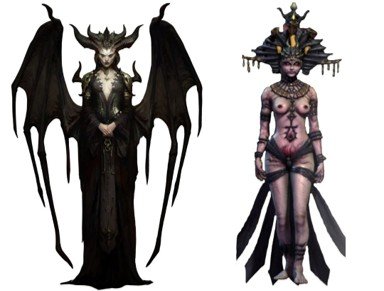
In medieval Judeo-Christian tradition, Lilith evolved from an Assyrian goddess-protector of women and infants into the queen of Hell and an incarnation of evil after the patriarchal transition. Diablo IV renders Lilith as a demonic, queenly matriarch of Sanctuary, akin to the popularised Judeo-Christian iconography – horns, wings and a hellish aura. Kleopatra, however, became affiliated with the second circle of Hell – Lust – due to Dante’s Divine Comedy (1314), which cast her as licentious and debauched. Dante’s Inferno subsequently merged this with Horace’s ‘fatale monstrum’ (23 BCE), thereby depicting a demonic, lustful witch-queen presiding over the second circle alongside her lover, Antony.
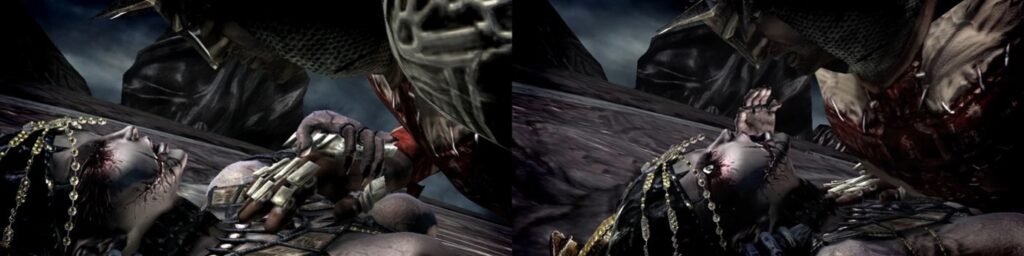
Dante’s Inferno offers a monolithic depiction of Kleopatra as a transgressive, lewd witch – her lustful storm, unclothed breast, provocative tone, and the unbaptised babies she unleashes from her bosom – a subversion of feminine chastity and the antithesis of the protagonist’s hegemonic masculinity, culminating in Kleopatra’s overly eroticised death. It is no coincidence that the only female boss in the game is located in the circle of lust, erotically killed and designed for the gratification of the male player. Kleopatra thus embodies the unworthy model to be avoided, while Dante is heralded for his misogyny and female subjugation, cementing the outdated social order for modern gamers and projecting a misconception of an overtly patriarchal Middle Ages in which women were inferior to men.
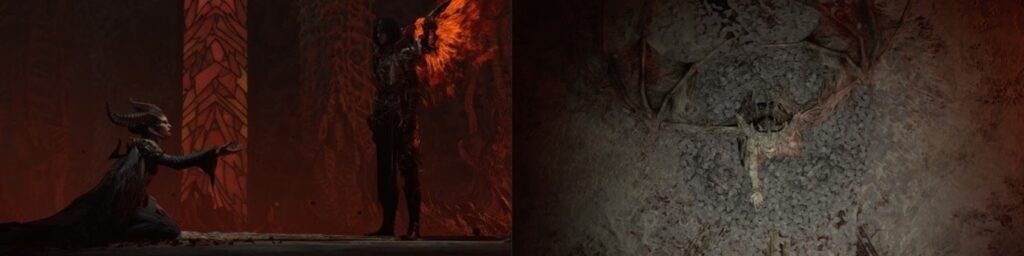
Equally, in Diablo IV, Lilith is portrayed as a demonic, queenly matriarch who manipulates humanity in an attempt to end the Eternal Conflict between the High Heavens and Hell. The game employs a tripartite allegory: the heavens as preservers of patriarchalism, Hell as subversive anarchy, and Lilith as a morally grey figure seeking a new order free of oppression and subjugation, akin to Lilith’s own break from Adam in Genesis. She symbolises free will and choice, opposing her male counterparts, who seek to control and dominate mankind. The game ends again with Lilith’s fall, but this time it is not eroticised; she is a worthy adversary, though still a victim of patriarchy. Her death, unlike Kleopatra’s, prompts players to question her villainy and the world she fought for, recasting the notion that the monstrous-feminine is not inherently transgressive and the misrepresentation of anyone who challenged the dominant social order.
The worlds of Diablo IV and Dante’s Inferno demonise female power and authority as monstrous and inherently transgressive or as victims and inferior, aligning with popularised perceptions of an archaic and deeply misogynistic Middle Ages that the player seemingly upholds. But they also demonstrate shifting perceptions in modern audiences’ engagement with and understanding of gender and power – from wholly demonic and perverse to more nuanced and layered, a reconsideration that recognises that not every woman branded as an anti-heroine deserved such condemnation. While both worlds highlight a patriarchal past, they also emphasise the clash between medievalism, modernity and the gendered past in video games, and the fraught legacy that remains ever present today.
Suggested Further Reading
Lilith:
Baral, Anuska. “Lilith in Video Games: Feminist Myth-Making and Monstrous Power.” Research Journal of English Language and Literature, Vol. 13, no. 1 (2025): 183-191.
Grenn, Kohenet Deborah J. “Lilith’s Fire: Examining Original Sources of Power Re-Defining Sacred Texts as Transformative Theological Practice.” Feminist Theology. Vol 16, no. 1(2007): 36-46. DOI: 10.1177/0966735007082514.
Kleopatra:
Sewell-Lasater, Tara. “Eternally Maligned as the Power-Hungry Femme Fatale: Kleopatra VII in Assassin’s Creed Origins and Other Video Games.” In How Pharaohs Became Media Stars: Ancient Egypt and Popular Culture. Edited by Abraham I. Fernández Pichel. 185-204. Archaeopress, 2023.
Gender:
Creed, Barbara. The Monstrous-Feminine: Film, Feminism, Psychoanalysis. 2nd Edition. Routledge, 2024.
Elhallaq, Ayman Hassan. “Representation of Women as Femmes Fatales: History, Development and Analysis.” Asian Journal of Humanities and Social Studies. Vol 3, no. 1 (2015): 85-91. https://ajouronline.com/index.php/AJHSS/article/view/2295.
“Tropes vs. Women in Video Games: Curriculum.” Feminist Frequency. July 27, 2018. https://feministfrequency.com/tropes-vs-women-in-video-games-curriculum/.
Author Bio
Kurtis Pope is a History PGR student at the University of Winchester. His doctoral research examines how premodern regnant queens are represented across modern popular culture, including digital games. He has recently delivered a paper on Kleopatra VII in Assassin’s Creed: Origins (2017) and a two-part podcast episode with the Royal Studies Podcast on the depiction of global queenship in film and TV.
Thank you so much for this paper Kurtis to kick off today’s panels – lots of really interesting examinations of gender and power in games coming today! So many things I’d love to talk more about here but to start us off I was wondering if you could touch a little on race – I know you have worked on Kleopatra VII in other games too, and obviously her ethnicity has been really widely discussed in popular discourse which has shaped a lot of popular representations generally but I don’t really know much about how that comes into her depictions in games, so I was just curious if you think that there is a racialised element to the way that she is portrayed and exoticised or if it seems to be really in line with the same ways that other powerful female characters are made monstrous and erotic (especially in death/defeat)?
Hi Tess, thanks for your question. As you noted, race and ethnicity have significantly influenced Kleopatra’s legacy and ongoing debates, from the controversy over Netflix’s Cleopatra docudrama (2023) to criticisms of Sarra El-Arifi’s Black Kleopatra (2026) (I recommend reading her book if you haven’t).
In digital games and many other platforms, Kleopatra is often portrayed through orientalist lenses. In Dante’s Inferno (2010), the decision to present Kleopatra as Pharaonic – through the Nemes headdress – alongside her immoral actions to summon unbaptized babies to fight Dante is an example of how Orientalism has still seeped through. Granted, demonic women, Lilith included, have often been commented on for their endangerment to children and mothers, although that is often in the act of taking newborns or miscarriages and so on. Kleopatra, however, in the game goes beyond this to use unbaptised babies as weapons, ultimately sending them to their doom – the opposite of the maternal figure. The Egyptian garb further emphasises this as an act of barbarism from an immoral otherness that is neither Greek nor Western and the antithesis of Dante’s perceived piety. The game itself, however, paints Kleopatra as fair-skinned; whether that is to represent the fact she is dead, or a comment on her claimed Greek (white) ancestry, is up for debate, but her actions nonetheless akin her to Orientalism.
Additionally, as Said highlights, Orientalism was intended to vindicate the West’s triumph over the Orient. From this perspective, Dante represents the Christian West and Kleopatra the archaic Orient, culminating in the final phallic act, which symbolises the West’s victory over the Orient, man over women, civilisation over barbarism, and so on.
It’s also worth noting that Dante’s Divine Comedy (1314) only gave a sentence to Kleopatra: ‘then comes licentious Cleopatra ’; the rest was the machinations of the game developers. From the babes, to her nudity, the lust storm and the phallic death and the Pharaonic headdress – all, as I have attempted to argue, were heavily influenced by Orientalism and used as a way of painting Kleopatra as something non-Western.
Similar tropes recur across other games, such as the Kleopatra who ‘will sleep with anyone’ in Assassin’s Creed (2017). The opening remark reasserts the idea that Kleopatra was promiscuous and slept with many men – we only know of two. In addition to her cruelty in the game against two high priestesses, along with the orientalist dream of appearing in front of Caesar having emerged from a carpet – more likely a cloak or bed roll.
As for whether there is a far wider trend across other powerful female characters who are made monstrous and erotic, that is beyond my current research, but certainly something that would make for an interesting case study, especially between historical and fantasy women.
I hope this answered your question.
So, I think there’s a bit I’d like to push you to unpack here on what you mean by Judeo-Christian: how similar are Jewish and Christian medieval ideas of Lilith in particular? Is there a lot of regular cross-fertilisation of the ideas about her that Dante ends up using and which get into modern esotericism, or are there one or two “jump” moments where the ideas from one tradition reach into the other? And also, for that matter, how much is this being influenced by neopagan and esotericist viewpoints that are generally a reaction to the Christian tradition?
I do see your point about Judaism and Christianity both being important here, but I’m always a little wary of the way they get lumped together so neatly (and often to the exclusion of other belief systems involved in the development of certain ideas), so I’d be really interested to hear more about that part.
Hi James, thank you for your questions. I will do my best to answer them. However, I do wish to preface this response by noting that I am not a specialist in religious studies.
For the most part, what we learn of Lilith originates from the Jewish ideas regarding the creation of man, the Babylonian Talmund and in the The Alphabet of Ben Sira. For ease I have bullet pointed each one and what we learn:
Genisis:
Lilith was created to reconcile the two creation stories in Genesis.
– Genesis 1. The simultaneous creation of both man and woman as equals, and both are the pinnacle of God’s creation.
– Genesis 2. Man created first and placed in the garden of Eden, and only later are animals created as possible companions and eventually Eve (woman) created as a counterpart to Adam. Thus, man is created first and woman last.
Thus, Genesis 1 was interpreted as Adam’s first wife: Lilith, and Genesis 2, as Adam’s second: Eve.
The Babylonian Talmund (c.500-600CE)
– BT Niddah 24b. We learn that Lilith had wings and that she could influence the outcome of a pregnancy
– BT Shabbat 151b. Warns that man should not sleep alone or Lilith may fall upon him.
(Referring to her being a female succubus, taking the seamen of men to produce hundreds of demon babies.)
Mesopotamian: Nurney Relief/The Queen of the Night: https://ac.nau.edu/omeka-s/s/lilith/item/3899.
The Alphabet of Ben Sira (c. 8th-11th Centuries)
– Lilith is the first wife of Adam, but after refusing to submit to him, she uttered the divine name and flew up into the air and fled. Afterwards, she refused to return under God’s orders and became a demonic entity associated with the death of infants.
Conversely, during the Christian Middle Ages, Lilith became identified with the succubae, but by and large remained omitted from Christian texts. In 1565, in German folklore, she became the grandmother of Satan. By the time we reach the late Middle Ages and the Early modern period, Lilith is associated with demons across the board.
Now, granted, the depiction of Lilith in Diablo IV (2023) is more akin to the artistic legacy of the witch hunts and the demonology that expanded from the early modern period, and more a reflection of what we would conceive a demon to be today than how the ancient or even the Middle Ages viewed her. In the game, she dons bat-like wings, whereas in iconography she is associated with owls and owl-like wings.
As for other religious affiliations with Lilith, that is beyond my knowledge for now, and so I cannot make comment on that.
Apologies if this has not fully answered your questions.
Thank you for this brilliant paper! I really enjoyed reading your examinations of female characters. Another point of comparison that includes the Slavic sphere could be the female (witch) character Baba Yaga, who also features in digital games – ranging from cosy games (depicting her as wise female sorceress) to shooters (presenting her as evil witch boss). Here, too, the implications of patriarchy and shifting role attributions in folklore narratives are evident.
Hi Kristina, I am glad you like the paper. Also, thank you for raising Baba Yaga as an interesting comparison. I know little about her, but it would be interesting to explore the shifting attitudes towards witches and witchcraft and their associated representations in games. Although sorcery is often villainised in Western contexts, different cultures and societies throughout history have had varied relationships with and perspectives on witchcraft and magic.
[…] 8 – Gender10h– ‘Queens of Hell: Kleopatra, Lilith, and Possible Pasts in Medieval Fantasy Games’– Kurtis Pope10h20 – ‘‘I do not seek a marquis title but peaceful seas’: The imagination […]