
In historical game studies, our usual mode of operation is analytical – looking at what games already do – or occasionally discussing our own personal bugbears in games, literal or otherwise. What if we set the net wider in terms of looking for inspiration?
In this short design case study, I’m going to make an abstracted attempt at doing that: I’m going to semi-randomly pick something medieval and design around it. I drew up a list of twenty western Asian and southeastern European high medieval texts, then dice-rolled to randomise book, chapter, and page or passage, and picked three:
- Page 36 of John Kinnamos’ Chronicle. This is from 1144, and mostly covers Manuel Komnenos recalling and reconciling with his uncle in the Pontus and brother in Constantinople after various political plots.
- Law 21 in Mkhitar Gosh’s Armenian law code. Late 12th century. This stipulates that Armenian peasants are free to live where they choose if they leave: if they are prevented from leaving by a lord, their children should not be.
- Mkhitar Gosh’s Colophon, section two. Yes, I somehow got the only pair of texts on the list by the same author. This covers the religious councils of 1139 among the Albanians/Aghuanians (that is to say, Caucasian Albanians, a former kingdom in the eastern Caucasus that was by this time a regional identity falling largely within the Armenian religious community). That, after a gap of some years, anointed a new Catholicos of the Albanians, and blessed a lot of new chrism (christening oil), which had run in such short supply that people were using water instead.
What here might provide us with game inspiration? First, we have some core narrative concepts – exile, forgiveness, missing a religious leader, freedom from servitude – to play with. Second, we have fairly contemporary material chronologically, so there is the possibility for a particularly historically grounded loose connection between these elements. Third, we have some activities. Travel in the case of the exiles, or in the case of the imagined freed peasant or their child, debate and travel in the case of the Albanian clerics brought together.
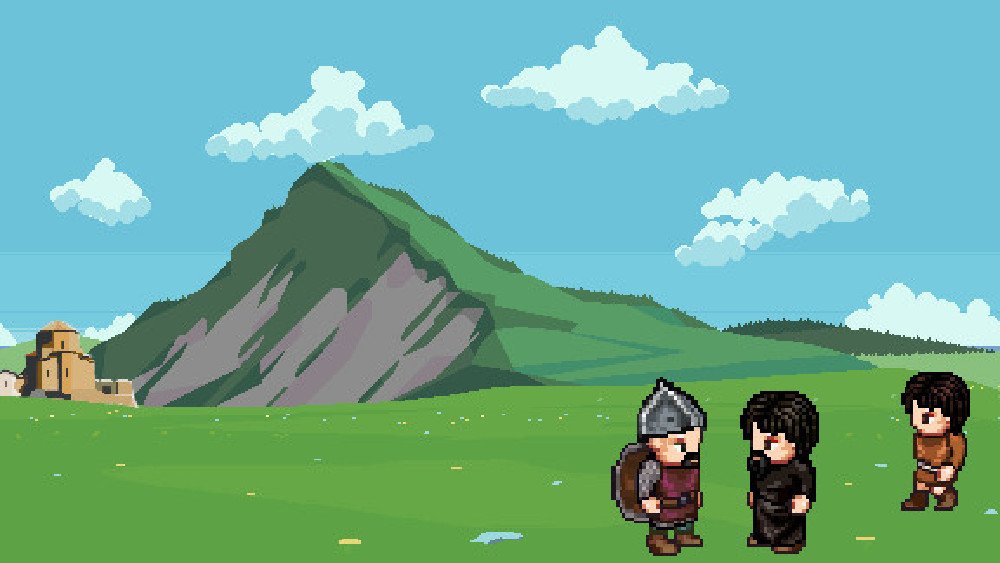
It feels like this is bringing together some sort of Canterbury Tales situation – or, indeed, an adventuring party. Whilst Manuel’s uncle was only sent as far as Heracleia in the western Pontus, sending exiles further afield did happen including his cousin and eventual successor Andronikos ending up in the Caucasus, so we can shift a less historically grounded, less senior Byzantine noble over to meet our other travellers, a peasant (or peasants) whose priest advised a reluctant noble that he should be allowed to leave and seek a new place to live, and an Armenian or Albanian monk carrying chrism or perhaps escorting a senior foreign cleric.
These characters are also neatly well motivated: the Byzantine as a military aristocrat will be trying to find someone to grant them land or to serve militarily, the peasants are presumably trying to find somewhere with a better lord to start a new life, the monk has an escort/delivery sidequest to do. There are tensions in these motivations too: the Byzantine noble is going to have different Christological views to the Armenians (and may be educated enough to express them),
Finally, how could we mechanise this? One could just play these guys at a D&D table quite easily, but I think as a standalone game the core objective might be to focus on exploration and the party. Balancing the needs of our party could essentially be a case of morale resource management, with storylet-style design (see for example Fallen London or Wildermyth) giving us particular story moments that can come in randomised orders.
And there you have it – a miniature bit of design through medieval text and randomisation. As an experiment this got me much closer to something that fits familiar modern gaming tropes than I expected, and I may try repeat tests to see if other random sets work out as well (the three passages above were literally the first three I picked). Whilst I needed my own wider knowledge to work out from these passages, using randomisation as a shortcut to serendipity and discovering historically-informed motivations, events, and processes that we can build game mechanics around might have useful potential for helping think through how we can, and could, convey medieval ideas through gameplay.
References
John Cinnamos, The Deeds of John and Manuel Comnenus trans. Charles Brand (1976).
Mkhitar Gosh, The Law Code [Datastanagirk’] of Mx’itar Gos’ trans. Robert W. Thompson (2000).
Mkhitar Gosh, Mkhitar Gosh’s Colophon, or, The Aghuanian Chronicle trans. Robert Bedrosian (2007).
Biography
Dr. James Baillie is the Digital Humanities coordinator for the Institute for Iranian Studies at the Austrian Academy of Sciences, and a collaborator on the Coding History project at the University of Oslo. His research interest include the medieval Caucasus in the 11th-13th centuries, prosopography and social network analysis, the interactions between data models and historiography, and the modern understanding of medieval history especially in games. He is a co-convenor of the Middle Ages in Modern Games conferences, and of the Medieval Caucasus Network, and a member of the International Association of Byzantine Studies’ Commission on Prosopography, as well as being lead convenor of the Coding Medieval Worlds workshop series. Outside academia, he is an active game developer, having released his last title The Exile Princes in 2024 and more recently working to support the development of the forthcoming game Innkeep! as well as his own, as yet unannounced, next game project. He is also chair of the Exilian indie creative and academic projects community.
Image credits: Base characters by Johannes “wulax” Sjölund, main background by craftpix, adjustments and domed church image my own.
Thank you so much for this James – I really love this as a thought experiment, especially seeing how the randomness forces us to think of things we likely otherwise wouldn’t have drawn out of those sources in isolation or only in amongst a wider set of sources. I’ve always been very hesitant about randomisation, with a tendency towards assuming that hand-picked/deliberate organisation is inherently going to be more meaningful or produce better combinations, but I’m more convinced every time we talk about game design like this! Could you talk a little bit about how much work actually goes into setting up the parameters to make randomisation work the way you want it to in something like randomised order for story elements if you turned this idea into a game? Or in other games you’ve designed, as obviously this was just a hypothetical! To someone without as much understanding of the back-end of game development, for this kind of scale of concept, where does the benefit of randomised elements come in or where does it start to be outweighed by the effort needed to ensure those elements still add up to the story or theme that you wanted to convey as the designer?
So for this experiment the randomisation was pretty genuinely fully random (excepting the initial selection of sources but that was fairly broad).
When it comes to actually randomising things within a game like story elements, it needs a lot more thought and constraints, and it also depends how big and how specific the steps are. If it’s big plot points, it’s easier to lose coherence if there’s a randomisation element, whereas smaller steps that can change things more gradually often work better, especially if there’s then a way of testing that against an overall requirement or mechanic (so if you’re gaining a resource, I might have a system that caps gain/loss in case the player’s luck or unluck gets ridiculous). A lot of that’s a testing problem, running a lot of simulations of the system you’re building until the feel is right.
Sometimes that can mean reducing the randomness, but not always sometimes it just means having particular combinations that the system rejects or accounts for in some way. So it might be “if you get X, you can’t then immediately get Y”, or having fixed points that let the player have a defined aim or point to reset what they’re doing with the randomness, or having a situation where if you get both X and Y, you also get Z which makes that make more sense. For the latter, an example would be in The Exile Princes where characters have romances and characters have separate mechanics for if they actually like one another as people: I could have reduced the fluctuation to avoid situations where those were out of synchrony, but what I actually did was wrote extra dialogue lines for the specific “these people are in a romantic relationship and arguing all the time” outcome to make that work narratively.
I hope that makes some sense! I can probably think of some better examples if useful.
This sounds so fun! It reminds me of the TTRPG design workshop Thom Gobbitt and I attended earlier this year at Leeds. It didn’t involve randomization (at least, not to this degree) but it encouraged us to mix-and-match diparate sources and themes into a game design idea.
I think my question is: even though the exercise is simple, it *does* require a deal of familiarity with the sources to be able to put it together. How do you see this previous research being incorporated into the design? Or to word it differently, how should one with a less-than-specialist-level knowledge of medieval sources (e.g. a classroom teacher) proceed to perform a similar design exercise with satisfactory results?
That’s a really good question. I think it depends on how much less knowledge the teacher has: for example, the average UK school teacher would not know the point above about Albanian meaning Caucasian Albanian (or indeed Iberian meaning Georgian) in medieval Byzantine sources. Stuff on that level I think you need the basics on before you can really approach some of this material, or you risk having things that are too incoherent or in some cases dangerously wrong. So you’d need material that had been a bit more filtered and selected by a historian (which loses some of the exploratory power of the method), or you’d need a historian in the loop (which is not in reach of most classroom teachers).
For a classroom application my instinct would be to get historians and teachers building much more structured design tasks than this sort of unstructured work: the average student (or indeed teacher) also doesn’t have a lot of game design experience so things that would be super intuitive to me like “hey this fits into the narrative structure I’d need for an adventuring-party setup” also won’t necessarily slot into place easily. It’d be a fun thing to write a book that has “pick from among these abstracts, pick which of these game setups would work best” as design-level challenges, but I think it would require an extra layer of pre-selection.
[…] Annals: Narrative Agency and the Gamic Mode of History’– Vinicius Marino Carvalho14h40 – ‘Sources and Serendipity: Experimenting with randomisation and medievalism’– James […]