
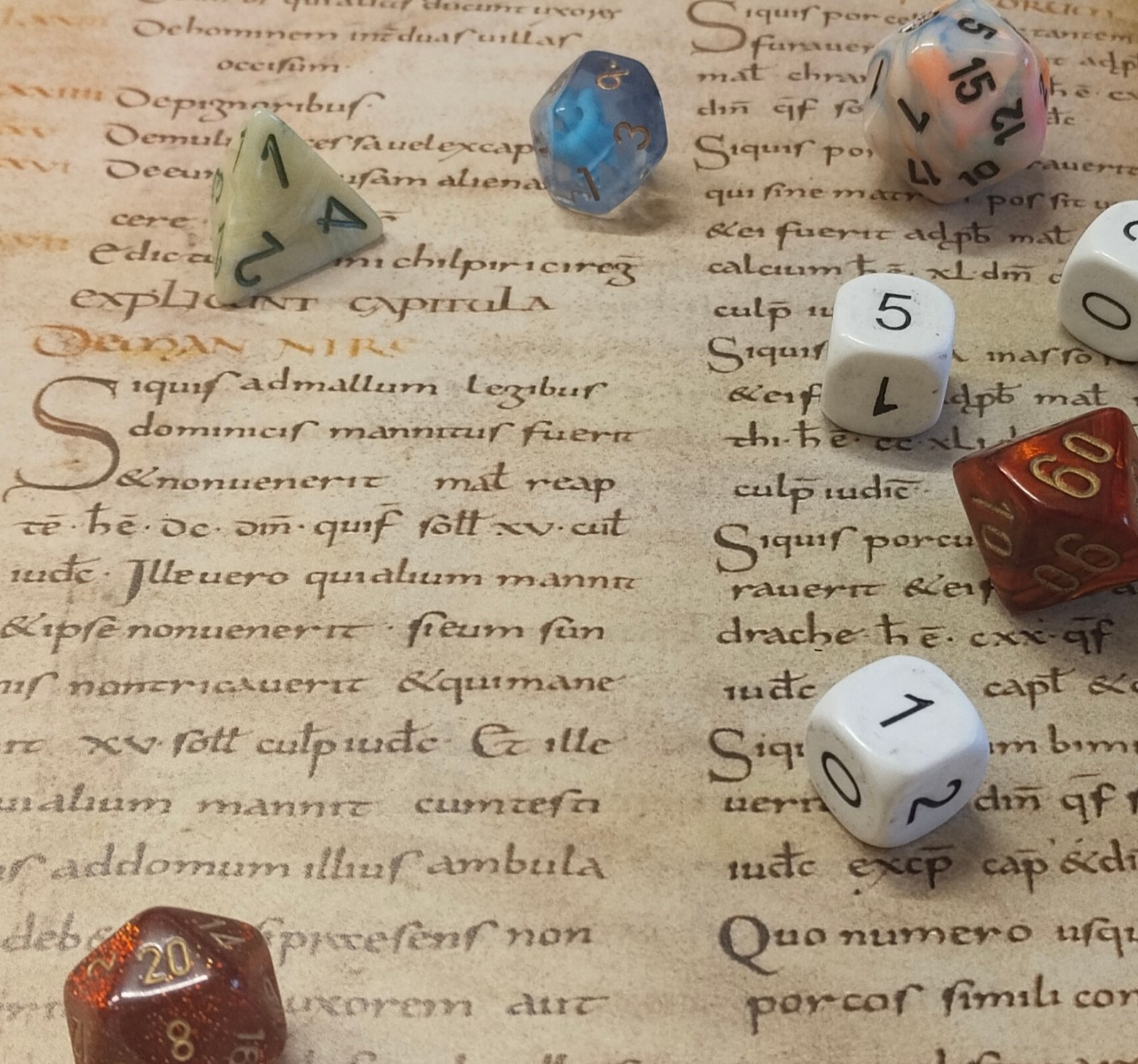
What I am increasingly terming Lawplay within the scope of my research comprises:
- The representation of law within ludic environments.
- The use of games to disseminate research findings in the field of the History of Law, and
- The use of games as a creative research method to facilitate analysis of (historical) legal sources and cultures.
While Lawplay has the potential to cover both a diverse range of historical and contemporary legal frameworks and different types of game—digital and analogue—the specific focus of my research is the intersection of the early medieval Leges Barbarorum and the Tabletop Roleplay Game (TTRPG). For those not in the know, the TTRPG is a form of semi-improvisational theatre for a small group, with one player taking the role of referee, while each of the other ‘regular’ players portrays a single character, one of the protagonists of the story (for a fuller, critical description, see: White et al. 2018; Zagal and Deterding 2018). A wide range of rulesets and diegetic settings are viable—and have been published both commercially and independently. My aim here today is to offer the first steps in an ongoing analysis of the potential for the TTRPG as a medium to investigate early medieval legal practice, and especially in relation to what the late and dearly-missed Lisi Oliver (2009, 70) termed “docufictions”.
Lisi’s venture into what she termed “speculative legal cases” (Oliver 2009, 70–77) can be found in the latter part of a chapter in an edited collection on early medieval peacemaking (Figure 1). She began with a reconstruction of the shared features of how legal cases were performed across the early medieval laws, then drew attention to the thorny problem of the limitations of the information explicitly contained in the laws. Essentially, the laws offer only a narrow band of information on the nature of a given crime and the compensation. While extant accounts of actual contemporary cases are few and far between, her solution, the docufiction, comprises constructing a hypothetical situation in which a crime might have happened: in her first example two (English) woodcutters go into the woods, one comes out missing a hand. Figure 2 offers a simplified flowchart of the key phases as the case progresses.
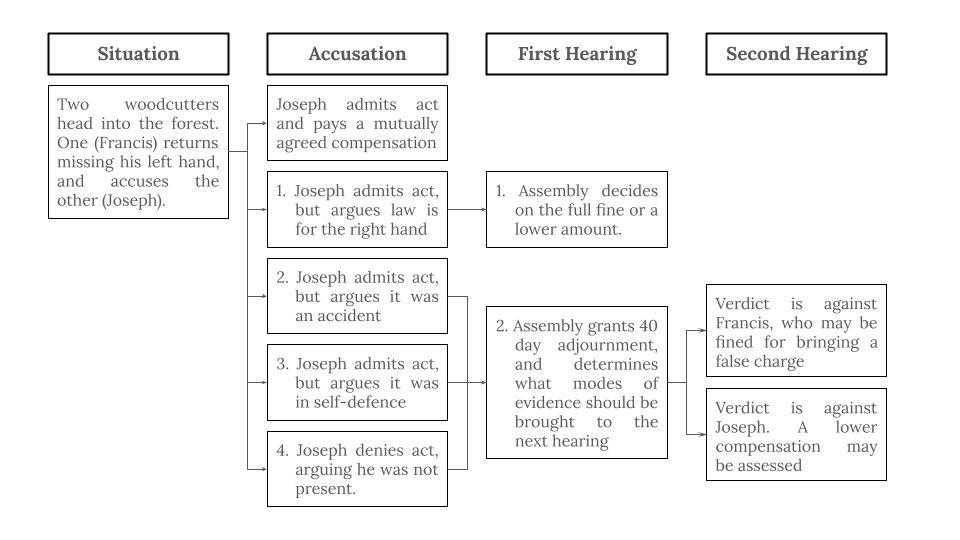
Following the outlining of the “scenario”, Lisi details if the two parties mutually agree the extent of compensation outside the court, followed by a list of four different ways that this might be disputed, then on through two phases of court hearing. She concludes with two outcomes, depending on whom the assembly finds against, and offers a brief conclusion on the payment of compensation and restoration of peace if the accused is found culpable.
To the player of TTRPGs, this structure already looks like the typical framing for a scenario that a group might run—and as the list of initial responses are already numbered, just roll a D4 to and see where the story goes for a randomised plot. The other phases could easily be turned into potential outcomes of appropriate skill rolls. From a gamification perspective, the docufiction already offers a means for analysing laws and expanding them into potential plot arcs. At the very least, then, we have here a means to facilitate lawplay as the representation of law in a ludic environment, and—depending on how the analysis of the docufiction is undertaken—the scope to convey and explore academic research findings and interpretation of early medieval laws. But more than that, the TTRPG offers a vehicle to explore the limitations and implications of those docufictions, and through them the laws, legal framework and legal imagination of early medieval people lying behind the often brief wordings of their lawbooks.
Bibliography
Lambert, T. B., and David Rollason, eds. 2009. Peace and Protection in the Middle Ages. Vol. 1. Durham Medieval and Renaissance Monographs and Essays. Durham University.
Oliver, Lisi. 2009. ‘Protecting the Body in Early Medieval Law’. In Peace and Protection in the Middle Ages, edited by T. B. Lambert and David Rollason. Durham Medieval and Renaissance Monographs and Essays. Centre for Medieval and Renaissance Studies & Durham University.
White, William J., Jonne Arjoranta, Michael Hitchens, Jon Peterson, Evan Torner, and Jonathan Walton. 2018. ‘Tabletop Role-Playing Games’. In Role-Playing Game Studies: Transmedia Foundations, edited by José P. Zagal and Sebastian Deterding. Routledge.
Zagal, José P., and Sebastian Deterding. 2018. ‘Definitions of “Role-Playing Games”’. In Role-Playing Game Studies: Transmedia Foundations, edited by José P. Zagal and Sebastian Deterding. Routledge.
I’m sure we’ve discussed this in the past, but one problem I find in designing around law and other social norms is how to hold the players to them effectively. This may be less of a problem if you’re playing with committed medieval historians, but even then, questions like “well why should I bother burying or moving this dead body, it’s not anyone I know and it’s unlikely anyone will just happen to see me if I leave it” are pretty common among players who are used to a fairly “maximise benefit, disregard custom” approach to play. Or even “well why shouldn’t I solve my problems with violence, if the law comes for me I will solve them with *more* violence”.
So do you have any good thoughts on how to get the players to “buy in” to wanting to act like members of this society, other than the negative feedback loop of “if you do that people will kill or at the very least fine you” which kind of sucks for the players?
Thanks James, yes that’s a very valid point and a question, and one that i think often requires tailoring the response to the given troupe.
So, firstly, i think a lot of this comes down to managing expectations in the “looking for group” and “session zero” phases, in order to get people who are already engaged with the setting and expectations. In addition to that, actually calling the gaming style “lawplay” actually embeds those expectations and gets people more motivated to that style of gaming. As you point out, i usually play with medievalists and archaeologists which gives me an advantage there. and yes I also expect that spreading more beyond those circles might make finding strong answers those questions a neccesity rather than a nicety…
From provisional poking at this, I’d say another thing that is essential is the system used. what are the traits on the character sheet, how does the ruleset use those to simulate/gamify expectations? As Sarah Albom pointed out in her “The Killing Roll” (2021), D&D drives players towards finding violent solutions. While as Camille Deschapelle’s argues in a case study of Pendragon, in “Around the Round Table” (2026), personality traits and passions can be used to override player impulses and set paramaters on what their character likely will or won’t do. I’ve been taking that approach in my own ruleset, with character “motivations” that help guide players towards appropriate actions and behaviour (mostly towards *breaking* laws, it must be said – and that reinforced by how rolled flaws [fumbles, botches] work for skills). But making those motivations also have a beneficial side for the player, so they feel like there’s layers of risk and reward for it.
But taken together, i think the biggest thing I’m currently working on, is framing. If players’ presupose that NPCs coming to kill or fine them for their actions “kind of sucks”, then sure they might not want to give it a try in the first place – but making those very events central to the plot, giving players a chance to evade them and to steer them? That *should* be the drama itself!!
I’ve not yet ran the pursuit of a law-case itself within my research-led roleplaying, so my hopes here might well be proven wrong. (Typically, I’ve ran oneshots, where the game ends when the crime is uncovered and an accusation brought, or is about to be brought. So that has evaded some of the consequences that might ‘suck’ for players). But early medieval law gives a lot of scope to incorproate violence into the process, and also to gamify the modes of legal proof and the pursuit of the case. I guess whether that works or not will be in the telling… and of course, when i reach the point fo getting these materials out for other referees to run themselves, in clarifying those elements within the ruleset 🙂
Oh, and the other point to add/clarify: making games so that they revolves around law and the legal framework, sometimes closer sometimes further away is also important. Sessions that give players their agency to explore the medieval world, i na way that might or might not bring them into contact with the law is vital. Often it’s about testing whether a given set of events is legal or not.
In many ways, this is what Lisi explores in her docufictions study. The laws basically present the narrow critieria to define when and where the crime has been committed (and/or proved) – but the real (or speculative, gamified) events that took place may or may not match those critieria. So there’s also a lot of scope for agency there too, to then be enriched by determining consequences and legalities.
Chatting with other Trekkies at work, nothing gets us nerding out like a court room episode. So I definitely see the appeal of bringing such into RPGs. And while I’d hate to encourage rules lawyers, this is the situation for it!
The TTRPG Warhammer Fantasy Roleplay even includes a court scene in its 2005 adventure Ashes of Middenheim. It’s fairly simple, but does include the option of playing through it instead of the party being bystanders. The two sides of the case of various surprises that players can bring out when they’re ready, to add to the drama.
Hi Andrew, Yes – pointing the rules laywers at the diegetic world rather than the ruleset could definitely be a way ahead (and it could be quite in character too – there are definitely instances we can see early medieval people going by the letter of the law. I’ve skimmed across that previously, in a blog post about Lombards and false-acusations of poisoning: https://www.oeaw.ac.at/imafo/read/poisoning-in-the-early-medieval-laws-of-liutprand)
But I’m bery glad you see the appeal of a good court drama, i think there’S a lot to be done with it. Sometimes there’s a problem that the “Hollywoodified” brain wants a plot to go: crime -> accusation -> failed legal resolution in a law-case -> violent solution and catharsis. But as the early medieval calculated violence of the faida [feud] seems to be there to draw attention to the wrong, and to drive the accused to the courts, a major part will be getting people to accept that there’S better plot and catharise in reversing the final two steps of that chain: crime -> accusation -> calcualted violence -> succesful legal resolution (and catharsis).
So it’s always good to kow that other roleplayers like a good law-case too!!
and many thanks for letting me know about the Warhammer Fantasy scenario, I’ll definitely have to get my hands on that in the near future!
[…] Journey into a Lifetime Engagement with One TTRPG/LARP’– Anastasija Ropa12h20 – ‘From “Docufiction” to “Lawplay” — On Speculative Engagement with Early Medieval Law’– Thom Gobbitt12h40 – ‘The Dark Ages over Innistrad: Medievalism and Gothic Horror […]