
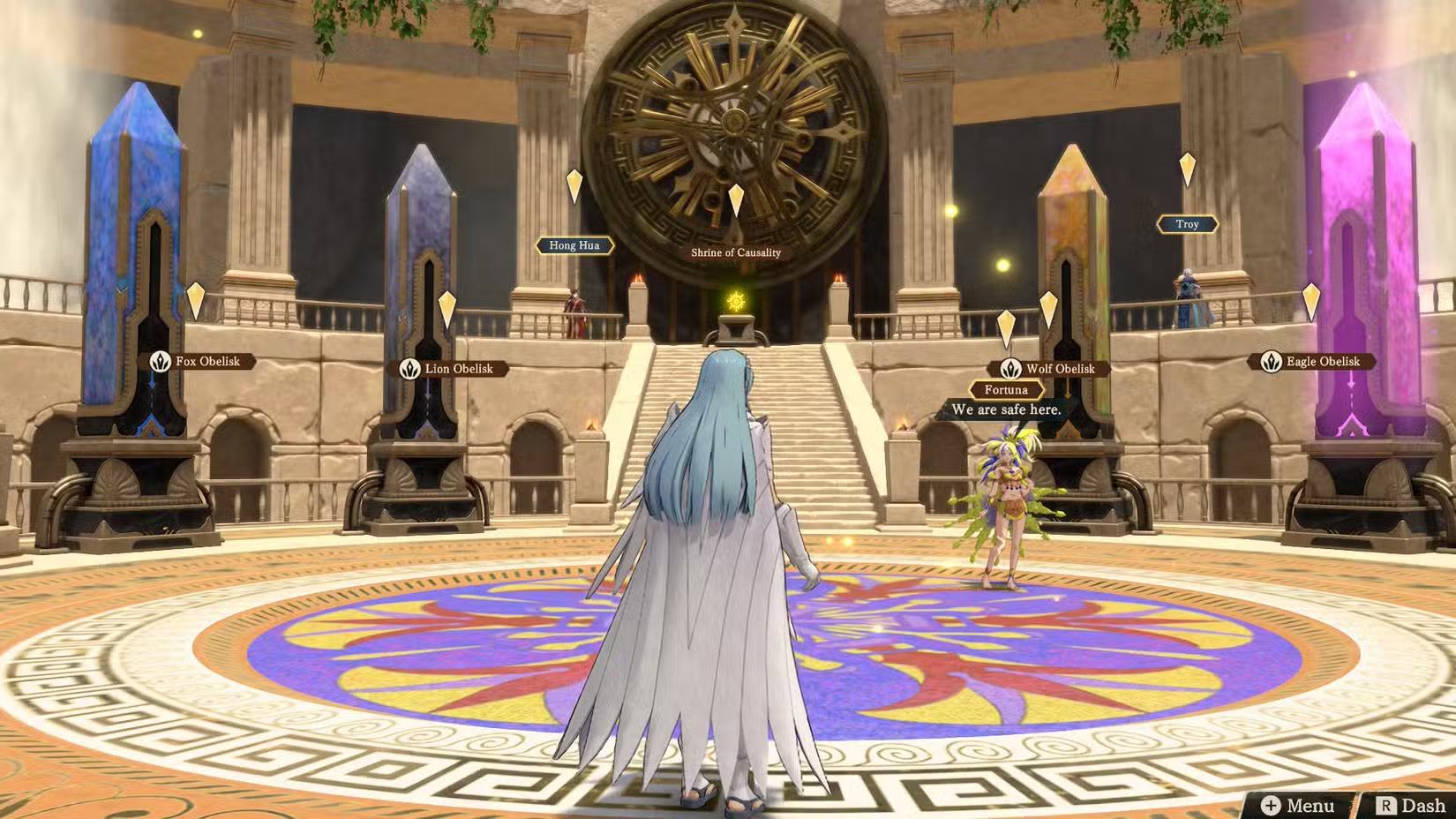
In the recently released Fire Emblem: Fortune’s Weave, the protagonist must merge together different possible pasts to save the world in a post-apocalyptic future.
This year’s Middle Ages in Modern Games asynchronous conference, which now draws to a close, has strived towards a comparable goal. Whereas past iterations have focused on the spatiality of medieval history and the weight of conflict in medievalist media (among many many other things), this year has pushed us to think about possibility itself, and the role of speculation in building a better relationship with time.
We started with a timely and provocative keynote by Leandro Wallace, who put into question the very raison d’être of the Middle Ages as an operational concept in ways we rarely see in historical game studies. The presentation was followed by a series of diverse and strong papers that covered topics as varied as the creative potential of medieval legal fiction and the spaces of possibilities that are players’ lives themselves, as they shaped and are shaped by the games they co-invent.
As it is unavoidable for a community of scholars gazing at the maw of political tribulations and ecological collapse, we had papers addressing the impact of horror and eco-anxiety in our current medievalist imaginaries. But we also had attempts to see the past as a source of potentially novel ways to rethink our relationship with time, death, and capitalism.
Following our past efforts to decenter hegemonic perspectives, some presentations tackled the thorny issue of regimes and politics of knowledge, questioning, for example, how the written bias of our sources sidelined oral tradition and the points of view of those who have been historically disfranchised by the learned elites.
Concomitantly, this conference has also further developed themes explored previously in previous iterations, like the representation and discussion of gender in historical games, the role of counterfactual reasoning in ludic medievalism, and the implications of expanding the concept of the medieval to a broader geographic sphere.
We are pleased to notice that these reflections have not only taken place throughout the papers themselves, but also in the lively discussions held at the comment sections. We wish to humbly thank everyone who took their time to engage with the work of these scholars and contributed to such a productive series of days.
And speaking of thanks, we would like to thank the Center for Medieval and Renaissance Research of the University of Winchester for its logistical and material support as well as Exilian for their continuing general support.
We would also like to thank the MAMG team, without whose work, either as organizers and moderators or behind the scenes, has been instrumental for the continuing success of the event.
Lastly, we also want all of you who presented and participated. Ultimately, this conference would be nothing without your enthusiasm, expertise and generosity, and we could not be more grateful to you all for making this happen!
MAMG will be very busy in 2027, hosting strands at both the Middle Ages in the Modern World conference at Oxford University and our traditional in-person strand at the forthcoming IMC Leeds. If any of you happens to be around the UK next summer (or winter if, like the authors of this closing remarks, you are based at the Southern Hemisphere) do consider joining us.
And, of course, the asynchronous conference will also be back next year!
We hope to see you all again! And, in the meanwhile, let’s keep playing the medieval past!
This was a tremendously rewarding experience, thank you so much!
Yay – super great to read all of the great work here! Thanks everyone 🙂
Big thanks Tess and Vinicius for putting everything together, and with my Exilian hat on we’re very happy to have supported this event once again 🙂
Per the site stats (which filter out most of the generic scraping bots), we had over 750 people from over fifty countries read at least one page in the days of the conference. It’s often hard to tell from our end as organisers, but I suspect a lot of what we do here has impacts in places and on people that we don’t fully realise. And I’m very glad we’ve managed it all pretty smoothly once again!